Low impact aerobic workouts at home: A practical guide to maintaining cardiovascular health
Low impact aerobic workouts at home offer a sustainable approach to physical activity for individuals seeking to improve cardiovascular fitness without the repetitive stress often associated with running or jumping 2. By definition, low-impact exercise ensures that at least one foot remains in contact with the floor, which significantly reduces the shock transmitted to joints while still allowing for a challenging, heart-rate-elevating routine 2. These routines are increasingly utilized by beginners, those returning from injury, or anyone looking to build a consistent movement habit in a controlled environment 2.
Understanding the Mechanics of Low-Impact Training
Low-impact does not equate to low effort. The objective is to maintain a sustained level of activity that increases heart rate and improves endurance without the forceful landings found in high-impact exercises like burpees or jump squats 2. By utilizing controlled movements such as marching in place, step touches, and shadow boxing, participants can achieve the same physiological benefits, including fat oxidation and enhanced mitochondrial density, as they would with higher-impact alternatives 4, 6. The goal is consistent, repeatable intensity rather than maximal effort 5.
Intensity in these workouts is frequently measured via the talk test, a reliable indicator where an individual can hold a conversation but cannot sing comfortably 4, 7. When performed at this moderate level-often classified as Zone 2 training-the body primarily utilizes fat as a fuel source 4. This controlled pacing ensures that the cardiovascular system is challenged without placing the body into a state of excessive recovery debt or joint fatigue 5, 6.
Essential Components of an At-Home Routine
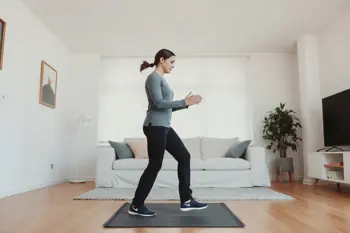
A structured home aerobic session typically follows a logical progression, beginning with a 5-minute warm-up, followed by 20 to 30 minutes of aerobic movement, and concluding with a 5-minute cool-down period 10. Regardless of the specific movements chosen, consistency is the primary driver of cardiovascular adaptation and metabolic health 2. Standard movements include marching on the spot, lateral step-touches, low-impact jacks, and arm-elevating exercises to further boost heart rate without requiring specialized gym equipment 1, 4.
| Movement Category | Examples |
|---|---|
| Lower Body | Marching in place, step touches, low step-ups |
| Full Body | Shadow boxing (no bouncing), low-impact jumping jacks |
| Rotational/Core | Spine twists, lateral reaches |
To maximize the utility of these movements, focus on proper form and core engagement. When marching or stepping, landing softly through the full foot rather than the toes helps maintain stability and protects the ankles and knees 8. If a specific movement feels too challenging, reducing the range of motion or slowing the pace are effective ways to manage intensity without stopping the workout entirely 10.
Guidelines for Frequency and Duration
Public health organizations, including the CDC, recommend that adults accumulate at least 150 minutes of moderate-intensity aerobic activity per week 2, 10. This volume can be partitioned into shorter, manageable bouts throughout the week, making at-home training highly adaptable for busy schedules 10. In addition to aerobic work, the inclusion of muscle-strengthening activities involving major muscle groups at least two days per week is encouraged to support overall physical function 2, 10.
For those starting a new routine, progression should be gradual. Increasing the duration or intensity of sessions over several weeks allows the musculoskeletal system to adapt to the load, reducing the risk of overuse injuries 10. Tracking progress through consistent, moderate sessions often leads to long-term adherence, as these workouts are generally perceived as less taxing than high-intensity interval training, which can lead to rapid burnout if mismanaged 4.
Equipment and Environment Considerations
One of the primary benefits of at-home aerobic training is the lack of mandatory equipment. A clear, nonslip surface is the only requirement to ensure safety during lateral movements or marching 10. While some individuals may choose to incorporate equipment like mini-trampolines, known as rebounders, or light dumbbells to integrate strength elements, these are optional enhancements rather than prerequisites for a successful session 8, 9. Any space that allows for full range of motion is sufficient for these routines 4.
When using equipment such as rebounders, it is essential to ensure the surface is level and the user has a secure grip or footwear, such as non-slippy socks or athletic shoes, to prevent wobbling 8. Regardless of the setup, the core should always be engaged to protect the lower back and improve balance, particularly for older adults or those regaining fitness after a prolonged break 8, 10.
Safety, Monitoring, and Modification
Maintaining safety requires active monitoring of the body's signals during exercise. Symptoms such as dizziness, chest pressure, or unusual shortness of breath should be treated as indicators to stop or significantly scale back the intensity of the workout 10. For those with pre-existing medical conditions or those returning to exercise after illness, consultation with a healthcare professional is standard practice before beginning any new physical activity program 6.
Modifications are a fundamental component of safe training. Seated alternatives or using a sturdy chair for balance are perfectly acceptable ways to perform these workouts 10. The flexibility to tailor the exercise to individual needs ensures that the cardiovascular benefits remain accessible, supporting goals like improved sleep, better weight management, and reduced risks of chronic illness over the long term 10.
The Long-Term Role of Moderate Aerobic Activity
Beyond immediate calorie burning, regular aerobic activity provides structural improvements to the heart and lungs 4, 6. Over time, sustained participation leads to a lower resting heart rate and enhanced cardiovascular efficiency 4. Because low-impact aerobic work is repeatable and carries a lower recovery cost, it is highly effective for maintaining consistent activity levels year-round, regardless of weather or facility access 4, 5.
Ultimately, the effectiveness of any aerobic program is determined by long-term adherence rather than short-term intensity. By selecting movements that are enjoyable and physically sustainable, individuals are more likely to integrate these habits into their daily lives, achieving the recommended weekly activity targets through steady, manageable, and joint-friendly effort 4, 10.
Sources
- Centers for Disease Control and Prevention
- U.S. Department of Health and Human Services
- American Heart Association
- Mayo Clinic
- Cleveland Clinic
- Harvard Health Publishing
- National Institute on Aging
- Johns Hopkins Medicine
- National Health Service
- American Council on Exercise
Authored by MyTrendSpot team