Best hospitals for hip replacement in the United States
For patients weighing options for hip replacement surgery, the landscape of institutional quality in the United States is both richly documented and meaningfully varied. National ranking bodies, independent accreditation programs, and Medicare outcome databases each capture different dimensions of surgical excellence, from complication rates to inflation-adjusted reimbursement trends, providing a multi-layered picture of where hip arthroplasty care performs best.
The U.S. News Rankings: A Systematic Framework for Orthopedic Quality
The most widely referenced benchmark for orthopedic hospital quality is the annual U.S. News & World Report Best Hospitals survey. For 2025-26, the publication analyzed data from more than 4,500 hospitals across 15 specialties, ranking the top 50 for orthopedics. 1 Hospital performance was assessed using patient outcomes, nursing care levels, patient-reported experience, and available technology including computer-assisted orthopedic surgery, with methodology drawing from the Centers for Medicare & Medicaid Services, the American Hospital Association, and professional organizations. 2
Leading the 2025-26 orthopedic rankings is Hospital for Special Surgery (HSS) in New York City, which claimed the top position for the 16th consecutive year. 3 Rounding out the top ten are NYU Langone Hospitals (New York City), Mayo Clinic-Rochester (Rochester, Minnesota), NewYork-Presbyterian Hospital-Columbia and Cornell, Cedars-Sinai Medical Center (Los Angeles), UCSF Health-UCSF Medical Center (San Francisco), North Shore University Hospital at Northwell Health (Manhasset, New York), Stanford Health Care-Stanford Hospital, Hospitals of the University of Pennsylvania-Penn Presbyterian (Philadelphia), and Santa Monica-UCLA Medical Center & Orthopedic Hospital. 1
Hospital for Special Surgery: A Closer Look at the Nation's Top-Ranked Orthopedic Center
HSS draws patients from all 50 states and more than 100 countries, frequently for complex musculoskeletal conditions requiring highly specialized care. 3 The institution is purpose-built for orthopedic and rheumatologic medicine, and its surgeon-in-chief Douglas E. Padgett, MD, has publicly attributed the sustained ranking to continuous quality evaluation and evidence-based clinical protocols. Newsweek's 2025 America's Leading Doctors list for hip surgery also placed multiple HSS-affiliated surgeons in the top positions, including Amar S. Ranawat, MD, Peter K. Sculco, MD, and Mathias P.G. Bostrom, MD. 4
Beyond prestige, HSS performance data reflects measurable institutional depth. Research published in the Journal of Arthroplasty included authors from HSS examining surgeon distribution in primary versus revision arthroplasty at a national scale, reflecting the institution's active contribution to evidence generation in the field. 5 Fellowship programs at HSS have also trained surgeons who now practice at leading centers nationwide, amplifying the institution's systemic influence on hip replacement standards across the country.
Top-Ranked Hospitals Outside New York: Regional Leaders in Hip Arthroplasty
Several institutions outside the New York metropolitan area consistently appear in both national rankings and specialty recognition programs. Mayo Clinic in Rochester, Minnesota holds the No. 3 position in the 2025-26 U.S. News orthopedic rankings and is independently cited by multiple clinical sources as a reference center for joint replacement outcomes and patient-centered recovery protocols. 6 Midwest Orthopaedics at Rush University Medical Center in Chicago ranks 11th nationally and is home to Dr. Richard A. Berger, MD, a surgeon credited with performing more than 20,000 outpatient joint replacements, representing the highest documented total for any orthopedic surgeon in the United States. 7
Cleveland Clinic, ranked 17th nationally for orthopedics, offers robotic-assisted hip replacement as a standard component of its arthroplasty program. 6 Johns Hopkins Hospital in Baltimore holds the 22nd position in the 2025-26 rankings, recognized for advanced surgical techniques and multidisciplinary orthopedic care. 1 On the West Coast, UCSF Health and Stanford Health Care both place in the national top ten, with UCSF faculty including fellowship-trained surgeons specializing in minimally invasive total hip replacement via the direct anterior approach. 8
Blue Distinction Designations and Outcome-Based Accreditation
Beyond national rankings, the Blue Distinction Centers+ (BDC+) program operated by the Blue Cross Blue Shield Association provides an outcomes-driven designation for knee and hip replacement facilities. Quality assessments under this program are developed in partnership with the American Academy of Orthopaedic Surgeons (AAOS). Designated facilities demonstrate an average of 21% fewer readmissions and 21% fewer complications within 90 days of knee and hip replacement surgery, and achieve cost savings of approximately 30% compared to non-designated facilities. 9
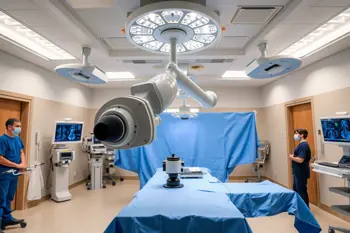
Sanford USD Medical Center in Sioux Falls, South Dakota received the BDC+ designation as recently as December 2025, reflecting meaningful orthopedic capability outside traditional major metropolitan centers. 9 Thompson Health in Canandaigua, New York similarly earned the designation from Excellus BlueCross BlueShield, underscoring that Blue Distinction criteria can identify high-performing community hospitals alongside flagship academic medical centers. 10 Facilities seeking this designation must maintain full national accreditation, low complication and mortality rates for elective primary total hip replacement, and enhanced recovery after surgery protocols.
Technological Advances Reshaping Hip Replacement at Leading Centers
Robotic-assisted surgery has become a defining differentiator among high-performing hip replacement programs. At the University of Iowa Health Care, robotic platforms use three-dimensional CT-guided registration or intraoperative surface-mapping to deliver personalized alignment strategies, and 85% of joint replacement patients at that institution return home the same day as their procedure. 11 This same-day discharge model, once considered exceptional, is now a standard expectation at multiple top-volume centers, enabled by advances in perioperative care coordination and minimally invasive surgical access.
The direct anterior approach to hip replacement, which avoids cutting major muscles and tendons, is now offered across a broad range of top-ranked institutions and is associated with reduced postoperative pain, improved early stability, and faster return to daily function compared to traditional posterior approaches. Surgeons at Mass General Brigham, UPMC, and Emory University Orthopaedics & Spine Hospital all incorporate this technique alongside robotic navigation systems, reflecting its broad adoption among fellowship-trained arthroplasty specialists. 8
Medicare Reimbursement Trends and What Patients Should Know
A peer-reviewed analysis published in Arthroplasty Today examined Medicare inpatient reimbursement for primary total hip and knee arthroplasty from 2013 to 2023, covering 3,724,353 primary discharges billed to Medicare. Inflation-adjusted reimbursement per discharge declined from $15,808 to $13,696, representing a reduction of $2,113 or 13.4%, while hospital-submitted charges rose from $71,469 to $85,675 over the same period. Annual inpatient volume fell by 84.1%, largely reflecting the migration of procedures to outpatient settings. 12
Regional declines in reimbursement ranged from 19.1% in the Midwest to 10.1% in the West, with no state recording an inflation-adjusted increase. 12 For patients relying on Medicare, these structural shifts affect where procedures are performed and how facilities are resourced. Average total hip replacement surgery costs in the United States generally range from $30,000 to $50,000 depending on geographic region and institutional setting, with significant variation between urban academic medical centers and community hospitals. 6 Patients are advised to verify insurance network participation and implant coverage specifics directly with any prospective facility before scheduling.
Key Evaluation Criteria When Researching Hip Replacement Hospitals
The American Academy of Orthopaedic Surgeons recommends that patients verify surgeon board certification and hospital accreditation as baseline criteria when selecting a hip replacement facility. 6 Independent research consistently shows that higher surgeon and institutional volume correlates with fewer complications and better recovery trajectories. Facilities with active participation in the American Joint Replacement Registry (AJRR) use benchmarking data to continuously refine their outcomes, an indicator of institutional commitment to quality improvement.
- National rankings: Review the U.S. News & World Report annual orthopedic specialty rankings, which evaluate patient outcomes, nursing ratios, and technology access across more than 4,500 hospitals. 1
- Accreditation designations: Look for Blue Distinction Centers+ status, Joint Commission Gold Seal of Approval for Advanced Total Hip Replacement, or AAOS-partnered program participation as evidence of adherence to standardized outcome benchmarks. 9
- Surgeon volume and specialization: Fellowship-trained surgeons who focus exclusively on hip and knee reconstruction generally outperform generalist orthopedic surgeons on complication metrics.
- Technology availability: Robotic-assisted platforms, intraoperative fluoroscopy, and CT-guided planning are now considered standard indicators of a high-functioning arthroplasty program.
- Recovery protocols: Programs offering same-day or next-day discharge, enhanced recovery after surgery (ERAS) pathways, and coordinated post-operative rehabilitation typically demonstrate higher patient satisfaction and lower readmission rates. 11
Sources
- Becker's Spine Review – Top 50 Orthopedic Hospitals 2025-26: US News (beckersspine.com)
- Business Wire – HSS Ranked No. 1 in Orthopedics by U.S. News & World Report for 16th Consecutive Year (businesswire.com)
- Healio – Hospital for Special Surgery Named Best US Hospital for Orthopedics in 2025 to 2026 (healio.com)
- Newsweek Rankings – America's Leading Doctors 2025: Hip Surgery (rankings.newsweek.com)
- Journal of Arthroplasty – Diverging Surgeon Distribution in Primary Versus Revision Arthroplasty: A National Analysis (doi.org)
- U.S. News & World Report – Best Hospitals Rankings: Orthopedics (health.usnews.com)
- Yahoo Finance / PRNewswire – Renowned Joint Replacement Surgeon Richard Berger, M.D., Celebrates 25th Anniversary of Outpatient Surgery (finance.yahoo.com)
- UCSF Health – Jeff Barry, MD, Joint Replacement Surgery & Hip and Knee Orthopedic Surgery (ucsfhealth.org)
- Sanford Health News – Sanford USD Medical Center Earns Knee/Hip Replacement Honor (news.sanfordhealth.org)
- Becker's Spine Review – Thompson Health Earns Hip, Knee Replacement Designations (beckersspine.com)
- University of Iowa Department of Orthopedics – Collaborative Excellence in Robotic-Assisted Total Joint Replacement Surgery (orthopedics.medicine.uiowa.edu)
- Arthroplasty Today – Geographic Variability in Medicare Hospital Reimbursement for Primary Total Hip and Knee Arthroplasty Episodes of Care From 2013 to 2023 (doi.org)
Authored by MyTrendSpot team