Police impound landscaping equipment for sale: How public auctions work and what buyers should verify
Police impound landscaping equipment for sale is generally offered through public auctions after property has been abandoned, forfeited, seized, or classified as surplus. Recent public notices and auction announcements show that lawn equipment may appear alongside vehicles, tools, generators, compressors, trailers, and other property, but listings are event-specific rather than a permanent inventory. 1
What police impound landscaping equipment includes
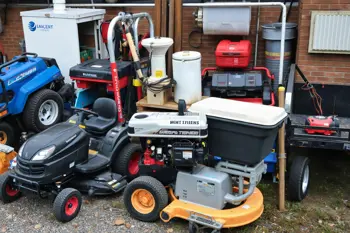
The category can cover commercial and residential grounds-maintenance machinery. A Washington County, Maryland, sheriff’s sale identified John Deere and Toro mowers, snow and salt spreaders, lawn equipment, air compressors, a generator, and hand and power tools among abandoned, forfeited, and surplus property. The same sale included vehicles, bicycles, electronics, jewelry, clothing, and other miscellaneous assets. 1
Equipment auctions organized under a police-seizure label may also include assets consigned by private owners, so the label does not automatically establish that every lot came from an impound facility. Powell Auction’s 2026 event description grouped lawn and landscaping equipment with tractors, skid steers, trailers, generators, welders, construction equipment, ATVs, UTVs, and shop equipment. 2
Where these auctions are commonly listed
Public agencies commonly use online government-surplus marketplaces instead of selling equipment directly from a police station. GovDeals lists property from government agencies, while Public Surplus serves participating public agencies and educational institutions. GSA Auctions handles federal surplus and forfeited personal property, including equipment and vehicles. The seller identity remains important because municipal surplus, police-held property, and ordinary public-works replacements can have different histories. 8
Other channels include PropertyRoom, which hosts law-enforcement-related property auctions, and Municibid, which lists municipal surplus assets. HiBid and AuctionZip aggregate independent auctioneer listings, meaning a listing appearing on either platform is not by itself proof that a police department owns the equipment. The agency, municipality, impound operation, or auctioneer named in the individual listing should be treated as the controlling source for provenance and sale terms. 11
Examples from documented auction notices
A Knoxville, Tennessee, police seizure and equipment auction scheduled for August 2026 described accepted consignments including lawn and landscaping equipment, farm machinery, tractors, attachments, trailers, tools, generators, compressors, and heavy equipment. The event was online only, with an advertised preview period, a stated pickup date, a 15% buyer’s premium, sales tax, and third-party shipping availability. Those terms illustrate why the headline category alone does not describe the complete transaction cost or logistics. 2
A separate Pennsylvania landscape-contractor surplus auction listed walk-behind commercial mowers, zero-turn mowers, skid steers, a Kubota tractor with loader and backhoe, salt spreaders, trailers, trucks, and related equipment. That event was commercial surplus rather than a confirmed police impound sale, demonstrating the need to distinguish law-enforcement property from contractor liquidation, municipal surplus, and general equipment auctions. 4
Condition, documentation, and legal status
Impounded equipment may have an incomplete maintenance history, missing keys, mechanical damage, worn cutting components, or unknown operating condition. Auction terms often state that property is sold as-is and without warranties. The Kansas City police tow-lot terms, for example, warn that abandoned property may not be working and that buyers may not know whether an item operates until after purchase. Binding bids and final-sale rules can limit remedies for mistaken assumptions. 5
Ownership status must also be separated from physical condition. Property seized during an investigation generally requires a legal process before it becomes forfeited state or agency property. A Florida public notice involving a sheriff’s forfeiture proceeding identified a Hummer, trailers, a generator, and tools, while explaining that owners and lienholders could seek a hearing. This illustrates that forfeiture is a regulated legal procedure, not simply an informal transfer of abandoned goods. 6
- Check whether the lot is seized, forfeited, abandoned, surplus, or consigned.
- Review serial numbers, ownership documents, lien information, and title language where applicable.
- Confirm whether inspection is permitted and whether the equipment can be started or tested.
Payments, inspection, and collection requirements
Public-auction rules can impose strict registration, payment, and removal deadlines. In the Columbus, Ohio, impound auction example, bidders had to be at least 18 and provide identification, vehicles were available for viewing before bidding, payment was due the same day, and purchased vehicles had to be removed within a stated period. Although that event concerned vehicles, the same type of deadline structure can affect equipment auctions and should be read before bidding. 7
Online equipment events may add buyer premiums, sales tax, payment restrictions, and collection appointments. Powell Auction specified a 15% buyer’s premium and stated that vehicle payments required cash, cashier’s check, or wire transfer, while smaller items could have different card rules. Buyers may also be responsible for loading, hauling, fuel, towing, or specialist transport. A third-party shipping reference does not mean shipping is included or available for every lot. 2
Risks and practical evaluation standards
The central risk is that an apparently useful mower, generator, or tractor may require repairs that cannot be assessed from photographs or a short description. Commercial landscaping equipment can also require model-specific blades, belts, batteries, tires, hydraulic components, or attachments. Auction buyers should compare the stated lot contents with the photographs, inspect visible damage, record model and serial information, and determine whether transport equipment is needed before submitting a binding bid. 4
Market friction also comes from irregular availability. Police departments do not necessarily hold recurring landscaping-equipment sales, and a documented event may mix public property with consignments or unrelated goods. The most reliable evaluation process is therefore source-based: identify the selling agency or auctioneer, read the complete terms, verify legal status, calculate premiums and taxes, inspect where allowed, and plan removal within the stated schedule. No listing should be treated as evidence of current inventory beyond its published event details. 1
Sources
- Tri-State Alert, “WCSO put abandoned, forfeited, and surplus cop cars, lawn equipment, and more on the sales block”
- Powell Auction & Realty, “Police Seizure & Consignment Auction”
- Frugal Info, “Police Impound Tractors: Auction Opportunities”
- Fleet Vehicle Disposal, “Landscape Contractor Surplus Equipment Auction, Langhorne, PA”
- Fowler Auction, “Kansas City Police Tow Lot Auction”
- NoticeRegistry, Polk County forfeiture notice
- The Columbus Dispatch, “Columbus police to sell about 120 impounded vehicles at auction”
- GovDeals, Public Surplus, and GSA Auctions government-surplus platforms
- PropertyRoom and Municibid public-property auction platforms
- HiBid and AuctionZip auction marketplaces
Authored by MyTrendSpot team