Pontoon Boat Takeover Payment Options: A Complete Consumer Finance Guide
Pontoon boat takeover payment options are among the most searched topics in recreational marine finance, reflecting growing consumer interest in acquiring pontoon ownership or access without a traditional full-price purchase. Whether the goal is assuming an existing loan, financing through a dealer, or managing a rental deposit on a peer-to-peer platform, the payment landscape for pontoons spans multiple structures with meaningfully different costs, credit requirements, and contractual risks.
What Does a Pontoon Boat Takeover Payment Actually Mean?
The phrase 'takeover payment' applies to at least two distinct scenarios in the pontoon market. In a private-sale context, it refers to a buyer assuming the remaining loan balance from a seller who can no longer continue making payments on the vessel. In a rental or slip-transfer context, it refers to the deposit and periodic payments required when one party takes over a docking arrangement or short-term rental agreement from another. 1 Both scenarios involve different legal frameworks, lender or marina approval requirements, and payment methods, and conflating them can lead to costly misunderstandings.
In a loan assumption scenario, the incoming buyer must typically qualify for the original financing terms with a comparable credit profile. 1 Lenders do not automatically transfer boat loans; the new borrower must apply and be approved. Marina slip takeovers, by contrast, are governed by the written dockage agreement between the marina and the original tenant, with payment terms including any outstanding balances, dockage fees, and deposits set by the marina's own policies rather than a national standard. 3
Pontoon Loan Assumptions: How the Finance Structure Works
When taking over boat payments from an individual seller, both parties must first agree on the purchase price, payment schedule, and any other material terms in writing. 1 The process then involves the lender reviewing the incoming buyer's creditworthiness to confirm the loan can be transferred or refinanced under similar conditions. Most secured marine loans use the vessel itself as collateral, which allows for longer repayment terms and lower interest rates compared to unsecured personal loans. 8
Standard loan terms for pontoon boats range from 10 to 20 years for secured financing, with most lenders requiring a down payment of 10 to 20 percent of the purchase price. 8 As a general market benchmark, a pontoon priced in the $40,000 to $60,000 range typically carries estimated monthly payments of $350 to $550 depending on terms and the down payment provided. 2 Before any assumption proceeds, prospective buyers should verify that no existing liens encumber the vessel beyond the primary loan being assumed. 1
Dealer Financing Rates and Market Payment Data
For buyers pursuing new pontoon acquisition rather than a private takeover, dealer-arranged financing remains the most common pathway. Fixed-rate boat loans are the most popular option, delivering consistent monthly payments throughout the loan term and simplifying long-term budget planning. 2 Lenders evaluate several factors when approving applications, including the pontoon model and year, the loan-to-value ratio, the borrower's income relative to the loan amount, and the applicant's credit score. 2
Published promotional financing data illustrates the range of available terms for qualified buyers. For example, G3 boat financing through Yamaha Financial Services has been offered at rates including 1.49% APR for 72 months, 2.99% APR for 144 months, and 5.99% APR for 180 months, all requiring a minimum 10% cash down payment and based on 90% loan-to-value or less. 4 These rates apply only to tier-1 credit customers; buyers with lower credit scores are subject to higher financing rates and may not qualify. 4 Monthly payment estimates across current market inventory range from approximately $251 per month for entry-level 2026 models priced around $29,999 up to $490 per month for luxury configurations priced near $58,879. 6
Layaway and Alternative Payment Structures
Some dealers and marine retail outlets offer layaway-style payment plans as an alternative to traditional loan financing. Under a layaway arrangement, the buyer reserves the vessel with an initial deposit, then makes scheduled weekly, bi-weekly, or monthly payments until the full balance is paid, at which point the boat is delivered. 9 One published example illustrates a pontoon priced at $24,999 being secured with a $2,500 deposit followed by payments of $700 per month for 32 months, with no interest applied to the balance. 9 This structure eliminates credit check requirements and interest charges but demands substantially more upfront liquidity and a longer timeline before the buyer takes possession of the vessel.
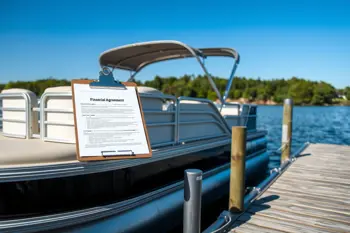
Layaway plans also carry cancellation risk. If a buyer needs to exit the plan before completion, cancellation fees are typically deducted from refunded payments. 9 Unlike financed purchases where the buyer takes immediate possession, layaway means the boat remains at the seller's facility during the payment period, exposing the buyer to potential inventory changes if the specific unit is somehow reassigned. Buyers considering layaway should review the written agreement carefully before making any payments.
Rental Takeover Deposits: Credit Card Requirements and Platform Rules
In the peer-to-peer and commercial rental market, the term 'takeover payment' frequently refers to the security deposit required before a renter takes temporary custody of a pontoon vessel. Most pontoon rental companies require a security deposit ranging from $500 to $2,000 depending on vessel size, and this deposit is almost universally required to be paid via a major credit card such as Visa, Mastercard, Discover, or American Express. 5 Debit cards are commonly prohibited for deposit purposes because lenders prefer the credit authorization process to avoid freezing the customer's actual liquid bank funds. 5
On major platforms such as Boatsetter and GetMyBoat, all rental payments and deposits are processed through secure integrated payment gateways rather than directly between owner and renter, providing a layer of financial protection for both parties. 5 Standard industry practice involves placing an authorization hold on the credit card rather than immediately charging the full deposit amount; this hold is released after the boat is inspected and returned in acceptable condition. 7 If a captain's fee is included in the rental arrangement, this charge is sometimes handled as a separate cash transaction directly with the captain, while the main deposit must remain electronic. 5
Key Risks, Eligibility Factors, and Ongoing Cost Considerations
Regardless of which payment pathway is pursued, several risk and eligibility factors merit careful review. For loan assumptions, the incoming buyer must clear the lender's credit underwriting process; a credit profile significantly weaker than the original borrower's may result in different terms or outright denial. 1 Prospective buyers should also inspect the vessel thoroughly, obtain a lien search, and confirm whether the boat carries any encumbrances beyond the primary loan before agreeing to take over payments. Ongoing costs beyond the monthly payment include mandatory boat insurance, marina or storage fees, annual maintenance and winterization, fuel, equipment, and registration and taxes. 8
In the rental deposit context, damages exceeding the deposit amount typically result in forfeiture of the entire deposit plus additional charges billed to the payment method on file. 5 Insurance deductibles frequently serve as the baseline for determining the required deposit amount, meaning the deposit is calibrated to cover the renter's financial exposure in a damage event. 7 For marina slip takeovers, payment disputes are governed by the specific written dockage or lease agreement and applicable state contract law rather than any uniform federal maritime rule, making a careful review of the agreement document essential before assuming any slip-related financial obligation. 3
Sources
- FinImpact - Taking Over Boat Payments Explained in 7 Steps (finimpact.com)
- Boat World MN - Pontoon Financing Options (boatworldmn.com)
- Dockwa - Marina Help and Policies (dockwa.com)
- SunCatcher Pontoons - Promotions and Financing Disclaimer (suncatcherpontoons.com)
- Boatsetter - Peer-to-Peer Rental Platform Payment Policies (boatsetter.com)
- River City Sports - 27 Pontoons Under $500 a Month (rivercityboats.com)
- Discover Boating - Rental Deposit and Credit Authorization Practices (discoverboating.com)
- Norton Yachts - Everything You Need to Know About Boat Loans (nortonyachts.com)
- Sea-Doos.com - Layaway Payment Plan Overview (sea-doos.com)
Authored by MyTrendSpot team