Hyperbaric Oxygen Therapy Chambers for Home Use: A Data-Driven Consumer and Clinical Guide
Hyperbaric oxygen therapy chambers for home use represent a growing segment of the personal wellness equipment market, drawing interest from athletes, rehabilitation patients, and longevity-focused individuals. What was once confined to hospital pressure suites is now available in configurations ranging from portable soft-shell units to full hard-shell installations engineered for residential and clinical settings. Understanding the technical distinctions, certified pressure ratings, and associated risks is essential before any purchase decision.
How Home HBOT Differs From Clinical Therapy
Hyperbaric oxygen therapy involves breathing high-purity or concentrated oxygen inside a sealed pressure vessel at elevated atmospheric pressure. In clinical settings, this means operating at 2.0 to 3.0 atmospheres absolute (ATA) with 100% medical-grade oxygen, meeting the thresholds required for all 14 conditions recognized by the Undersea and Hyperbaric Medical Society (UHMS). 2 Home systems, particularly soft-shell models, typically operate in the mild HBOT (mHBOT) range between 1.3 and 1.5 ATA, which represents a fundamentally different device category in terms of therapeutic depth. 1
At 2.0 ATA hard-shell pressure, tissue oxygen delivery in wound patients reaches approximately 333 mmHg, compared to roughly 161 mmHg at 1.4 ATA in a soft-shell unit. 7 This measurable physiological gap explains why regulatory bodies and medical societies distinguish between mild home systems and clinical-grade chambers. The FDA classifies hyperbaric chambers as Class II or Class III medical devices, and home-use models must meet specific pressure vessel certifications and incorporate emergency protocols to reach the consumer market. 1
Soft-Shell vs. Hard-Shell: Construction and Pressure Capabilities
The residential market divides cleanly into two construction categories. Soft-shell chambers use thermoplastic polyurethane (TPU) or similar flexible fabric materials and are generally limited to 1.3 to 1.5 ATA. Representative examples include the OxyRevo Elite32, which measures 230 cm in length and 80 cm in diameter, weighs 13 kg (28.6 lbs), operates at 1.4 ATA, and incorporates dual YKK zippers, five large double-layered windows, and dual internal and external pressure gauges. 9 The Oxify Flow Extended, a soft-shell sitting configuration, reaches 1.5 ATA using thermoplastic polyurethane construction with a five-stage air filtration system and delivers oxygen purity of 90 to 96% through a 10 L/min concentrator. 3
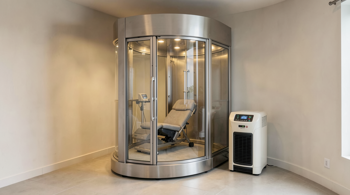
Hard-shell chambers use stainless steel, aerospace-grade aluminum, or thick polycarbonate and sustain repeated pressurization cycles for 20 to 30 years. 7 The OxyRevo Space60 is a widely referenced hard-shell sitting model constructed from stainless steel and polycarbonate, weighing 800 kg, measuring 210 cm in length and 96 cm in width, achieving 2.0 ATA with oxygen purity between 95 and 97%. 10 At the premium end, the Oxify Nova Duo is a two-person stainless steel and polycarbonate hard-shell unit measuring 87 inches long by 39 inches wide by 72 inches tall, weighing 957 lbs, certified to ASME, ISO, and CE standards, and generating a total power draw of 3,850 watts across four dedicated circuits. 2
2026 Market Price Tiers and Representative Models
Market pricing spans several distinct tiers, each corresponding to a construction type and pressure capability. Soft-shell entry units begin around $2,695, while two-person clinical hard-shell installations reach $68,999 or more. 6 The table below summarizes representative models documented in 2026 market data.
| Model | Type | Max Pressure | Market Price (USD) |
|---|---|---|---|
| Frosty Dive Pro (1.5 ATA) | Soft-shell, supine | 1.5 ATA | $2,695 |
| OxyRevo Elite32 | Soft-shell, supine | 1.4 ATA | $7,499 |
| OxyRevo Apex36 (1.5 ATA) | Soft-shell, supine | 1.5 ATA | $8,999 |
| Oxify Sit Plus / Flow Extended | Soft-shell, sitting/supine | 1.4–1.5 ATA | $15,950 |
| OxyRevo Space60 (1.5 ATA) | Hard-shell, sitting | 1.5–2.0 ATA | $42,999–$45,999 |
| Oxify Nova Duo (2.0 ATA) | Hard-shell, two-person | 2.0 ATA | $68,999 |
Broad market surveys indicate home soft-shell units typically range from $2,500 to $15,000, personal hard-shell chambers capable of reaching 2.0 ATA range from $15,000 to $50,000, and clinical monoplace chambers range from $30,000 to $150,000. 6 Hospital-grade multiplace systems extend beyond $500,000. The Airvida multiplace chamber with a full BIBS system, for example, carries a market price of $150,000 at the residential-to-commercial crossover point. 11
Certifications, Regulatory Oversight, and FDA Classification
In the United States, hyperbaric chambers are regulated by the FDA as medical devices. The agency classifies them under Class II or Class III categories, each carrying distinct 510(k) clearance or premarket approval requirements. 1 Common certifications present across the reviewed product segment include ISO 13485 (quality management for medical devices), ISO 9001, ISO 14001, CE marking for the European market, and ASME PVHO-1 (Pressure Vessels for Human Occupancy), the engineering benchmark governing hard-shell construction integrity. 7 Soft-shell units from brands such as OxyRevo and Oxify carry ISO and CE certifications. Hard-shell systems such as the Oxify Nova Duo and the OxyCell OxyPro Vantage reference ASME compliance in addition to CE and ISO marking.
The UHMS maintains a recognized list of accepted clinical indications for HBOT, which includes decompression sickness, arterial gas embolism, carbon monoxide poisoning, chronic non-healing wounds, radiation tissue injury, and diabetic foot ulcers. 2 Medicare covers HBOT for these specific recognized indications, but coverage does not extend broadly to home-based use, and prior authorization is typically required for reimbursement. 5 Home systems marketed to consumers in the United States often require physician oversight or a prescription, reflecting the medical risk profile of pressurized oxygen therapy. 1
Key Safety Considerations and Known Risks
Operating a pressurized oxygen environment at home introduces physiological and mechanical risks that are distinct from consumer wellness equipment. Oxygen toxicity is a documented risk when breathing high-purity oxygen at elevated pressure for extended durations; the severity is proportional to both the concentration of oxygen and the duration of exposure. Barotrauma, including ear and sinus pressure injury during pressurization and depressurization, is a common adverse event, particularly in users who pressurize too rapidly or who have underlying ear pathology. 4 Fire risk is a recognized concern in oxygen-enriched environments because materials that are non-flammable under normal atmospheric conditions can become highly flammable at elevated oxygen concentrations.
Well-engineered home chambers address these risks through multiple layers of redundancy. The Origin Recess soft-shell chamber, for example, incorporates automatic pressure relief valves, a manual exhaust valve for emergency decompression, dual pressure gauges for real-time monitoring, and an emergency stop function. 8 The OxyRevo Space60 hard-shell system includes inside and outside pressure deflate valves, a phone communication system, pressure relief valves, and both internal and external touch screen controls. 10 Home users generally require formal training on chamber assembly, diagnostic checks, emergency decompression procedures, and session monitoring before independent operation is considered appropriate. 14
Electrical, Space, and Ongoing Maintenance Requirements
Prospective buyers often underestimate the infrastructure demands of a home hyperbaric installation. Hard-shell systems require dedicated electrical circuits well beyond what a standard residential room provides. The Oxify Nova Duo, for instance, draws a total of 3,850 watts and requires four separate grounded 3-prong 120V outlets across three to four dedicated 120V/20A circuits to power its all-in-one compressor, oxygen concentrator, and air conditioning unit simultaneously. 2 Even soft-shell systems carry meaningful power requirements: the Oxify Flow Extended all-in-one machine operates at 110V/1800W, with the additional air conditioning unit adding 900W. 3
Physical footprint is also a practical constraint. The OxyRevo Space60 hard-shell chamber measures 210 cm (83 inches) in length and weighs 800 kg (1,763 lbs), requiring reinforced flooring and adequate ceiling clearance for installation. 10 Soft-shell supine models like the OxyRevo Apex36 measure 89 inches in length by 32 inches in diameter and weigh substantially less, making residential placement more straightforward. Ongoing maintenance requirements include regular inspection of pressure seals, zipper mechanisms, air filter replacements, oxygen concentrator servicing, and periodic recertification of safety valves. Manufacturers such as Carbon Wellness MD and Hyperbaric World include two-year commercial and three-year residential manufacturer warranties along with lifetime technical support for certain models, reflecting the long service lifecycle expected of this equipment category. 9
Sources
- U.S. Food and Drug Administration (FDA) - fda.gov/medical-devices/products-and-medical-procedures/hyperbaric-oxygen-therapy
- Undersea and Hyperbaric Medical Society (UHMS) - uhms.org/resources/hbot-indications
- Oxify - oxify.com/products/oxify-flow-extended
- MedlinePlus, U.S. National Library of Medicine - medlineplus.gov/ency/article/007196.htm
- Centers for Medicare and Medicaid Services (CMS) - medicare.gov/coverage/hyperbaric-oxygen-therapy
- Baric Boost - baricboost.com/how-much-does-a-hyperbaric-chamber-cost
- Baric Boost - baricboost.com/hard-shell-hyperbaric-chamber
- Origin Hyperbaric Oxygen Chambers - originoxygen.co.uk/product/recess-chamber-1-5ata
- Carbon Wellness MD / OxyRevo - carbonwellnessmd.com/products/oxyrevo-elite32-portable-hyperbaric-chamber
- OxyRevo Australia - oxyrevo.com.au/oxyrevo-space60-pro
- Airvida Chambers - airvidachambers.com/collections/hyperbaric-oxygen-therapy-palm-coast
- Oxify - oxify.com/products/oxify-nova-duo
- OxyChen - oxycheny.com/news/is-hbot-safe-at-home
- American College of Hyperbaric Medicine - achm.org/resources
Authored by MyTrendSpot team