Train tours across Switzerland: A factual guide to panoramic rail journeys
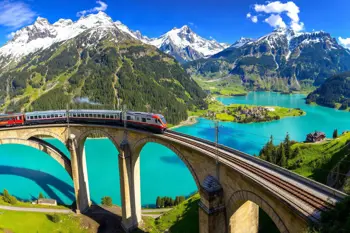
Train tours across Switzerland are commonly organized around the Grand Train Tour, a roughly 1,280-kilometer network journey linking panoramic rail routes, major lakes, UNESCO-listed landscapes, and destinations such as Zermatt, St. Moritz, Lucerne, and Montreux. The route is not a single train service, but a sequence of existing railway connections that can be completed in stages or adapted into shorter journeys. 1
The overall Grand Train Tour structure
Switzerland’s Grand Train Tour is described as a route of approximately 1,280 kilometers crossing four language regions, passing 11 lakes and five UNESCO World Heritage sites. The complete concept combines eight stages, although travelers can select individual sections rather than follow the entire circuit. This structure makes the journey different from a conventional escorted train excursion because overnight stops and connections may vary according to the itinerary. 1
| Characteristic | What it means |
|---|---|
| Route scale | Approximately 1,280 kilometers |
| Landscape coverage | Alps, lakes, gorges, vineyards, and historic towns |
| Travel format | Several rail services linked into a continuous route |
The Glacier Express
The Glacier Express connects Zermatt and St. Moritz in approximately eight hours. Its route passes through mountain scenery associated with the Rhine Gorge and crosses 291 bridges and 91 tunnels. The service is frequently used as the central long-distance segment of a Swiss rail itinerary, but its duration means that travelers should treat the ride as a full-day experience rather than a short transfer between resorts. 3
Because the Glacier Express is a named panoramic service, travel planning involves checking operating dates, timetable details, and reservation requirements separately from ordinary regional trains. The route crosses high alpine terrain and links the Matterhorn area with the Engadin, giving it a different visual character from the lake and vineyard sections farther west. 3
The Bernina Express and northern Italy
The Bernina Express runs from northern Switzerland toward Tirano in Italy, crossing the Albula and Bernina railway landscapes. The route is associated with glaciers, high mountain passes, alpine lakes, and a rapid change toward lower, warmer landscapes. The Rhaetian Railway identifies the Albula and Bernina sections as UNESCO-listed railway landscapes, making the journey notable for both scenery and railway engineering. 4
- Typical Swiss base: St. Moritz.
- International destination: Tirano, Italy.
- Principal character: high alpine railway scenery and engineered mountain crossings.
GoldenPass and central Switzerland
The GoldenPass corridor connects Lucerne, Interlaken, and Montreux through central and western Switzerland. It combines lake views, alpine villages, valleys, and vineyards, linking the historic center of Switzerland with the Lake Geneva region. A related Lucerne to Interlaken connection is often paired with the GoldenPass journey, creating a route that links major mountain and lakeside destinations without requiring a separate long-distance flight or road transfer. 5
GoldenPass itineraries can therefore be arranged as a westbound or eastbound sequence. Montreux provides access to the Lake Geneva area, Interlaken serves as a base for the Bernese Oberland, and Lucerne connects the route with central Swiss lakes and mountain excursions. The exact trains, stopping patterns, and reservation conditions should be checked in the current timetable. 2
Mountain excursions beyond panoramic trains
Many Swiss train tours add short mountain railways, cable cars, or cogwheel excursions to the intercity route. Jungfraujoch is reached by railway at an altitude of 3,454 meters and is identified by Jungfrau Railways as Europe’s highest railway station. Pilatus offers a separate cogwheel railway with gradients of up to 48 percent, described by Pilatus-Bahnen as the world’s steepest cogwheel railway. 6 7
| Excursion | Defining figure or feature |
|---|---|
| Jungfraujoch | 3,454 meters above sea level |
| Pilatus cogwheel railway | Gradients of up to 48 percent |
| Gornergrat | Cogwheel railway excursion associated with Zermatt and Matterhorn views |
Common itinerary patterns
Published escorted itineraries commonly use Zurich, St. Moritz, Zermatt, Montreux, Interlaken, and Lucerne as overnight bases. One documented nine-night format includes first-class rail travel, a Bernina Express reservation, a Glacier Express journey with lunch, a GoldenPass Express reservation, a Gornergrat excursion, a Lavaux-area wine tasting, and a Rigi excursion. Another 10-day guided format follows a similar sequence and emphasizes tour-manager support and luggage transfers. 11 12
- Shorter journeys can focus on Lucerne, Interlaken, and Montreux.
- Alpine-focused journeys often combine St. Moritz, Bernina, Glacier Express, and Zermatt.
- Longer circuits may add Zurich, St. Gallen, Tirano, or mountain excursions.
Tickets, passes, and reservations
The Swiss Federal Railways timetable is the principal reference for checking connections, departure times, and changes between services. The Swiss Travel Pass provides eligible visitors with travel on much of the Swiss rail, bus, and boat network for selected consecutive periods. Pass coverage does not automatically eliminate every reservation or supplement, particularly on named panoramic trains. 2 9
Eurail and Interrail provide planning information for rail-pass users, but some scenic and high-speed services can require additional reservations or supplements. The main planning friction points are seat availability, seasonal schedules, luggage handling, cross-border travel to Tirano, and the need to distinguish included rail travel from separately priced mountain excursions. 10
Entry rules and practical limitations
U.S. citizens can generally visit Switzerland for tourism without a visa for up to 90 days in any 180-day period, subject to Schengen entry requirements. Travelers of other nationalities may face different rules, so passport validity, permitted stay, and entry conditions must be checked against the applicable official guidance before departure. 8
Train tours also involve operational limitations. Panoramic services may have fixed schedules, reservations may be separate from a rail pass, and mountain weather can affect the value or visibility of high-altitude excursions. A route that appears geographically compact can still require several hours on board, especially when it includes the Glacier Express or multiple alpine transfers. The official timetable remains essential for testing realistic connection times. 2
How to assess a proposed rail tour
A reliable comparison should identify the exact overnight cities, rail class, named trains, reservation status, luggage arrangements, meals, excursions, and exclusions. Published tour programs may include accommodation and breakfast while leaving flights, insurance, personal expenses, and unspecified meals outside the stated itinerary. Checking these categories prevents confusion between a scenic rail route and a fully inclusive escorted holiday. 11
| Check before travel | Reason |
|---|---|
| Named train and date | Panoramic services may operate on specific schedules |
| Reservation or supplement | A rail pass may not cover every charge |
| Excursion status | Mountain railways may be optional or separately arranged |
| Luggage plan | Transfers may be limited by bag size or route segment |
Sources
- MySwitzerland, Grand Train Tour of Switzerland
- Swiss Federal Railways, Official Timetable
- Glacier Express
- Rhaetian Railway, Bernina Express
- GoldenPass
- Jungfrau Railways, Jungfraujoch
- Pilatus-Bahnen, Cogwheel Railway
- U.S. Department of State, Switzerland Travel Information
- Switzerland Travel Centre, Swiss Travel Pass
- Eurail and Interrail, Switzerland Rail Information
- Exotik Journeys, Grand Train Tour of Switzerland
- Tenon Tours, Switzerland by Train
Authored by MyTrendSpot team