Commercial Cold Plunges on sale: Commercial Cold Plunge Systems: Engineering, Sanitation, and Market Overview
Commercial cold plunge systems represent a specialized segment of the rapid-recovery wellness market, engineered specifically to handle the continuous physical demands of high-traffic environments 1. Unlike residential models designed for periodic household use, professional systems are built for gyms, spas, hotels, and rehabilitation clinics where they must accommodate back-to-back sessions while maintaining strict sanitary and temperature baselines 2. In the modern wellness market, commercial operators prioritize automated filtration, rapid chilling speeds, and structural durability to ensure maximum equipment uptime and absolute user safety 1.
Defining Commercial-Grade vs. Residential Cold Plunges
The primary differentiator between residential and commercial cold plunges lies in the engineering of their mechanical systems and structural frameworks. Commercial units must support dozens to hundreds of users daily without experiencing significant temperature fluctuations or water quality degradation 1. High-traffic wellness spaces require systems that can continuously operate 24/7, maintaining a consistent temperature even when new users introduce ambient body heat into the basin every few minutes 1.
To support this high-volume usage, commercial chillers are significantly overbuilt compared to home models. While a standard home unit may utilize a 1/4 horsepower compressor, commercial configurations frequently deploy 1.0 HP to 1.5 HP chillers, delivering up to 3600 watts of cooling capacity 2. This extra power allows the system to pull water temperatures down rapidly, often at a rate of 8 to 14 degrees Fahrenheit per hour, ensuring the tub remains at the target temperature during peak facility hours 3.
Sanitation Standards and Filtration Protocols
Hygiene is the most critical operational variable for any business offering public cold water therapy. Commercial cold plunges must employ multi-stage, high-flow sanitation systems to comply with commercial health standards and prevent the transmission of waterborne pathogens 1. These systems generally run continuous water circulation, ensuring the entire water volume is processed and cleaned every few minutes.
- Ozone Disinfection: Standard commercial units integrate chlorine-free ozone generators that actively oxidize organic contaminants and kill bacteria on contact 2.
- Micron Cartridge Filtration: Systems typically utilize high-surface-area 20-micron to 50-square-foot micron filters to capture hair, skin cells, and microscopic debris 3.
- Integrated Skimmers: Surface skimmers with removable hair catches are essential to clear floating debris before it reaches the primary filtration pump 4.
Technical Comparison of Professional Plunge Systems
Commercial facilities must evaluate several physical and electrical parameters when choosing a cold plunge system. Factors such as tub volume, weight (both empty and filled), and power draws dictate installation logistics and facility layout. Below is an overview of technical specifications based on current market-leading configurations:
| System Metric | Standard Commercial Specification | High-Capacity / XL Specification |
|---|---|---|
| Water Capacity | 70 to 125 Gallons 3 5 | 150 to 160 Gallons 6 7 |
| Chiller Power Rating | 1.0 HP Japanese-Built Chiller 3 | 1.5 HP High-Performance Chiller 2 |
| Temperature Range | 33F to 104F (0.5C to 40C) 2 8 | 32F to 107.6F (0C to 42C) 9 |
| Empty Weight | 120 kg to 180 lbs 2 5 | 175 lbs to 196 kg 7 10 |
| Filtration Tech | 2-Stage, 8-Layer Filtration + Ozone 5 | 3-Stage Sanitization + UVC LED 10 11 |
Material Engineering and Structural Durability
Commercial plunges are exposed to challenging environmental conditions, including constant moisture, chemical exposure, and physical wear from diverse users. Consequently, manufacturers utilize heavy-duty materials that resist degradation. Common structural materials include marine-grade 316 stainless steel, lightweight structural aluminum, and high-density polyethylene (HDPE) derived from recycled sources 2 10. These materials prevent corrosion and ensure structural integrity over years of continuous service.
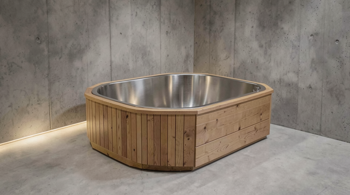
To maintain thermal efficiency and reduce energy consumption, commercial tubs feature heavy insulation. For example, some models integrate up to 3 inches of polyurethane foam insulation within the tub walls 10. This high level of insulation reduces the workload on the compressor, particularly in outdoor installations where ambient temperatures can fluctuate dramatically. Furthermore, premium exterior finishes, such as acetylated natural wood or industrial matte black powder coatings, are applied to protect the unit from UV damage and scratching 2 5.
Operational Integration and Facility Requirements
Integrating a cold therapy station into a professional facility requires careful planning around utility access and spatial layout. Most commercial-grade cold plunges are designed with a plug-and-play architecture, utilizing standard electrical outlets (often 110V to 120V on 15A circuits) and requiring no external, permanent plumbing lines 3 6. This self-contained layout enables easy placement inside recovery suites, next to saunas for contrast therapy, or outdoors on concrete patios.
Despite the lack of permanent plumbing requirements, operators must plan for regular maintenance tasks. Commercial plunges feature integrated bottom drains or high-flow drain pumps with extended hoses to facilitate complete water changes 2 5. Depending on daily traffic levels, water changes may be required every few weeks to every few months. Additionally, smart control systems with Wi-Fi application integration allow facility staff to monitor water temperature, set sanitation schedules, and lock temperature controls remotely to prevent unauthorized changes 2 3.
Financial Considerations and Regulatory Compliance
Acquiring professional-grade recovery equipment involves a substantial capital investment, with prices typically ranging from $5,000 to over $15,000 depending on the chiller capacity, water volume, and custom finishes 1. Because of these upfront costs, commercial wellness operators frequently leverage business equipment financing or leasing programs to distribute the capital expense over several years 1. Some manufacturers also partner with health savings payment processors, allowing eligible clients to utilize pre-tax HSA or FSA funds to offset the purchase price 6.
Beyond the initial acquisition cost, businesses must ensure the selected system carries the necessary safety certifications. Commercial facilities are subject to strict regulatory oversight regarding electrical and structural safety. Operators should look for systems certified under international standards such as CE, UL, and NSF50 3 4. These certifications guarantee that the electrical components, high-flow circulation pumps, and pressure vessels meet public safety regulations, minimizing liability risks for the business 1.
Sources
- Garage Gym Reviews
- Temperd
- ReGen Total Wellness
- Plunge
- HTSS Hot Tubs
- Recovery For Athletes
- LIT Method
- Fire Cold Plunge
- Himalaya IceTech
- Airvida Chambers
- The Fitness Outlet
Authored by MyTrendSpot team