Hardwood Flooring Rolls: A Complete Consumer Research Guide to Wood-Look Roll Formats, Materials, and Installation
Searches for hardwood flooring rolls reflect a genuine consumer interest in continuous-format wood or wood-look flooring that simplifies coverage across large areas. However, the marketplace blends distinctly different product categories under this label. True engineered hardwood, vinyl sheet flooring with wood-grain printing, and peel-and-stick PVC roll formats each carry different performance characteristics, refinishing potential, and long-term durability outcomes. Understanding what separates these categories is essential before any purchasing or installation decision is made.
What the Term 'Hardwood Flooring Rolls' Actually Covers
In North American retail, the phrase hardwood flooring rolls most often surfaces alongside vinyl sheet products and peel-and-stick PVC formats that replicate the appearance of real wood rather than solid or engineered hardwood boards. 1 Major retail category pages at retailers such as Lowe's and Home Depot typically return wood-look sheet or flexible vinyl products when this search term is used, rather than traditional solid hardwood plank inventories. 2 True solid hardwood, by contrast, is universally sold in plank or board form and installed via nail-down, glue-down, or click-lock methods rather than as a continuous roll. 3
Engineered hardwood, which features a real wood veneer bonded to a multi-ply plywood core, comes closest to bridging the gap. Products such as the TORLYS EverestXP Elite Collection use 100% natural wood in wider and longer planks, with plank dimensions of 1/2 inch thickness by 6-1/2 inch width and lengths up to 59-5/16 inches, installed using gap-resistant Uniclic and Unifit X joint systems that allow transition-free installation across spaces up to 50 feet by 50 feet. 4 These are not rolls in a literal sense, but large-format, continuous-looking installations that answer the same consumer intent.
Vinyl and PVC Roll Products: Construction and Specifications
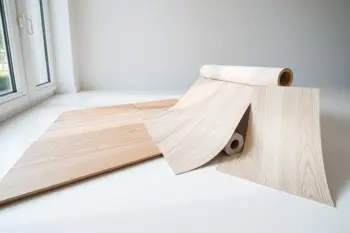
PVC vinyl roll flooring with wood-grain printing represents the most literal interpretation of a hardwood flooring roll. These products are manufactured using a PVC vinyl top layer that resists moisture by not forming hydrogen bonds with water molecules, making them fully waterproof and suitable for kitchens, bathrooms, RVs, and stairs. 5 Standard roll widths in the US retail market range from 12 feet to 16 feet, with some formats available at 13 feet 6 inches, and thickness is commonly listed at 55 gauge with a 10-mil wear layer. 6 Tarkett's commercial Performa sheet vinyl, for example, is offered in 6-foot-wide rolls with approximately 75 linear feet per roll and a 2.0 mm total construction, carrying a 10-year commercial warranty and requiring a full-spread glue-down installation on wood, concrete, ceramic, or existing resilient subfloors. 7
Peel-and-stick vinyl roll formats add further accessibility by including backing paper with trimming gridlines for precise measurement and cutting, eliminating the need for adhesive products or professional tools. 8 These products weigh as little as 0.31 kilograms per roll and carry an item thickness of approximately 0.02 inches, which means they add negligible height to existing floors and are frequently used in renovation scenarios rather than new construction. Consumers should note that these ultra-thin formats offer no refinishing potential and have a shorter service life than either solid or engineered hardwood.
Engineered Hardwood: Technical Benchmarks and Species Data
Engineered hardwood is the format most frequently recommended as a middle path between the durability of solid wood and the moisture resilience of vinyl. According to Consumer Reports, engineered hardwood with a plywood base and veneer top layer resists moisture and temperature fluctuations better than solid hardwood and typically costs 30 to 50 percent less per square foot. 9 Market pricing for hardwood flooring products in this category ranges from approximately $3 to $12 per square foot depending on species, grade, and wear layer thickness. The GBS Waterproof Hardwood Click Flooring, for instance, carries a per-square-foot benchmark of $7.99 and covers 20.81 square feet per box, with species options spanning Natural Oak, Walnut, Earth Grey Oak, Powder White Oak, and Hard Smoked Oak in standard, XL, and XXL plank sizes. 10
Wear layer thickness is a defining specification for engineered hardwood longevity. The Vellichor River Run Collection, constructed from European Oak with a 4mm top layer in dimensions of 5/8 inch by 7-1/2 inch by 75 inches, can be re-sanded and refinished up to two times over its service life, carries FloorScore and CARB II certification for indoor air quality, and covers 23.31 square feet per carton. 11 The PanTim Artiso line similarly uses a 2mm French White Oak prime-grade surface layer that is resandable twice, with a 50-year surface warranty and a lifetime structural warranty, and is GREENGUARD Gold certified. 12 Brett Miller of the National Wood Flooring Association has noted that the average hardwood plank is now 7 to 7-1/2 inches wide, reflecting a broader industry shift toward wide-plank formats. 13
Installation Methods, Moisture Requirements, and Subfloor Compatibility
Installation method compatibility is a critical evaluation point that varies significantly across product types. Floating installation is the fastest approach and the most accessible for non-professional installers, while glue-down and nail-down or staple methods are required for solid hardwood and some engineered formats. 14 Mohawk's TecWood Essentials Woodmore engineered hardwood, at 3/8-inch thickness and 3-inch width, supports float, glue, nail, and staple methods and is compatible with both wood and concrete subfloors, with 28.25 square feet covered per carton and a Crystal Shield Aluminum Oxide finish. 15 Sheet vinyl roll formats such as Tarkett Performa require full-spread glue-down installation and are compatible with wood, concrete, ceramic, terrazzo, marble, metal, and existing resilient subfloors. 7
Moisture content management is non-negotiable for any wood-based flooring format. The National Wood Flooring Association specifies that hardwood flooring moisture content must be maintained between 6 and 9 percent during both storage and installation to prevent cupping, crowning, and gap formation. 16 Vinyl and PVC roll formats bypass this requirement entirely due to their waterproof construction, which makes them the default choice for below-grade installations, basements, and laundry rooms where wood movement risk is elevated. Underlayment is required for most roll and plank hardwood formats to deliver moisture protection and sound dampening between the subfloor surface and the finished floor. 17
Cost Range Comparison Across Product Formats
| Format Type | Typical Price Range (per sq ft) | Wear Layer / Thickness | Refinishable |
|---|---|---|---|
| PVC Peel-and-Stick Vinyl Roll | Under $1.00 | 0.02 in. / 55 gauge | No |
| Vinyl Sheet Roll (Commercial) | $1.29 to $3.29 | 2.0 mm total construction | No |
| Engineered Hardwood (Entry) | $3.00 to $5.00 | 1.2 mm to 2 mm veneer | Limited (1x) |
| Engineered Hardwood (Premium) | $7.00 to $12.00 | 4 mm dry-sawn top layer | Yes (up to 2x) |
| Solid Hardwood Plank | $8.99 to $16.73+ | 3/4 in. solid wood | Yes (multiple) |
HomeAdvisor estimates the average total cost to install new flooring in a standard 320-square-foot living room at approximately $3,162, a figure that includes materials and labor. 18 Pre-finished hardwood formats reduce on-site installation time to 2 to 5 days compared to 7 to 14 days required for unfinished hardwood that needs sanding and staining on-site. 19 Adding a 10 percent waste factor to any square footage calculation is a standard industry practice recommended by multiple suppliers to account for cuts, corners, and irregularities.
Risks, Limitations, and Long-Term Maintenance Realities
Wood-look flexible roll flooring differs substantially from real hardwood in feel, acoustic response, and long-term value contribution. US consumer guidance consistently cautions that vinyl and PVC roll formats cannot be sanded or refinished, meaning their service life is fixed at the point of installation and replacement is the only corrective option once the wear layer is depleted. 20 Solid hardwood flooring, by contrast, can be sanded and refinished more than once, which can extend its service life by decades, and it is recognized as one of the most desirable flooring types for home resale value. 21 Lowe's buying guidance notes that solid wood floors require refinishing approximately every ten years to maintain optimal condition, and that professional installation is generally advisable except for experienced DIY practitioners.
Certification standards are a meaningful indicator of product safety and environmental compliance. Consumers evaluating engineered hardwood or composite roll formats should look for FloorScore certification, CARB II compliance, and GREENGUARD Gold status, all of which signal tested indoor air quality performance. Products such as the Malibu Wide Plank French Oak Boca Raton line carry FloorScore certification and Lacey Act compliance, with a Janka hardness rating above 1,240 and a matte-finish urethane with aluminum oxide surface treatment. 22 Subfloor preparation quality, acclimation time, and ambient humidity control during and after installation remain the most common sources of long-term performance failure across all wood and wood-look flooring categories regardless of format.
Sources
- Lowe's - flooring-buying-guide (lowes.com)
- Home Depot - hardwood flooring roll search results (homedepot.com)
- Pergo - product literature overview (pergo.com)
- TORLYS - EverestXP Elite Collection specifications (torlys.com)
- AbodelLook - Wood Vinyl Flooring Roll product description (abodelook.com)
- Sam's Flooring - Vinyl Roll collection specifications (sams-flooring.com)
- Floor City - Tarkett Performa 55024 Rubberwood Myrtle sheet vinyl (floorcity.com)
- AbodelLook - Wood Vinyl Flooring Roll installation features (abodelook.com)
- Consumer Reports - Flooring Buying Guide (consumerreports.org)
- Green Building Supply - GBS Waterproof Hardwood Click Flooring (greenbuildingsupply.com)
- JC Flooring Direct - Vellichor River Run Collection specifications (jcflooringdirect.com)
- PanTim Hardwood Flooring - Artiso 7-1/2 Prime Grade specifications (pantimhardwoodflooring.com)
- Consumer Reports - Flooring Buying Guide, Brett Miller NWFA quote (consumerreports.org)
- Floor Critics - Hardwood Flooring Installation Methods (floorcritics.com)
- Arko Flooring - Mohawk TecWood Essentials Woodmore 3-inch specifications (arkoflooring.com)
- National Wood Flooring Association - Installation Guidelines (nwfa.org)
- This Old House - Hardwood Flooring Underlayment guide (thisoldhouse.com)
- Consumer Reports - Flooring Buying Guide, HomeAdvisor cost data (consumerreports.org)
- Bob Vila - Hardwood Flooring Cost and installation timelines (bobvila.com)
- Wayfair - wood flooring roll category descriptions (wayfair.com)
- Lowe's - How to Choose the Right Type of Flooring guide (lowes.com)
- Secure Flooring - Malibu Wide Plank French Oak Boca Raton specifications (secureflooring.ca)
Authored by MyTrendSpot team