Australian Government Surplus Vehicle Listings: A State-by-State Research Guide for Informed Buyers
Australian government surplus vehicle listings represent one of the more structured categories of public asset disposal in the country. With no single national portal consolidating all offerings, understanding how federal, state, and territory fleet programs dispose of retired vehicles is essential context for anyone researching this market. Each jurisdiction operates its own disposal framework, and the auctioneers, vehicle types, registration processes, and buyer obligations vary considerably from one state to the next.
How Australian Government Fleet Disposal Works
Australia's Commonwealth asset disposal process is governed by policies designed to manage and dispose of surplus Commonwealth property in an efficient and accountable way. 1 The federal government primarily disposes of surplus vehicles through public online auctions rather than direct private sales. 2 Pickles Auctions serves as the primary partner for the disposal of Australian Commonwealth fleet vehicles, while Grays and Manheim Australia also facilitate auctions for government and corporate fleet vehicle disposals across multiple jurisdictions. 3
GovAu Surplus provides a government surplus marketplace where organisations list assets including fleet items for public sale. 4 Beyond the federal level, state and local government entities often maintain their own auction platforms separate from Commonwealth fleet disposals, meaning surplus vehicle listings may appear across several different sites depending on jurisdiction. 5 As noted by GovAuctions.app, which aggregates 5,314 live Australian government auction listings across three auction platforms as of mid-2026, there is no single unified national site. 6
State and Territory Breakdown: Where Listings Appear
New South Wales is the largest market by volume. The state consolidated its StateFleet vehicle disposals through Pickles, generating significant annual savings by trimming surplus from the fleet. Typical NSW lots include low-kilometre ex-government sedans, wagons, 4WDs, utes, vans, and council works vehicles. Major Manheim yards operate at Moorebank, Beresfield/Newcastle, and Wagga Wagga. Registration transfer in NSW requires a pink slip (eSafety inspection) and stamp duty payment through Transport for NSW. 7
Victoria's VicFleet disposes of used vehicles primarily through Pickles, with weekly auctions held on Tuesdays and inspection available at an undercover facility in Sunshine, in Melbourne's west. This creates a predictable, high-frequency supply of fleet cars in that state. Queensland, Western Australia, South Australia, Tasmania, the ACT, and the Northern Territory each have their own fleet programs and appointed auctioneers. The Victoria Daly Regional Council, for example, partnered with Manheim Industrial Australia to auction surplus council fleet vehicles through Manheim's online platform in June 2026, with inspections by appointment only at their Katherine office. 8 Because most surplus is collection-only, geographic location is a major practical consideration when evaluating any lot.
Types of Vehicles Typically Found in Surplus Listings
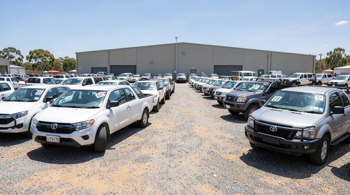
Surplus listings frequently include sedans, 4WDs, utility vehicles, and heavy machinery retired from government agency service. 9 Transport and service vehicles appear as surplus following fleet renewals or agency upgrades. Recent auction records illustrate the range: a 2022 Isuzu FVZ 240/300 6x4 Service Truck showing 40,199 km was listed through Smith Broughton Auctioneers in Western Australia, while a 2021 Hino FM500 6x4 Tipping Body Truck with 35,717 km appeared in the same sale. 10 Heavy plant and equipment also appears regularly alongside passenger vehicles.
The Slattery Grays Auction Group, which connects more than one million monthly visitors and over 250,000 active bidders with more than 13 million bids placed each year across approximately 3.3 million customers, handles fleet vehicles sourced from government and corporate programs alike. 11 ALLBIDS is specifically noted as a key platform for government and police surplus. Ritchie Bros. Australia's End of Financial Year auctions alone topped AU$100 million in Gross Transaction Value in 2026, reflecting the scale of the heavy equipment and fleet disposal market nationally. 12
Platforms, Auctioneers, and Registration Requirements
Prospective buyers must register an account on the respective auction house platform to participate in bidding for government fleet assets. 13 Key platforms operating in the Australian government surplus vehicle space include Pickles, Manheim, Grays, ALLBIDS, Slattery Auctions, Ritchie Bros., and Smith Broughton Auctioneers. Manheim auctioned approximately twice as many dealer-consigned cars at auction in 2025 as it did in 2023, and more than 500 franchise and independent dealers sold used cars at a Manheim auction in 2025. The average selling time between a car arriving at Manheim for processing and being successfully sold was 10.9 days. 14
NSW Government maintains four vehicle pricing lists under its Motor Vehicles Scheme (SCM0653), active from April 2023 to March 2028, covering passenger vehicles, SUVs, light commercial vehicles under 4.5 tonnes GVM, and heavy commercial vehicles over 4.5 tonnes GVM. 15 The scheme is managed by NSW Procurement and was set up for a five-year period with an annual refresh to include new suppliers and vehicle models. While this scheme governs acquisition, the same fleet eventually enters disposal channels through auction platforms once vehicles are retired.
Costs, Fees, and True Price Considerations
Government surplus vehicles are generally sold 'as is, where is,' meaning the buyer is responsible for any inspections or post-purchase repairs. 16 The hammer price is never the final amount a buyer pays. Buyer's premiums, GST, card surcharges, and freight costs can substantially increase the total outlay. At Smith Broughton Auctioneers, for example, the buyer's premium is calculated at 8.8% (GST inclusive) of the hammer price for purchases of $5,001 or more, and at 16.5% (GST inclusive) for purchases of $5,000 or less. 17
A useful cost breakdown for buyers to factor in before bidding:
- Hammer price: the winning bid amount
- Buyer's premium: typically ranges from a few percent to over 20% depending on the platform and lot value
- GST: applies when the seller is a business or government entity
- Card surcharge: varies by platform
- Transport or freight: particularly significant for lots located in remote yards
- Post-purchase inspection or repair costs: standard given the 'as is' sale condition
- Registration transfer fees and stamp duty: vary by state
Risks, Limitations, and Buyer Cautions
Several structural risks characterise participation in government surplus vehicle auctions. First, geographic friction is significant: most surplus lots are collection-only, and a vehicle located in Perth carries real logistical costs for a buyer based in Brisbane. Second, inspection windows are typically narrow and often by appointment only, limiting the ability to thoroughly assess condition before bidding. The New Vehicle Efficiency Standard (NVES), which began in July 2025, is also gradually reshaping the composition of government fleets, with around 12% of vehicles covered during the 2025 reporting period being electric and 88% internal combustion or hybrid. 18 This regulatory shift will gradually affect the mix of vehicle types entering surplus disposal over coming years.
Buyers sourcing ex-government vehicles should also be aware that service histories, while often more complete than private-sale equivalents, do not guarantee absence of mechanical issues. Fleet vehicles frequently carry high kilometres from sustained daily use across government operations. Sales are generally final, and most auctioneers explicitly recommend physical inspection of all lots prior to bidding. There is no centrally standardised warranty or recourse process across all Australian government surplus vehicle programs, making pre-purchase due diligence the buyer's primary risk management tool.
Sources
- Australian Government Department of Finance - finance.gov.au
- Pickles Auctions - pickles.com.au/cars/info/gov-auctions
- Manheim Australia - manheim.com.au
- GovAu Surplus - govausurplus.com.au
- GovAuctions.app: Government Auctions by State and Territory in Australia (2026) - govauctions.app
- GovAuctions.app: Auction Sources and Coverage - govauctions.app/sources
- GovAuctions.app: New South Wales Government Auctions - govauctions.app
- Victoria Daly Regional Council: Council Fleet Vehicles Available Through Online Auction - victoriadaly.nt.gov.au
- SaleHoo: Best Australian Auction Sites (2026) - salehoo.com
- Smith Broughton Auctioneers - sbauction.com.au
- 4x4 Australia: 2019 HiLux sourced from Slattery Auctions - 4x4australia.com.au
- StreetInsider: Ritchie Bros. Australia EOFY auctions top AU$100 million in GTV - streetinsider.com
- Grays Australia - grays.com/cars
- Mike Costello, Cox Automotive Australia - LinkedIn, March 2026
- NSW Government: Motor Vehicles Scheme SCM0653 - info.buy.nsw.gov.au
- Australian Government Department of Finance: Asset Management and Maintenance - finance.gov.au
- Smith Broughton Auctioneers: Sale #2043 Buyer's Premium Terms - sbauction.com.au
- Inside State Government: First New Vehicle Efficiency Standard Performance Results Published - insidestategovernment.com.au
Authored by MyTrendSpot team