Early signs of Varicose veins and leg swelling: A Clinical Guide to Symptoms and Risk
Early signs of varicose veins and leg swelling often begin with subtle changes rather than immediately prominent, twisted veins. Mild ankle swelling, leg heaviness, aching, itching, or fatigue may become more noticeable after prolonged standing or sitting, while elevation can provide relief in some cases. 1
How Varicose Veins Develop
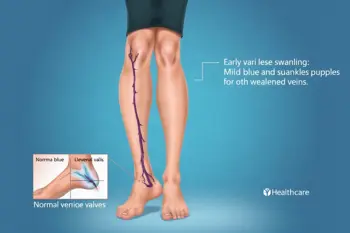
Leg veins contain small one-way valves that help move blood toward the heart. When vein walls weaken or valves become damaged, blood can flow backward and pool in the lower legs. The resulting pressure may enlarge superficial veins, producing blue or purple lines, raised vessels, or later, bulging and twisted veins beneath the skin. 1
Varicose veins may occur alone or alongside chronic venous insufficiency, a condition involving impaired venous return and increased pressure in the leg veins. Family history is associated with greater susceptibility, and pregnancy, aging, prolonged standing, and excess weight are recognized contributing factors in the supplied clinical sources. 5 9
Early Visible Changes in the Legs
The first visible change may be a small blue, purple, or reddish vein beneath the skin. Early vessels can appear slightly enlarged or raised without the pronounced rope-like shape associated with more established varicose veins. Spider veins, which are smaller red or purple lines, may also appear around larger affected veins. 1 3
Appearance alone does not determine severity. Some people have visible varicose veins with little discomfort, while others experience heaviness, aching, burning, or itching before prominent bulging develops. A pattern of symptoms that repeatedly worsens after extended periods upright or seated is more informative than a single isolated vein. 3 7
Leg Swelling and Edema
Swelling linked to venous problems commonly affects the ankles and lower legs and may extend into the feet. Venous pressure can cause fluid to move from blood vessels into surrounding tissue, producing peripheral edema. Swelling that increases toward the end of the day or after long periods of standing or sitting is a commonly described pattern. 4 8
Occasional mild swelling can also follow long travel, extended standing, or hot weather and may improve with rest or elevation. Persistent, recurrent, or progressively worsening swelling should not automatically be attributed to varicose veins, because leg edema has multiple possible causes and may require clinical evaluation. 8 4
Discomfort, Itching, and Muscle Symptoms
Early venous symptoms can feel like everyday tiredness, but recurring heaviness, fullness, pressure, aching, throbbing, or fatigue may indicate that blood is not returning efficiently from the legs. Burning or itching around visible veins can occur as fluid accumulates in nearby tissue and the skin becomes irritated. 2 5 6
Cramping, including cramps that occur at night, is another symptom reported in descriptions of venous insufficiency. Symptoms may fluctuate and can be less noticeable after the legs are elevated. This pattern can support a venous explanation, but discomfort alone cannot establish a diagnosis because several conditions can cause leg pain or cramps. 3 7
Skin Changes and Possible Progression
When elevated venous pressure continues, skin around the ankles may become discolored, irritated, thickened, or hardened. Venous insufficiency is described as a progressive disorder that can include edema, itching, skin discoloration, and, in advanced cases, venous ulcers. These findings represent more than a cosmetic change and are reasons for structured medical assessment. 6
Slow-healing sores, marked skin thickening, or persistent irritation suggest that the condition may have progressed beyond an early stage. Varicose veins can also develop after deep vein thrombosis, according to the Merck Manual. The presence of skin changes does not identify the cause by itself, so examination and the person’s medical history remain important. 5 9
When Assessment Is Appropriate
A healthcare professional can assess visible veins, swelling, skin condition, pulses, and symptom patterns during a physical examination. For chronic bilateral lower-extremity edema, duplex ultrasonography with reflux can help evaluate chronic venous insufficiency. NCBI guidance also identifies venous duplex ultrasound as a confirmatory study used in the evaluation of impaired venous flow. 4 6
Medical assessment is particularly relevant when swelling persists, affects daily activities, becomes progressively worse, or occurs with skin discoloration, ulcers, significant pain, or pronounced vein changes. Sudden swelling in one leg, especially when accompanied by substantial pain or other acute symptoms, should be treated as a separate medical concern rather than assumed to be routine varicose-vein swelling. 5 6
Managing Symptoms and Understanding Limits
Conservative measures described in the research include leg elevation and compression, which may assist blood flow back toward the heart and reduce symptoms for some people. Regular attention to prolonged standing or sitting is also relevant because these positions can increase discomfort and swelling. Compression is not appropriate for every person, so its use should be considered in the context of a clinical assessment. 5 7
Possible medical approaches vary according to symptoms, examination findings, and the underlying vein problem. The Merck Manual lists compression, wound care, sclerotherapy, and surgery among treatment options, while NCBI describes management ranging from conservative measures to pharmacologic and interventional procedures. Early symptoms therefore warrant interpretation, not automatic assumptions about a particular treatment. 5 6
Sources
- Cleveland Clinic, Varicose Veins: Symptoms, Causes & Treatment
- Cardiovascular Center of Florida, Early Signs of Varicose Veins
- USA Vein Clinics, Early Signs of Varicose Veins
- Center for Vein Restoration, Varicose Veins and Edema
- Merck Manual Professional Edition, Varicose Veins
- NCBI Bookshelf, Venous Insufficiency
- United Vein & Vascular Centers, Early Stages of Venous Insufficiency
- Vascular Center and Vein Clinic, Varicose Veins and Leg Swelling
- Cardiology Specialists of Orange County, Leg Pain and Varicose Veins
Authored by MyTrendSpot team