How police impound auctions actually work: A factual guide to notices, bidding, titles, and risk
How police impound auctions actually work depends on the agency, the vehicle’s legal status, and the jurisdiction’s disposal rules. Police-related auctions may involve abandoned vehicles, recovered property, seized assets, or municipal surplus, and the applicable notice, bidding, payment, title, and collection requirements are set by the seller rather than by one universal national procedure. 1
What a police impound auction is
An impound auction is generally the final stage of a government or law-enforcement property process. Vehicles can enter an impound system after being abandoned, towed under local law, held following enforcement activity, or retained while towing and storage charges remain unpaid. If the vehicle is not lawfully reclaimed within the required process, an agency or contracted auctioneer may dispose of it through an in-person, online, sealed-bid, or other commercially recognized sale. 2
The phrase “police auction” covers several different categories. Some sales concern vehicles held by a police department or municipal auto pound, while federal and state agencies may sell seized or forfeited assets through separate programs. USAGov identifies federal channels including GSA vehicle sales, GSA Auctions, U.S. Marshals Service seized-asset auctions, and Treasury auctions, showing that ownership and legal authority can vary significantly from one listing to another. 3
Why vehicles reach the sale stage
Not every impounded vehicle is immediately eligible for public sale. The vehicle may remain evidence, be connected to an active court case, be listed as stolen property, or be subject to unresolved ownership and lien claims. In ordinary impound situations, the registered owner and eligible lienholders generally have an opportunity to recover the vehicle by addressing the underlying requirements and paying applicable towing, storage, and administrative charges before disposal. 4
Abandoned-vehicle statutes illustrate the procedural nature of the process. Texas describes formal handling and sale procedures for abandoned vehicles, while California law addresses removal, custody, notice, and disposal of qualifying vehicles. Florida also identifies documentation and notice issues that must be addressed before an abandoned vehicle can be disposed of. These rules mean that the auction date is usually the endpoint of a legal timetable, not the start of an informal sale. 567
How the auction is organized
A public agency may run the sale itself or contract with an auction company. New York City publishes auction information and vehicle-related requirements through its municipal process, while Austin directs prospective participants to auction-specific procedures for city vehicles. Seattle’s police vehicle-auction information likewise demonstrates that agency instructions control participation, viewing, payment, and removal details. 8910
Online marketplaces can combine listings from police departments, municipalities, and other public agencies, but each seller’s terms remain controlling. A listing may specify whether inspection is available, whether bidding is open to the public, which identification is accepted, how payment must be made, and when the vehicle must leave the property. In Dallas, for example, attendees must register, be at least 18, pay within the stated deadline, and arrange removal by a licensed wrecker. 11
What bidders should examine
Police impound vehicles are commonly sold as-is and without a mechanical warranty. Mechanical condition may be difficult to establish because the vehicle could have been stored for an extended period, damaged before towing, or offered with limited inspection access. A listing’s photographs and description therefore do not substitute for checking the vehicle identification number, visible condition, odometer information, title brand, and any stated restrictions before bidding. 12
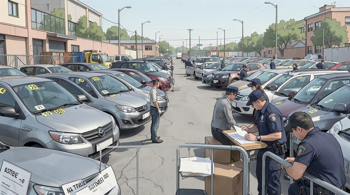
The paperwork is as important as the vehicle itself. A buyer might receive a transferable title, a salvage title, a bill of sale, or court or lien-sale documentation, depending on the jurisdiction and the vehicle’s history. The fact that a government entity has authority to sell does not automatically mean that registration will be straightforward in every state. Public-auction marketplaces instruct bidders to review the individual listing’s title, inspection, payment, pickup, and removal conditions. 13
How bidding, payment, and pickup work
Some auctions are conducted at a physical auto pound, while others use timed online bidding. In a timed sale, the highest recorded bid when the auction closes generally becomes the winning bid under the platform’s rules. The winning amount may not be the complete financial obligation because buyer premiums, sales tax, title charges, registration costs, towing, and storage can be added according to the seller’s terms. 14
Payment deadlines are strict and vary by auction. Dallas requires full payment no later than one hour after the final vehicle is sold, and vehicles cannot be driven away from that auto pound. The city requires licensed towing and sets a removal deadline of 11:59 p.m. on the day after the auction. Other sellers may impose different deadlines, so failure to collect a vehicle can create additional storage charges or affect the completed sale. 11
Key risks and regulatory limits
The principal risk is assuming that every police-auction vehicle has ordinary retail documentation or predictable operating condition. Some vehicles may need substantial repairs, may carry a salvage designation, or may be difficult to register. Auction terms can also limit remedies after payment, making a pre-bid review of condition, title status, fees, and removal requirements essential. Copart’s published terms illustrate why these categories must be checked individually rather than inferred from an auction’s name. 15
Regulatory oversight operates through statutes, agency procedures, public notices, court orders, and financial controls. Spokane’s municipal code, for example, requires disposal of certain forfeited property after specified case and appeal milestones, public notice before an auction or sealed-bid solicitation, documentation of the legal basis for seizure, and yearly financial auditing. Those safeguards show why a legitimate auction should identify the selling authority and provide terms that explain the property’s status and the buyer’s obligations. 16
How to interpret the outcome
A successful winning bid does not necessarily mean immediate possession or road use. The vehicle may require towing, repairs, title processing, insurance, inspection, registration, or resolution of a documentation issue before it can legally operate. A buyer should treat the auction result as a transfer subject to the seller’s paperwork and local motor-vehicle rules, not as confirmation that the vehicle is ready to drive. 311
The most reliable way to understand any individual auction is to separate five questions: who owns or controls the vehicle, why it became eligible for disposal, what notice process applied, what documents transfer, and what costs and deadlines follow the winning bid. Police impound auctions can be legitimate public sales, but their practical outcome depends on jurisdiction-specific rules, vehicle history, title condition, inspection access, and strict compliance with the auction contract. 213
Sources
- BBC Morning Live, “How do police auctions work?”
- Wikipedia, “Police auction”
- USAGov, “Government vehicle auctions”
- City of San Diego, “Vehicle impound”
- Texas Department of Motor Vehicles, “Abandoned vehicles”
- California Legislative Information, Vehicle Code Section 14607.6
- Florida Highway Safety and Motor Vehicles, “Abandoned vehicles”
- New York City Department of Finance, “Auctions”
- City of Austin, “Vehicle auctions”
- Seattle Police Department, “Vehicle auctions”
- Dallas Police Department, “Auto Pound Auction”
- PropertyRoom, online public-auction information
- GovDeals, government auction marketplace terms
- Public Surplus, government auction marketplace terms
- Copart, auction terms
- Spokane Municipal Code, Section 08.19.020
Authored by MyTrendSpot team