Best lymphatic drainage for post-surgery swelling: Clinical guidance on safe recovery
The question of the best lymphatic drainage for post-surgery swelling depends on the procedure, the location and cause of the swelling, and the operating surgeon’s instructions. Manual lymphatic drainage may improve comfort and help move excess fluid, but it is not universally necessary and should not replace assessment for infection, a blood clot, a fluid collection, or wound complications.
Why swelling develops after surgery
Surgery triggers inflammation, sending fluid and immune cells into injured tissues. Incisions and tissue reshaping can also temporarily disrupt microscopic lymphatic channels, allowing fluid to collect in spaces around the treated area. Common effects include puffiness, tightness, heaviness, bruising, firmness, and sensitivity. These symptoms may occur after breast surgery, mastectomy, liposuction, tummy tuck, facelift, fat transfer, and other procedures. 1
The lymphatic system normally helps maintain fluid balance, support immune function, and transport cellular waste toward lymph nodes and the venous circulation. Muscle activity and one-way valves assist this movement, so reduced mobility during recovery can contribute to fluid retention. Swelling that is mild and gradually improving may be part of healing, while rapidly worsening or uneven swelling requires review by the surgical team. 2
What usually provides the strongest foundation
For uncomplicated postoperative edema, the central plan is generally the surgeon-approved combination of gentle movement, elevation when advised, prescribed compression, and routine wound and skin care. These measures address fluid accumulation without relying on massage alone. Compression is particularly important when persistent lymphedema is present, although the garment, pressure, fit, and timing should be selected by a qualified clinician rather than guessed by the patient. 3
Movement should remain within the limits set by the operating team. Complete decongestive therapy, commonly used for appropriate lymphedema patients, combines manual lymphatic drainage, compression, exercise, skin care, and education. This broader approach recognizes that swelling control is an ongoing process rather than a single appointment. Its components are adjusted according to tissue condition, surgical restrictions, and the person’s ability to manage care at home. 4
How manual lymphatic drainage differs from ordinary massage
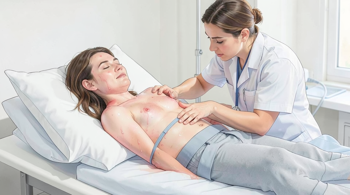
Manual lymphatic drainage, or MLD, is a specialized, light-touch technique using gentle rhythmic movements on the skin’s surface. It is intended to encourage fluid toward functioning lymphatic pathways. Deep-tissue massage, vigorous kneading, and heavy pressure are different approaches and may be inappropriate over healing incisions, bruised tissue, drains, or areas with significant inflammation. 5
MLD may be useful for comfort and swelling after selected procedures, particularly operations involving lymph nodes or extensive tissue disruption. However, evidence is not uniform. A Cochrane review found uncertain or mixed evidence about the additional benefit of MLD when added to compression for breast-cancer-related lymphedema. Therefore, MLD should be considered as part of an individualized plan, not as a guaranteed method for preventing chronic swelling. 6
Timing, clearance, and practitioner qualifications
The safest starting point is written or clearly documented clearance from the operating surgeon. Timing varies by procedure, bleeding status, drains, incisions, tissue viability, and other medical factors. Some clinical practices describe low-pressure lymphatic stimulation within 24 to 72 hours for selected soft-tissue procedures, while other operations may require approximately a week or longer before massage is considered. These timelines are not universal protocols. 7
A certified lymphedema therapist or physical therapist with postoperative experience can assess whether the problem is ordinary edema, lymphedema, a seroma, infection, or another complication. Professional assessment also helps determine whether compression is safe and how it should be fitted. Patients should avoid self-massage of a new swollen area until the surgical team has excluded wound problems, infection, fluid accumulation, and clot-related concerns. 8
How recommendations differ by procedure
After mastectomy, lumpectomy, or lymph-node surgery, swelling management may have a stronger clinical rationale because lymphatic pathways can be directly affected. Compression, exercise, skin care, education, and specialized massage may all be considered. For cosmetic procedures such as liposuction, tummy tuck, or body contouring, MLD is often discussed for comfort and temporary swelling reduction, but the research does not establish that every patient needs it. 9
Lipedema reduction surgery may involve a structured complete decongestive therapy plan because the underlying condition affects fatty tissue and lymphatic function. In that setting, MLD, compression, movement, skin care, and education are coordinated rather than treated as isolated services. Across procedure types, the practical question is not simply which massage is “best,” but whether the swelling has been evaluated and whether the proposed technique fits the operation and healing stage. 10
Risks, warning signs, and ongoing care
Massage or compression can be unsafe when active bleeding, compromised tissue, infection, or a suspected clot is present. Urgent assessment is warranted for sudden one-sided leg swelling, calf pain, warmth, redness, chest pain, shortness of breath, or coughing blood because these symptoms can occur with deep-vein thrombosis or pulmonary embolism. These signs should not be managed with massage while awaiting improvement. 11
The surgical team should also be contacted for increasing redness, heat, drainage, fever, wound separation, or rapidly worsening swelling. Once complications have been excluded, ongoing management may include prescribed compression, gradual activity, skin protection, and periodic reassessment. Clinical sources consistently describe lymphedema care as individualized and potentially long term, meaning that symptom control may require maintenance rather than a fixed number of massage sessions. 12
Sources
- Cleveland Clinic, Manual Lymphatic Drainage: https://my.clevelandclinic.org/health/treatments/21768-manual-lymphatic-drainage
- NHS, Lymphoedema: https://www.nhs.uk/conditions/lymphoedema/
- National Cancer Institute, Lymphedema: https://www.cancer.gov/about-cancer/treatment/side-effects/lymphedema
- Johns Hopkins Medicine, Lymphedema Treatment: https://www.hopkinsmedicine.org/health/treatment-tests-and-therapies/lymphedema-treatment
- Memorial Sloan Kettering Cancer Center, Lymphedema Education: https://www.mskcc.org/cancer-care/patient-education/lymphedema
- Cochrane Library, Manual Lymphatic Drainage for Breast-Cancer-Related Lymphedema: https://www.cochranelibrary.com/cdsr/doi/10.1002/14651858.CD003475.pub2/full
- HUIMAIN, Pressotherapy and Postoperative Recovery: https://www.huimainbeauty.com/guides/can-pressotherapy-devices-post-op-recovery/
- Academy of Lymphatic Studies, Certified Lymphedema Therapists: https://www.clt-lana.org/
- American Cancer Society, Lymphedema: https://www.cancer.org/cancer/managing-cancer/side-effects/swelling/lymphedema.html
- Lipedema Medical Solutions, CDT and MLD Recovery: https://lipedema.net/your-guide-to-cdt-and-mld-recovery/
- NHS, Deep Vein Thrombosis: https://www.nhs.uk/conditions/deep-vein-thrombosis-dvt/
- American College of Surgeons, After Surgery: https://www.facs.org/for-patients/preparing-for-surgery/after-surgery/
Authored by MyTrendSpot team