Top rated noise canceling headphones under $100: An evidence-based market review
Top rated noise canceling headphones under $100 can provide meaningful isolation without reaching premium-model pricing, although performance varies substantially across sound quality, microphone behavior, comfort, and battery endurance. Current testing and review data show that the category includes established Soundcore and Sony models alongside newer options from Baseus, FiiO, and SOUNDPEATS.
What the under-$100 category actually offers
Noise-canceling headphones below $100 generally combine wireless Bluetooth playback with active noise cancellation, a rechargeable battery, and plastic-heavy construction intended to limit weight and manufacturing cost. SoundGuys reports having tested more than 1,000 headphones while evaluating trade-offs in this segment, noting that most current ANC headphones provide at least passable reduction of outside noise. 1
The category is not defined by one uniform level of performance. Over-ear designs usually suppress more environmental sound because their earcups create a physical barrier around the ears, while earbuds offer greater portability. What Hi-Fi? identifies the Sony WH-CH720N as an all-round choice and separately identifies the Sony WF-C710N for listeners who prefer an in-ear format. 2
Models frequently identified in comparative research
Several models recur in the supplied research. The Anker Soundcore Life Q30 is widely cited for hybrid ANC and a 40-hour battery, while the Life Q20 is commonly positioned as a simpler entry-level option. The 1MORE SonoFlow is associated with LDAC support and up to 70 hours of battery life. These specifications illustrate why battery endurance and codec support often distinguish products in the same price class.
Other frequently mentioned names include the Tribit QuietPlus 72, Edifier W820NB Plus, JBL Tune 760NC, TOZO HT2, Skullcandy Hesh ANC, Sony WH-CH720N, and Audio-Technica ATH-S300BT. The research describes these models through different strengths, including lightweight construction, low-frequency noise reduction, high-resolution audio, foldability, app controls, or long battery life. These are comparative attributes, not guarantees of identical results for every listener.
Newer alternatives and documented specifications
The FiiO EH13 represents a newer lower-cost entry with a stated $50 price, 40mm dynamic drivers, five microphones, hybrid ANC, Bluetooth 6.0, multipoint connectivity, and LDAC support. Its listed battery figures are 45 hours with ANC enabled and 75 hours with ANC disabled. Three ANC levels are described for awareness, indoor work, and louder environments, although independent long-term testing remains important when assessing real-world behavior. 4
The SOUNDPEATS Cove Pro is described in an independent review as costing around $69 and offering adaptive hybrid ANC rated up to 56dB, Bluetooth 6.0 with LDAC, app-based equalization, USB-C wired audio, and strong battery life. The same review characterizes its sound as bass-forward and identifies several budget-related trade-offs. Specification density therefore does not automatically indicate superior tuning or isolation. 5
Sound, comfort, and construction trade-offs
Sound quality under $100 tends to involve deliberate compromises rather than a single technical failure. The available research describes the Baseus Inspire XH1 as comfortable, good-sounding, and capable of good noise canceling, while also reporting that ANC modes affect its sound signature and that its Dolby audio implementation is disappointing. Such observations show that listening impressions can change when noise-canceling modes or processing profiles are switched. 6
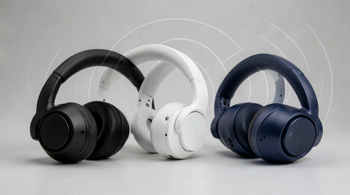
Physical design also requires scrutiny. Most products in this range use plastic construction to control weight and cost, while folding hinges, ear-pad materials, clamp pressure, and swivel resistance affect long-session comfort. The Baseus XH1 uses metal in its hinge but was reported to have very loose hinge movement. A supplied review also notes a protective travel case and a design influenced by Bose styling and tuning, without implying Bose ownership or endorsement. 6
Battery life, codecs, and app controls
Battery expectations in this category commonly fall between 30 and 70 hours on one charge, depending on whether ANC is active and which connection mode is used. The cited examples range from 40 hours for the Life Q30 to 70 hours for the 1MORE SonoFlow, while the FiiO EH13 lists 45 hours with ANC and 75 hours without it. Stated endurance should therefore be read as a mode-dependent specification rather than a universal runtime. 4
LDAC support appears on several value-focused products, including the 1MORE SonoFlow, FiiO EH13, and SOUNDPEATS Cove Pro, but codec availability depends on the source device and listening setup. Soundcore models are also associated with proprietary apps that allow equalizer adjustments and ANC-mode selection. These controls can improve personalization, yet they add software dependence to a product that otherwise functions as ordinary Bluetooth hardware.
How ANC performance should be interpreted
Active noise cancellation is most effective when the unwanted sound is relatively consistent, such as engine rumble or other low-frequency background noise. The supplied research describes the Tribit QuietPlus 72 as providing effective low-frequency reduction, while the FiiO EH13 offers separate ANC levels for different environments. These descriptions should not be treated as standardized laboratory scores because manufacturers and reviewers may use different measurement conditions and terminology.
Call quality presents a separate evaluation problem. The FiiO EH13 uses five microphones and environmental-noise-cancellation algorithms intended to reduce surrounding sound during calls, while many other models emphasize music playback rather than voice transmission. TechRadar’s review of the Tribit QuietPlus 81 characterizes that model as having several flaws, reinforcing that a headphone can offer ANC yet still have weaknesses in microphones, controls, fit, or overall usability. 7
Practical evaluation criteria and market friction
A reliable comparison should begin with fit, intended environment, and device compatibility rather than headline specifications alone. Over-ear headphones may offer stronger passive isolation, but their size and heat retention can reduce comfort. Earbuds are easier to carry but depend more heavily on ear-tip fit. Multipoint, wired USB-C audio, app equalization, and codec support can matter for work or travel, yet each feature introduces compatibility requirements that may not apply equally across phones, computers, or operating systems.
Pricing is another source of uncertainty because a model described as under $100 can move above or below that threshold by retailer, region, date, or temporary market conditions. The Baseus XH1 has been described as $150 through Baseus and $100 through Amazon, while CNET’s broader testing describes sub-$100 headphones as capable of solid ANC and calling but not generally audiophile-grade sound. Independent review coverage should therefore be weighed alongside the price context. 3
Sources
- SoundGuys, “Best budget noise canceling headphones for 2026”
- What Hi-Fi?, “Best cheap noise-cancelling headphones 2026”
- CNET, “Best Budget Noise-Canceling Headphones Under $100”
- ecoustics, “FiiO EH13 Budget Wireless Noise Cancelling Headphones”
- HiFi Oasis, “SOUNDPEATS Cove Pro Review”
- WIRED, “Baseus Inspire XH1 ANC Headphones Review”
- TechRadar, “Tribit QuietPlus 81 review”
Authored by MyTrendSpot team