Understand herniated disc treatment options: A clinical guide to recovery, injections, and surgery
Understand herniated disc treatment options by comparing the main approaches used for pain, nerve irritation, weakness, and functional limitation. Most people are initially treated without surgery because symptoms often improve over several weeks to months as inflammation settles and the disc fragment may shrink or resolve. 1
How a herniated disc causes symptoms
A herniated disc occurs when the soft inner nucleus pushes through a tear or weakened area in the tougher outer annulus. If displaced material irritates or compresses a nearby nerve, symptoms may include back or neck pain, radiating pain into an arm or leg, tingling, numbness, or weakness. Lumbar herniations are especially common at L4-L5 and L5-S1, while cervical herniations more often produce shoulder, arm, or hand symptoms. 2
- Lower-back herniations commonly cause sciatica affecting the buttock, thigh, calf, or foot.
- Neck herniations may cause pain or altered sensation along the shoulder and arm.
- Some people have a herniation visible on imaging but no symptoms.
Initial nonsurgical treatment
Initial care generally combines a short period of activity modification with continued gentle movement rather than prolonged bed rest. A brief rest period of 24 to 48 hours may be appropriate when symptoms are severe, but extended inactivity can make recovery more difficult. Short supported walks, avoidance of heavy lifting, twisting, and deep bending, and gradual return to routine activity are commonly emphasized. Treatment selection depends on symptom severity, examination findings, duration, and response to care. 3
- Activity is adjusted to reduce movements that intensify arm or leg pain.
- Prolonged bed rest is generally avoided.
- Follow-up is important if pain, numbness, or weakness changes.
Medication and physical therapy
Medication is primarily used to control symptoms while the irritated nerve recovers. Nonsteroidal anti-inflammatory drugs such as ibuprofen or naproxen may help when medically appropriate, although individual health conditions and medication interactions must be reviewed by a clinician. Physical therapy can then address posture, core strength, flexibility, and movement mechanics through a structured exercise program. These measures support function, but they do not guarantee that every disc protrusion will resolve. 4
- Medication choice should account for medical history and other medicines.
- Therapy should be adapted to pain level and neurological findings.
- Exercises that worsen radiating symptoms require reassessment.
When injections may be considered
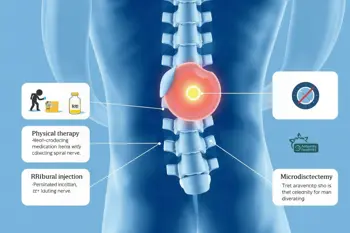
An epidural steroid injection may be considered when inflammation around a spinal nerve continues to cause substantial radiating leg or arm pain despite initial treatment. The aim is symptom relief that can facilitate movement and rehabilitation, rather than permanent removal of the herniation. Benefits may be temporary, and injections do not replace evaluation of progressive weakness or other neurological changes. Interventional treatment is therefore selected according to the clinical examination, imaging correlation, and persistence of symptoms. 5
- Injections are most relevant to nerve-related arm or leg pain, not every type of back pain.
- Expected duration of benefit varies between individuals.
- Persistent or worsening weakness requires medical assessment rather than repeated symptom treatment alone.
Imaging and decisions about surgery
MRI is commonly used when symptoms persist, neurological deficits are present, or an injection or operation is being considered. A scan by itself does not determine treatment because disc abnormalities can occur without symptoms. Surgery is generally discussed when pain remains disabling despite appropriate nonsurgical care, when symptoms fail to improve, or when neurological problems progress. For lumbar sciatica, microdiscectomy or discectomy removes the portion of disc material pressing on the affected nerve. 6
- Surgical planning requires agreement between symptoms, examination, and imaging.
- Microdiscectomy targets the compressive disc fragment rather than automatically treating every spinal abnormality.
- Most herniated discs do not require surgery.
Urgent warning signs and treatment expectations
New loss of bladder or bowel control, numbness around the buttocks or genital area, or severe and rapidly worsening leg weakness can indicate serious nerve compression and requires urgent medical evaluation. Progressive neurological compromise is treated differently from uncomplicated pain. For less severe cases, recovery may occur gradually over weeks or months, and the decision to escalate care is based on functional limitation, neurological status, symptom duration, and response to conservative treatment rather than anxiety about an MRI report. 3
- Seek urgent assessment for new bladder or bowel dysfunction.
- Report saddle-area numbness promptly.
- Arrange medical review for severe or progressive weakness.
- Discuss persistent disabling pain when nonsurgical care has not restored function.
Sources
- Johns Hopkins Medicine, “Lumbar Disk Disease (Herniated Disk)”
- Mayo Clinic, “Herniated disk: Symptoms and causes”
- Harvard Health, “Herniated Disk”
- NCBI Bookshelf, “Disk Herniation”
- Northwell Health, “Herniated Disc Treatment: Here’s What Works”
- American Association of Neurological Surgeons, “Herniated Disc”
Authored by MyTrendSpot team