2026 update: Average assisted living expenses by state
Assisted living costs represent one of the largest financial considerations for families navigating senior care decisions in 2026. The national landscape reveals significant variation in monthly expenses depending on geographic location, facility amenities, and individual care requirements. Understanding the current pricing structure helps families prepare financially and make informed decisions about residential care options.
National Median Costs and Price Range Overview
The national median cost of assisted living in 2026 ranges across multiple estimates, reflecting data collected from different industry sources. A Place for Mom reports a median of $5,830 per month 1, while other sources cite figures of $5,419 per month 2, $5,500 per month 3, $5,200 per month 4, and $6,200 per month 5. These variations reflect different survey methodologies and data collection timeframes throughout 2026. Across all measurements, the national landscape suggests annual costs ranging from approximately $62,400 to $74,400 per year 1. The spread between the lowest-cost and highest-cost states demonstrates substantial geographic variation in the senior care market.
Monthly expenses for assisted living typically fall between $4,000 and $8,000, though some high-cost markets exceed this range significantly 1. Understanding this baseline establishes realistic expectations before comparing specific state-level data. Pricing models vary considerably; some communities charge all-inclusive monthly rates that bundle housing, meals, and care services, while others use tiered or a la carte pricing that adjusts as care needs change 1.
Lowest-Cost States for Assisted Living in 2026
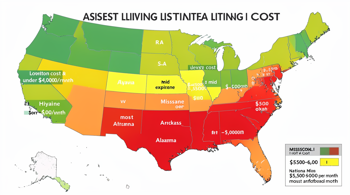
The most affordable assisted living markets in 2026 cluster primarily in the South and Midwest. Mississippi and Arkansas lead the lowest-cost category at approximately $3,700 per month 3. Missouri follows closely at $3,800 per month, while Alabama, Georgia, Louisiana, North Dakota, Oklahoma, South Dakota, and Utah all report base rates around $4,000 monthly 3. These states represent approximately 30-40% savings compared to national medians, translating to annual costs between $44,400 and $48,000 for basic assisted living services.
The affordability in these regions stems from lower labor costs, reduced real estate expenses, and variations in regulatory requirements across state lines. Families in these states benefit from extended private-pay runways, meaning a given asset base lasts longer before Medicaid becomes necessary 6. Kentucky at $4,400 monthly and Idaho, Nevada, New Mexico, North Carolina, Tennessee, Texas, West Virginia, and Wyoming at $4,500 per month represent the next tier of affordable options 3.
Mid-Range Cost States and Regional Pricing Patterns
Mid-range assisted living expenses cluster between $4,800 and $5,800 per month across multiple states. Florida, Ohio, Pennsylvania, and Wisconsin report $4,800 monthly costs, while Arizona, Illinois, Indiana, Iowa, Kansas, Michigan, Montana, and Nebraska average $5,000 per month 3. Colorado, Maryland, Minnesota, and Virginia fall in the $5,500 range, and Oregon and Vermont approach $5,800 monthly 3. These mid-tier markets represent the broad center of the national distribution, where most families encounter pricing relatively close to national medians.
Regional patterns emerge from this pricing structure. Coastal states and markets with higher population density generally command premium pricing, while rural areas and interior regions tend toward lower costs. The difference between mid-range and low-cost states typically reflects labor market dynamics, with direct care worker wages driving the largest portion of operational expenses. Cities with higher overall costs of living consistently report elevated assisted living rates, particularly in metropolitan areas with competitive job markets.
Highest-Cost States and Premium Markets
The most expensive assisted living markets in 2026 concentrate in specific geographic regions. Hawaii tops the list at approximately $12,096 per month, nearly double the national median 5, with some sources citing rates above $6,500 monthly 3. Alaska follows as another premium market, with costs approaching or exceeding $7,000 per month 3. Washington, D.C. reports median costs of $8,960 monthly 7, representing the highest cost in the continental United States. Other high-cost jurisdictions include Vermont at approximately $7,885 monthly 7, Massachusetts approaching $6,500-$7,200 monthly 3, and New Jersey, California, Connecticut, Delaware, New Hampshire, Rhode Island, and Washington, each reporting $6,500 or higher monthly 3.
Premium pricing in these states reflects multiple cost drivers: elevated regional labor standards, expensive real estate markets, higher insurance and regulatory compliance costs, and strong demand for services. Families in these markets face significantly extended care planning horizons, with a $300,000 asset base lasting only 22-30 months in Massachusetts versus 40 months in Oklahoma at lower cost structures 6. Maine and New York similarly report elevated costs of $6,000 monthly, completing the list of states where assisted living expenses substantially exceed national averages.
Memory Care and Specialized Service Premiums
Memory care, which serves individuals with Alzheimer's disease and other dementias, commands premium pricing above base assisted living rates. Memory care nationally averages $6,690 per month according to 2026 data 2, representing approximately a 30-50% premium over base assisted living in most markets 3. This pricing reflects increased staffing ratios, specialized staff training in dementia care, secured environments preventing wandering, and enhanced activities programming designed for cognitive decline. Regional variation in memory care pricing follows similar geographic patterns as assisted living, with Hawaii, Vermont, and Massachusetts reporting the highest specialized care costs, and Southern states offering more affordable options.
Beyond memory care, assisted living facilities frequently charge additional fees for specialized services not included in base rates. Medication management, higher-level assistance with activities of daily living, physical therapy, and transportation beyond scheduled routes typically add $500 to $2,500 monthly 1. Understanding these potential add-ons prevents billing surprises after move-in. Families should request complete fee schedules from facilities before committing, ensuring they understand which services are bundled versus separately charged.
Cost Drivers and Factors Influencing 2026 Pricing
Multiple interconnected factors drive assisted living pricing in 2026. Direct care worker wages represent the single largest operational expense, accounting for the majority of cost variations between states and facilities 8. Labor market tightness, minimum wage levels, and benefits requirements vary dramatically by jurisdiction, creating substantial pricing differences. Real estate and facility costs constitute the second major driver, with urban locations and markets experiencing strong demand commanding significantly higher property expenses. Regulatory compliance requirements, insurance costs, and maintenance expenses round out the primary cost components.
Inflation within the senior care sector has consistently outpaced general consumer price inflation, rising approximately 4.4% annually in assisted living and 3.7% in memory care according to 2026 year-over-year comparisons 2. This accelerated inflation reflects chronic workforce shortages in healthcare, which push wages upward faster than general economy wage growth. Facility maintenance costs have increased due to aging infrastructure and updated safety standards. The combination of these factors explains why senior care costs have risen approximately 16-22% since pre-pandemic levels, with direct care worker wages increasing 22% in the same period 8.
Payment Methods and Coverage Limitations
Understanding how assisted living costs are covered proves critical for financial planning. Medicare does not cover assisted living room and board, as these are long-term custodial care services rather than acute medical care 9. This fundamental coverage gap means most residents rely on private pay using personal savings, pension income, or long-term care insurance benefits. Some families supplement private resources by selling homes, accessing home equity lines of credit, or leveraging investment accounts. The median assisted living stay duration of approximately 22 months means total costs often exceed $130,000 for individual placements.
Medicaid assistance for assisted living varies substantially by state, with some states offering Home and Community-Based Services (HCBS) waivers covering facility costs for low-income residents, while others provide no coverage 10. Where available, Medicaid HCBS waivers frequently feature lengthy waitlists, sometimes extending years in high-demand jurisdictions. Long-term care insurance can cover portions of assisted living expenses for policyholders, though coverage limitations and benefit caps require careful policy review. Veterans may access VA Aid and Attendance benefits to offset senior living costs, though eligibility requirements are stringent. Families should explore all available assistance programs within their state and investigate their loved one's eligibility for various support options.
Sources
- A Place for Mom, Assisted Living Costs by State: 2026 Pricing Guide
- A Place for Mom, 2026 Costs of Long-Term Care and Senior Living Report
- AveeCare, Assisted Living Cost by State 2026: All 50 States
- CarePriced, How Much Does Assisted Living Cost in 2026: A State-by-State Guide
- Brevy Care, Assisted Living by State: Costs, Rules and Medicaid Coverage
- ElderCareAtlas, Long-Term Care Costs 2026: By State, By Care Level
- Newsweek, Map Shows States With the Highest Senior Care Costs
- AllyKin, 2026 Senior Care Cost Report and Senior Care Cost Index
- Investopedia, $5,400 a Month for Assisted Living: How Families Are Paying
- PayingForSeniorCare, State-Specific Medicaid HCBS Waiver Information
Authored by MyTrendSpot team