When leg pain may be related to the sciatic nerve: A clinical guide to symptom patterns and warning signs
When leg pain may be related to the sciatic nerve, the most useful clues are its route, quality, and associated neurological symptoms. Sciatica describes persistent pain along the sciatic nerve, which travels from the lower back through the buttock and into the lower leg. 1 The pattern can help distinguish nerve-related pain from problems involving muscles, joints, blood vessels, or other structures.
What the sciatic pain pattern looks like
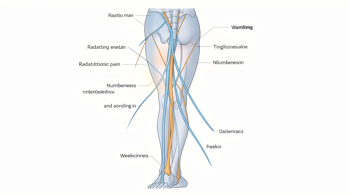
Sciatic pain commonly begins in the lower back or buttock and radiates through the thigh, calf, and sometimes the foot. It may feel dull, aching, burning, sharp, or electric, rather than like localized soreness. Tingling, pins and needles, numbness, or weakness can occur in the affected leg or foot. 1 The symptoms usually affect one side, although some underlying conditions can produce symptoms on both sides.
Pain that extends below the knee is more suggestive of nerve-root involvement than pain confined to the lower back, hip, or upper thigh. A symptom checklist described in the research data highlights several useful clues: pain traveling from the buttock down the leg, symptoms reaching beyond the knee, altered sensation in the leg or foot, and difficulty lifting the foot or toes. 2 These features do not establish a diagnosis, but they make a clinical assessment more relevant.
Why sciatic nerve symptoms develop
Sciatica is a symptom pattern rather than a single disease. The most common causes are a herniated or displaced disk, inflammation around a nerve root, and bony enlargement associated with arthritis. 1 A herniated disk can press on a lumbar or sacral nerve root, creating pain and sensory or motor changes along the nerve distribution.
Other causes include spinal narrowing, known as stenosis, and vertebral changes associated with osteoarthritis or rheumatoid arthritis. Merck Manual notes that radiculopathies result from pressure on a nerve root next to the spine, with herniated intervertebral disks identified as the most common cause. 3 Less common explanations include infection, tumors, diabetes-related nerve-root injury, or compression of the sciatic nerve farther from the spine.
Activities that can change the symptoms
Sciatic pain may begin suddenly after lifting, twisting, or another physical activity, but it can also develop gradually. Harvard Health reports that symptoms may worsen at night and become aggravated by movement. 1 Coughing, sneezing, prolonged sitting, or sudden changes in position may also increase discomfort because these actions can place additional stress on irritated nerve roots.
Symptoms do not always correspond neatly to the severity of a finding on a scan. Research information on sciatica symptom patterns notes that a relatively small disk problem can produce intense pain, while a larger imaging abnormality may not match a person’s daily symptoms. 2 For that reason, pain location, sensation, strength, reflexes, and functional changes are considered together rather than relying on one symptom or an imaging report alone.
How clinicians evaluate possible sciatica
Assessment generally starts with a medical history and a physical examination. A clinician may ask whether low-back pain spreads into the leg, whether symptoms pass below the knee, and whether weakness affects the leg or foot. Neurological testing can assess sensation, muscle strength, and reflexes, while a straight-leg-raising maneuver may reproduce radiating pain in some cases. 4
Imaging is not automatically required for every episode. The research data indicate that magnetic resonance imaging or computed tomography may be considered when symptoms persist, when significant weakness or sensory loss occurs, or when there is concern about infection, a tumor, or another serious condition. 5 Electrodiagnostic testing and systemic tests may also be used when the symptoms do not clearly fit a single nerve-root pattern.
When leg pain may have another explanation
Not every pain in the buttock, hip, or leg is sciatica. Hip disorders, local muscle or tendon injuries, and conditions affecting peripheral nerves can create overlapping symptoms. Sciatic nerve compression can also occur outside the spine, including within the deep gluteal space, where it is sometimes described as deep gluteal syndrome or subgluteal entrapment. 6
Vascular and infectious conditions may also need consideration when the presentation is unusual. The research data identify early shingles before a rash appears as one possible mimic, while plexus disorders can cause mixed pain, sensory loss, and weakness that does not follow one individual nerve root. 4 Persistent, unexplained, rapidly changing, or atypical leg pain should therefore be evaluated rather than labeled as sciatica based only on location.
Warning signs requiring prompt assessment
Some symptoms indicate that leg pain should not be managed as an ordinary episode of nerve irritation. Loss of bowel or bladder control, numbness in the saddle area, and severe or progressive weakness can signal serious compression of nerves in the lower spine. 7 Symptoms affecting both legs, especially when they are worsening, also warrant urgent medical evaluation rather than routine observation.
Most uncomplicated cases improve with nonsurgical care over several weeks. The provided research reports that approximately 80% to 90% of cases resolve within six to 12 weeks with appropriate nonsurgical management, while other summaries place resolution for many cases within about six weeks. 8 Common conservative approaches include maintaining activity as tolerated, physical therapy, targeted exercises, and appropriate pain-relief medicines, with treatment selected according to the cause, severity, and examination findings.
Sources
- Harvard Health Publishing, “Sciatica”
- Sciatica.pro, “Sciatica Symptoms Checklist: When to Seek Care”
- Merck Manual Professional Edition, “Nerve Root Disorders”
- Merck Manual Professional Edition, “Brachial Plexus and Lumbosacral Plexus Disorders”
- Wikipedia, “Sciatica”
- Radiopaedia, “Sciatic Neuropathy”
- MedlinePlus, “Cauda Equina Syndrome”
- American Academy of Orthopaedic Surgeons, “Sciatica”
Authored by MyTrendSpot team