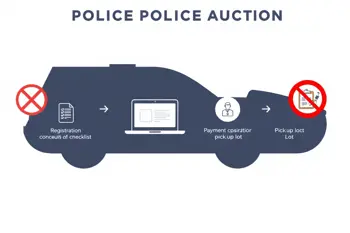
How police auctions work: steps from registration to pickup: a documented process map for bidders
Police auctions typically liquidate unclaimed, forfeited, or seized property, and buyers encounter an as-is, where-is sales model that requires preparation before bidding. Many police departments use third-party online auction platforms to run listings, registration, payment, and communications, meaning the practical steps depend on the specific site and jurisdiction. This article follows the common workflow reflected across police auction guidance: start with locating the auction, complete registration and eligibility checks, bid using published lot details, pay within the required window, then retrieve items during the permitted pickup period while meeting documentation requirements.
1) What police auctions sell and who runs the sale
Police auction inventory generally comes from categories such as unclaimed property, seized assets from investigations, forfeited items, or surplus equipment released for public sale. Vehicle inventory can include cars, trucks, SUVs, motorcycles, and other specialty units, while non-vehicle categories often include electronics, jewelry, tools, office or facility equipment, and surplus public assets. The sales are designed to recoup costs associated with storage and administration while maintaining transparency in disposal.
Jurisdiction matters because police auctions are not a single nationwide marketplace with one uniform process. A city police department, county sheriff, state agency, impound contractor, or federal entity may each use a different auction company, schedule, and payment policy. Research sources also note that many agencies do not operate their own auction sites, instead using third-party platforms to handle listings and bidding communications.
| Source category | Examples of what appears | Common buyer expectation |
|---|---|---|
| Impound and abandoned property | Towed vehicles not reclaimed within the legal window; other stored items | Condition and mechanical history may be unknown |
| Seized or forfeited property | Evidence-room property released for auction; confiscated assets | As-is, where-is terms; paperwork and title questions may require review |
| Retired fleet or surplus | Vehicles and equipment from law enforcement or agencies ending a service cycle | May have more maintenance context than impounds, but still sold as-is |
2) Finding the right auction: location and platform selection
Police auctions are organized by multiple authorities, so discovery typically starts with the jurisdiction hosting the sale and the platform used for listings. Research guidance emphasizes that the best starting point is auctions serving a specific state, metro area, or ZIP code, then confirming the details for the items of interest. In practice, buyers often encounter overlapping naming patterns such as police impound auctions, sheriff surplus, or government vehicle sales that use separate listing systems.
Third-party platforms commonly appear in police and government disposal workflows. Examples from provided research include GovDeals and PropertyRoom for seized and surplus sales, and GSA-related channels for federal surplus vehicles and property. A key point for process planning is that each platform can define different account requirements, authorization steps, inspection rules, bidding formats, and pickup instructions. Matching the auction location to the correct site reduces the risk of missing the correct registration and payment pathway.
3) Registration and eligibility: identity checks and terms acceptance
Registration is a required gateway in most police auction workflows. Prospective bidders typically create an account on the auction site and complete identity verification, which may include providing a credit card for authorization. Provided research also frames registration as including explicit agreement to platform terms of service, where bidders accept liability waivers and the consequences of failing to comply with payment and pickup requirements.
Eligibility and authorization may limit access to bidding on police-confiscated goods. Sources reference examples where bidders must receive authorization before being permitted to bid. Because police auctions are governed by state and local rules and implemented through contracted platforms, the exact eligibility sequence and documentation expectations can vary across jurisdictions, but the common pattern is consistent: account creation, verification, and acknowledgement of auction terms.
- Account registration on the specific auction platform
- Identity verification and possible payment authorization using a credit card
- Agreement to terms of service, including legal waivers and compliance responsibilities
- Completion of any platform-specific authorization steps before bidding on police items
4) Before bidding: reading lot descriptions, as-is terms, and inspection realities
Police auctions typically sell items on an as-is, where-is basis, which means no warranties are offered for functionality or condition. This model shifts risk to the bidder, making the lot description and any available inspection process central to decision-making. Research sources emphasize that police auctions can include items with limited known history, such as impounded vehicles with missing keys or unknown mechanical background, and seized items where title and documentation issues must be assessed.
Inspection opportunities vary by auction type and facility. Some auctions publish catalog data such as lot numbers and descriptions in advance, and certain sales allow in-person viewing on sale day, while others rely more heavily on photos and written disclosures. Regardless of format, bidders face a consistent compliance burden: items are sold as-is with the expectation that the buyer performs due diligence before bidding starts.
- Verify lot numbers and item category, including vehicle vs. property sales
- Confirm as-is, where-is language and whether any functional guarantees exist (often none)
- Assess disclosed condition issues and missing components mentioned in the listing
- Use any inspection window offered by the auction platform and lot listing
5) How bidding works: auction format and the contract moment
Bidding mechanics vary by platform and agency, but the common structure is that a published listing includes a starting bid or opening price and then uses timed or live auction dynamics to determine the highest bid. Research on government auctions notes that online timed auctions are common, while other events may be live with bidder cards and incremented price calls. The practical implication for police auctions is that the winning determination follows published platform rules, not buyer negotiation.
Once bids close, the highest bidder becomes responsible for completing the transaction according to the auction’s terms. Research sources describe a strict process expectation: payment is required within a specified window to avoid penalties or account suspension. This reinforces that bidding is effectively the start of the transaction workflow rather than the end of preparation.
| Common bidding format | How results are determined | Process consequence for winners |
|---|---|---|
| Online timed auctions | Closing time ends the bidding window | Payment deadlines begin immediately after close, per platform rules |
| Live auctions | Auctioneer announces closing when no further bid is raised and the gavel drops | Contract is formed at closing, requiring prompt payment and retrieval steps |
6) Payment after winning: deadlines, penalties, and documentation readiness
Police and government auction guidance frequently stresses payment deadlines as a major friction point. Provided research states that successful bidders generally must complete payment within a specified window, often 48 to 72 hours, to avoid penalties or account suspension. Because police auctions may be managed through third-party platforms, the exact payment mechanism can include credit card settlement or certified funds, depending on the platform and item category.
Documentation readiness affects the next phase, pickup. Research indicates that winners must present official government identification and provide a copy of the winning bid receipt to retrieve items from a police impound or warehouse. Some jurisdictions also include additional requirements such as proof of insurance when picking up vehicles, and strict adherence to removal hours and permitted times. Payment completion and document preparation therefore need to be synchronized to avoid missed pickup eligibility.
- Pay within the platform-defined deadline, often 48 to 72 hours
- Use the accepted payment method specified by the auction platform
- Prepare government-issued ID and winning bid receipt copy before pickup
- Confirm any vehicle-specific requirements, including proof of insurance where applicable
7) Pickup and retrieval: removal windows, logistics responsibility, and common risks
Pickup operations are governed by strict removal windows. Research sources note that many police auctions give 3 to 7 days to remove a vehicle after purchase, while some can enforce tighter rules such as 48-hour pickup requirements that do not account for weekends or holidays. Missing the pickup window can trigger storage-related penalties, forfeiture of the item, or forfeiture of payment, depending on jurisdiction and platform terms. Pickup rules also commonly restrict hours, such as business-hours-only access for lots.
Winning bidders are responsible for logistics once the transaction closes. This includes loading and transporting items away from the site, which can be especially relevant for vehicles, large equipment, or bulky property. Because many items are sold as-is with unknown or partially disclosed condition history, retrieval can introduce additional realities such as towing needs for vehicles that may not be operational. The compliance focus is that pickup is not only about presenting paperwork but also about executing removal within the permitted timeframe and according to facility procedures.
8) Risk and compliance considerations across the lifecycle
A balanced view of police auctions includes explicit risk factors. The as-is, where-is structure removes warranties for condition and functionality, placing emphasis on inspection, lot description review, and due diligence. Vehicle and property condition may be affected by the source reason such as impoundment, seizure, or retirement from agency service. Research highlights that the reason for auction affects expected issues, ranging from high idle hours in retired vehicles to missing keys or unknown mechanical history in impounded units.
Compliance also extends beyond bidding and pickup. Registration terms typically include waivers and conditions for legal transfer and liability assumptions. State-specific rules can shape titling and registration outcomes after purchase, and registration processes may vary for auction vehicles across states due to DMV and inspection standards. Practical friction points therefore include paperwork requirements, transport planning, and the possibility of limited recourse if the item is discovered to have issues not fully disclosed in the listing.
- As-is, where-is sales transfer condition risk to buyers
- Source of item affects expected condition and disclosure quality
- Payment deadlines and pickup windows are strict and platform-defined
- Post-purchase registration may vary by state and titling requirements
Sources
- Government Auctions Blog (Police Auctions: How to Buy Without Guesswork) https://www.governmentauctions.org/blog/2026/08/03/police-auctions-how-to-buy/
- BidProwl (How Government Auctions Work in 2026) https://bidprowl.com/guides/how-government-auctions-work
- Catalyst Legal (What Is a Police Auction and How Do They Work) https://catalystlegal.org/what-is-police-auction-how-do-they-work/
- Engineer Fix (How to Buy a Car From a Police Auction) https://engineerfix.com/how-to-buy-a-car-from-a-police-auction/
- EasyHaul Blog (How to Arrange Shipping for a Car You Bought at a Police Auction) https://www.easyhaul.com/blog/2026/03/04/how-to-arrange-shipping-for-a-car-you-bought-at-a-police-auction/
- GovDeals Blog (Where to Find Police Auctions Near Me) https://blog.govdeals.com/where-to-find-police-auctions-near-me
- LegalClarity (Public Vehicle Auctions: What to Know Before You Bid) https://legalclarity.org/public-vehicle-auctions-what-to-know-before-you-bid/
- GovAuctions.app (How to Find and Buy Government Car Auctions Near Me) https://govauctions.app/guides/government-car-auctions-near-me
- AuctionGate.io (How to Register Auction Cars in the US: State-by-State Rules) https://auctiongate.io/us/news/post/step-by-step-guide-to-registering-auction-vehicles-across-us-states
Authored by MyTrendSpot team