Best antifungal creams for nails: Clinical guidance on topical treatment options
Why ordinary antifungal creams may not work well on nails
When people search for the best antifungal creams for nails, the most important distinction is between treatments for fungal skin infections and medicines specifically formulated for onychomycosis. Terbinafine and clotrimazole creams can treat several skin infections, but an established infection inside a thick nail may prevent enough medicine from reaching the nail bed. Specialized solutions and lacquers are designed for direct nail application, while oral therapy may be considered when disease is extensive. 1
Terbinafine cream, including Lamisil cream, contains terbinafine hydrochloride and is widely used against dermatophyte infections of the skin. However, available clinical guidance describes its nail effectiveness as limited because the nail plate is a difficult barrier. A cream may still be relevant when athlete’s foot or surrounding skin infection accompanies nail disease, but it should not automatically be treated as a complete cure for infected toenails. 2
Prescription topical treatments designed for nail fungus
Three established prescription topical categories are efinaconazole 10% solution, tavaborole 5% solution, and ciclopirox 8% nail lacquer. Efinaconazole and tavaborole are applied once daily for 48 weeks for toenail onychomycosis. Ciclopirox is also applied daily for an extended course and is used as part of a broader nail-management program. These products are not ordinary creams, but they more directly match the anatomy and treatment requirements of fungal nail disease. 3
| Topical treatment | Form | Typical labeled approach |
|---|---|---|
| Efinaconazole | 10% solution | Once daily for 48 weeks |
| Tavaborole | 5% solution | Once daily for 48 weeks |
| Ciclopirox | 8% nail lacquer | Daily use with lacquer removal and nail care |
The ciclopirox label specifies use in immunocompetent patients with mild to moderate infection without lunula involvement caused by susceptible Trichophyton rubrum. The regimen includes daily application, weekly trimming by the patient, and periodic removal of unattached infected nail by a healthcare professional. These eligibility details illustrate why treatment choice depends on severity and nail anatomy rather than product popularity alone. 4
Where amorolfine and other topical products fit
Amorolfine is another topical antifungal ingredient used in nail lacquers in some countries. A 5% amorolfine lacquer is marketed specifically for fungal nail infections, while an amorolfine 0.25% cream formulation is described for external treatment of onychomycosis when no more than two-thirds of the nail plate is affected. Availability, approval status, and instructions vary by country, so the local product label and professional advice are important. 5
Nonprescription pens and solutions may contain ingredients such as ciclopirox, amorolfine, undecylenic acid, acetic acid, or ethyl lactate. Their reported effectiveness varies, and daily application may continue for six to twelve months. These products can be convenient, but convenience does not establish equivalent evidence to prescription therapies. A worsening, painful, or extensive nail should be assessed rather than managed indefinitely with unverified topical products. 6
How severity changes the treatment decision
Topical treatment is most useful when infection is limited, affects a smaller portion of the nail, and does not involve the nail root or matrix. Merck Manual guidance similarly distinguishes limited nail disease, where topical therapy may be useful, from extensive or matrix-involving infection, which often requires systemic treatment. The visible appearance of a nail alone cannot reliably determine severity, because thickness, discoloration, and brittleness may have several causes. 7
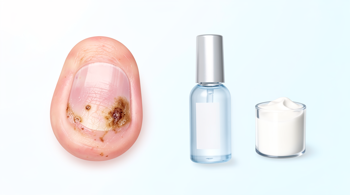
Oral terbinafine generally has higher cure rates than topical treatment for suitable patients with confirmed dermatophyte toenail infection. It is not appropriate for everyone, however. Medical evaluation is needed because liver disease, possible drug interactions, and monitoring considerations can affect eligibility. The decision therefore involves balancing the extent of infection, the likely organism, medical history, current medicines, and the risks of systemic exposure. 8
Diagnosis, duration, and realistic expectations
Fungal nail disease can resemble trauma, psoriasis, yeast-related changes, or other nail disorders. The American Academy of Dermatology notes that examination and, in some cases, laboratory testing of nail clippings or scrapings may be needed before treatment. Confirming the diagnosis can prevent prolonged exposure to an antifungal medicine when the nail change is not caused by fungus. 9
Nails grow slowly, so successful treatment does not usually produce an immediately normal-looking nail. Prescription topical courses commonly last many months, and visible improvement may appear only as healthy nail grows from the base. Mayo Clinic and MedlinePlus both describe nail-fungus treatment as a prolonged process that may require months. Stopping as soon as discoloration improves can leave residual infection untreated. 10
Safety issues and treatment limitations
Topical antifungals generally limit systemic exposure, but irritation, itching, redness, or allergic reactions can occur. Product-specific instructions matter because solutions, lacquers, and creams have different application sites, drying requirements, and removal procedures. Applying a skin cream under an occlusive dressing, combining several antifungals without advice, or using a product on broken skin may increase irritation without improving nail penetration. 11
Oral treatment introduces different concerns, particularly liver-related risks and interactions with other medicines. Patients with relevant medical conditions, those taking several prescriptions, or people with recurrent treatment failure should seek clinical assessment. A professional may also recommend trimming or debridement to reduce the amount of infected nail and improve topical contact, especially when a labeled regimen requires regular nail maintenance. 12
Reducing recurrence after treatment
Recurrence is a practical limitation because fungal organisms can persist on the skin, footwear, and shared damp environments. Keeping nails trimmed and dry, treating coexisting athlete’s foot, and avoiding prolonged moisture exposure can reduce reinfection risk during and after therapy. Walking barefoot in communal showers and locker rooms is identified as a common exposure route, while warm, sweaty footwear creates conditions that favor fungal overgrowth. 13
The most defensible answer to the question of which antifungal cream is best is that the appropriate treatment depends on confirmed diagnosis and disease extent. Ordinary terbinafine cream may be useful for associated skin fungus, but prescription nail solutions or lacquer are more specifically designed for nail penetration. Extensive disease, matrix involvement, repeated recurrence, or uncertain diagnosis warrants medical evaluation rather than repeated experimentation with topical creams. 14
Sources
- American Academy of Dermatology, Nail Fungus Treatment
- Nailicy, Treating Nail Fungus: Is Terbinafine Hydrochloride Cream Effective?
- FDA prescribing information for Jublia and Kerydin
- CICLOPIROX DailyMed Drug Label, FDA.report
- Pharmica, Loceryl 5% Amorolfine Lacquer, and Medixlife, Oflomil Derma
- Nailicy, Fungal Nail Pens: Effective Treatment or Temporary Fix?
- Merck Manual, Nail Fungal Infections
- StatPearls, Onychomycosis
- American Academy of Dermatology, Nail Fungus Treatment
- Mayo Clinic and MedlinePlus, Nail Fungus Treatment Information
- Nailicy, Terbinafine Hydrochloride Cream Safety Information
- FDA.report, Ciclopirox Prescribing Information
- Cleveland Clinic, Onychomycosis
- Drugs.com, Terbinafine Topical
Authored by MyTrendSpot team