Early signs of poor blood circulation in legs: A clinical guide to symptoms and risks
What poor circulation in the legs can mean
Early signs of poor blood circulation in legs may reflect a problem in either the arteries, which deliver oxygen-rich blood, or the veins, which return blood to the heart. Peripheral artery disease, or PAD, develops when arteries narrow, commonly because of atherosclerotic plaque. Venous problems can instead cause blood to pool in the lower limbs. The symptoms may overlap, so a persistent change in temperature, sensation, color, pain, or swelling should be assessed in its clinical context. 1
PAD is particularly important because reduced arterial flow may first become noticeable when leg muscles need more oxygen during walking or exercise. MedlinePlus describes pain, aching, fatigue, burning, or discomfort in the feet, calves, or thighs that commonly improves after several minutes of rest. Symptoms may initially occur only when walking uphill, moving faster, or covering longer distances, then appear with progressively less activity. 1
Coldness, numbness, and tingling
Feet or lower legs that remain unusually cold, including in a warm environment, can be a warning sign of reduced blood delivery. Reduced circulation may also produce numbness or a persistent pins-and-needles sensation. These symptoms are not specific to vascular disease, because nerves and other conditions can cause similar sensations, but their appearance alongside pale skin, walking-related pain, or a weak foot pulse increases the importance of a professional evaluation. 2
Arterial narrowing can limit the oxygen and nutrients reaching muscles, nerves, skin, and other tissues. MedlinePlus notes that legs or feet may feel numb at rest, while the legs can become cool to the touch and the skin may look pale. The Dudley Group NHS Foundation Trust also lists cold, pale, or bluish feet and toes among symptoms of peripheral ischaemia. 1 3
Walking-related pain and muscle fatigue
Cramping, aching, burning, or fatigue in the calves, thighs, feet, or buttocks after physical activity is known as intermittent claudication when it is caused by PAD. The characteristic pattern is discomfort that develops during walking or exercise and settles after rest. At an early stage, the distance that triggers symptoms may be long, but the discomfort can occur sooner as arterial disease progresses. 1
Activity-related leg pain should not automatically be attributed to aging or ordinary muscle strain. The American Heart Association identifies PAD as a consequence of plaque restricting blood flow to the legs and emphasizes that it can be underdiagnosed. Risk is especially associated with smoking and diabetes, while MedlinePlus also lists high blood pressure, high cholesterol, heart disease, kidney disease requiring hemodialysis, and stroke among relevant risk factors. 4 1
Skin color, texture, and hair changes
Changes in the appearance of the legs and feet can provide visible clues about circulation. Pale, bluish, or purple coloring may indicate that tissues are receiving less adequately oxygenated blood. The NHS patient information leaflet lists color changes, thin and very dry skin, and the disappearance of hair on the legs and feet as symptoms of peripheral ischaemia. These findings are more meaningful when they persist or occur with coldness, pain, or reduced sensation. 3
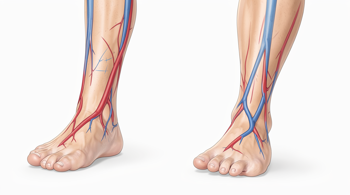
Chronic reduction in blood flow can affect the skin’s ability to remain healthy and repair minor damage. The same NHS source states that damaged skin may take a long time to heal or may fail to heal, allowing a foot ulcer to develop. Skin changes can have several causes, so visual appearance alone cannot establish PAD, but new or worsening changes deserve clinical review, particularly in people with diabetes or a history of smoking. 3
Swelling and heaviness from venous problems
Swelling in the feet, ankles, or calves can point toward impaired venous return rather than reduced arterial inflow. When vein valves or the venous circulation do not move blood efficiently back toward the heart, fluid may accumulate in the lower limbs. Swelling that is more noticeable after prolonged standing or sitting, together with heavy, aching, or tired legs, is commonly described in connection with venous circulation problems. 2
Arterial and venous symptoms are not identical. PAD more typically produces exertional muscle pain, coolness, pallor, numbness, and later pain at rest, while venous circulation problems are associated with pooling and swelling. A vascular assessment is needed to distinguish these patterns and identify the underlying cause. Other reported contributors to circulation problems include diabetes, high blood pressure, high cholesterol, smoking, obesity, kidney disease, and prolonged inactivity. 1 2
When symptoms suggest advancing disease
Slow-healing sores, ulcers, increasing nighttime cramps, or pain in the feet and toes while resting are more concerning than occasional mild coldness. MedlinePlus reports that severe PAD may cause pain and cramps at night, as well as pain or tingling in the feet or toes. The NHS warns that a blocked artery can stop blood flow altogether, potentially causing gangrene, while untreated skin damage can become an ulcer. 1 3
Medical evaluation commonly considers symptoms, risk factors, skin temperature and color, sensation, and pulses in the feet. A weak or absent foot pulse is a clinical finding that healthcare professionals may identify during examination, rather than a reliable self-diagnosis. PAD represents a progressive form of systemic atherosclerosis and ranges from disease without obvious symptoms to intermittent claudication and chronic limb-threatening ischaemia. New rest pain, a non-healing wound, marked color change, or tissue breakdown warrants prompt medical attention. 5 4
Sources
- MedlinePlus Medical Encyclopedia, Peripheral artery disease - legs: https://medlineplus.gov/ency/article/000170.htm
- Mass General Brigham, Warning Signs of Poor Blood Circulation: https://www.massgeneralbrigham.org/en/about/newsroom/articles/signs-poor-blood-circulation
- The Dudley Group NHS Foundation Trust, Peripheral Ischaemia: https://www.dgft.nhs.uk/pil/peripheral-ischaemia/
- American Heart Association, Is your leg pain actually PAD?: https://www.heart.org/en/news/2025/09/30/is-your-leg-pain-actually-pad-watch-for-these-warning-signs
- NCBI Bookshelf, Peripheral Arterial Disease: https://www.ncbi.nlm.nih.gov/books/NBK430745/
Authored by MyTrendSpot team