Best northern lights cruises from US ports: Industry briefing and route research for aurora-focused sailing
Published cruise coverage frames Northern Lights success around moving beyond land light pollution into higher latitudes, ideally within the auroral oval, and using a ship’s ability to reposition toward clearer skies and darker horizons at sea. Itinerary design is therefore not only about geography, but also about timing and viewing conditions across multiple nights. The discussion below summarizes aurora-relevant route characteristics and specific cruise patterns that appear in reporting for travelers departing from the United States. 1
1) What “from US ports” usually means for Northern Lights itineraries
Northern Lights cruises that originate in the United States are commonly structured as trans-Atlantic repositioning moves or long-haul itineraries, rather than short cruises that stay within US Arctic waters year-round. This matters because most aurora-prime routes are positioned toward Norway, Iceland, and Greenland latitudes, which typically require crossing toward the auroral oval. The research context also notes that many US-origin itineraries increase the likelihood of viewing by building in overnight port calls that support aurora observation windows. 1
Route mobility is central to aurora cruise logic. A cruise ship can sail away from land-based light pollution, reposition between ports, and provide unobstructed views from observation decks, lounges, or cabin terraces, depending on vessel design. One aurora-focused guide describes the key trade-off clearly: a cruise is not the highest-probability method if Northern Lights are the only objective, because clear-sky conditions and solar activity govern sightings. 4
2) Aurora timing: the viewing window referenced across cruise guidance
High-latitude aurora viewing is frequently described as strongest between late September and March for destinations such as Norway and Iceland, aligning with longer, darker nights needed for visibility. A US-facing cruise-oriented context similarly emphasizes that aurora chances are typically best from November through March in the Northern Hemisphere. This creates a practical planning constraint for US departures: itineraries that sail across the Atlantic later in the year naturally overlap with the core viewing season. 6 1
Some reporting highlights the role of geomagnetic activity around equinox periods, which is often mentioned as a factor that can increase the likelihood of vivid aurora activity. For travelers comparing multiple route options, the key implication is to treat “Northern Lights season” as a planning framework, not an outcome guarantee. Any given voyage remains contingent on cloud cover, local weather, and the auroral response on the night of observation. 6
- Prime viewing guidance cited for Norway and Iceland: late September through March. 6
- General Northern Hemisphere cruise framing: November through March as a typical best chance window. 1
- Equinox-linked aurora activity often noted for increased geomagnetic behavior. 6
3) Route geography: the auroral oval and what ships attempt to achieve
The auroral oval is described as a latitude band where the Northern Lights are most likely to appear, with one cruise-focused explanation describing coverage between 60 and 75 degrees in the northern hemisphere across regions including Norway, Sweden, Finland, Iceland, and Canada. Another guidance source emphasizes best viewing from latitudes commonly described as the auroral oval and places relevance near about 65 to 72 degrees north. For cruise routes, the goal becomes spending multiple nights near these latitudes. 1 0
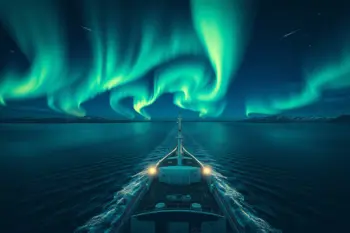
At sea, the viewing environment changes. One guide describes why cruise viewing can differ from fixed land stays: at sea, the sky is described as genuinely dark in all directions, without city glow halos or nearby horizon lighting that can wash out faint aurora curtains. The same guidance also notes an important limitation: a cruise does not eliminate the risk of overcast skies and it cannot force aurora occurrence, which depends on solar activity. 4
4) Documented US-port patterns: examples from published itineraries
A concrete US-port example in the research set is a Holland America “Voyage of the Vikings” itinerary described as a roundtrip sailing from Boston, featuring an Arctic-facing route pattern that includes Greenland’s remote coastal towns, Iceland’s fjords, and an overnight stay in Reykjavik. The listing also frames the trip as a client favorite and highlights storm avoidance steering in a specific context, illustrating that weather management becomes operationally relevant when navigating northern seas. 2
Another US-port pattern appears in an AdventureSmith expedition product description, which outlines an “Arctic Sights & Northern Lights” voyage on the M/V Sea Spirit, exploring Eastern Greenland with daily chances described as an excellent chance each night on the voyage. That itinerary is described as round-trip from Reykjavik, but it still provides a template for how aurora-focused cruise operators build repeated night observation opportunities into multi-day expedition routes near high latitudes. 3
| US departure context (from research set) | Aurora-relevant itinerary elements cited | Notes on viewing logic |
|---|---|---|
| Roundtrip Boston (Holland America “Voyage of the Vikings” listing) | Visit Greenland coastal towns, sail Iceland’s fjords, overnight in Reykjavik; named cruise ship ms Volendam | Overnight port call and Arctic sea access support multi-night positioning and observation 2 |
| US departure context not specified in product page (AdventureSmith expedition route is Reykjavik based) | “Arctic Sights & Northern Lights” on Sea Spirit, round-trip from Reykjavik, through Scoresby Sund and Denmark Strait region coverage | Expedition design described as providing an excellent chance each night, with repeated aurora opportunities during the voyage 3 |
5) “Best” in practice: selection criteria that align with how cruises attempt higher odds
Across the research set, cruise-based aurora success is linked to mobility and sky conditions rather than any fixed itinerary promise. One aurora cruise guide explicitly frames the cruise advantage as mobility: ships can sail toward clearer-sky windows and can navigate between ports to improve viewing conditions, while also positioning on open sea away from land-based light pollution. This operational flexibility is described as the core reason cruise platforms are used for aurora hunting. 4
Selection criteria commonly implied in the sources include route latitude emphasis, observation access, and itinerary duration near aurora-favorable regions. The Yahoo-linked cruise coverage also discusses observing from observation decks, glass-roofed lounges, or cabin terraces, emphasizing unobstructed viewing possibilities. Meanwhile, expedition-focused descriptions highlight smaller-ship dynamics and activity scheduling such as Zodiac cruising and shore excursions, which can increase time spent outdoors during darker evening windows, but still requires weather-compatible operations. 1 4
- Priority concept: repositioning toward clear skies and darker horizons at sea. 4
- Viewing environment: observation decks, glass-roofed lounges, and cabin terraces noted in cruise coverage. 1
- Probability trade-off: Northern Lights are not guaranteed because solar activity and clear skies dominate outcomes. 0 4
6) Risks, logistics, and friction points that affect US-port aurora cruises
Severe weather and rough seas are repeatedly identified as realistic expectations when sailing in northern latitudes during fall and winter months. This affects comfort, shore operations, and the ability to remain outside for observation periods. The aurora cruise guide frames trade-offs directly by noting that cruising is not necessarily the highest-probability route if the only objective is aurora viewing, since cloud cover and auroral intensity remain uncontrollable. 0 4
Operational complexity also includes timing alignment with the auroral season. Research notes indicate that many trans-Atlantic repositioning cruises occur in late autumn, which aligns with the start of the optimal viewing season and supports the practical likelihood of dark, aurora-visible nights. Even with season alignment, ongoing maintenance realities such as continuous weather monitoring and route adjustment capability influence daily outcomes. Additionally, some itinerary pages include terms and “subject to change” framing that can reflect availability and scheduling variability. 0 5
7) Practical comparison framework: mapping US-port departures to aurora outcomes
Given that US-origin itineraries often transit toward aurora-favorable regions, a useful comparison framework focuses on whether the itinerary spends time at or near the auroral oval and whether it provides repeated night opportunities. One aurora cruise guide describes that a cruise can accumulate exposure to multiple aurora-prime latitudes over several days, which can matter more than a single observation night. This is operationally aligned with multi-day coastal routes and expedition itineraries that remain far north for extended stretches. 4
When comparing specific voyages named in the research set, the most measurable differentiators are route origin and itinerary structure. For example, the Boston-based Holland America listing explicitly includes an overnight stay in Reykjavik, while expedition descriptions like AdventureSmith’s “Arctic Sights & Northern Lights” and longer “Northern Lights Explorer” style routes describe sailing patterns that stay close to Arctic Circle coastlines and into regions associated with aurora viewing. These details can help contextualize why some voyages may be structured to maximize darkness and observation time, even though sightings remain probabilistic. 2 3 0
Sources
- https://www.yahoo.com/lifestyle/articles/six-best-northern-lights-cruises-140000068.html
- https://cruiseandtravelexperts.com/portfolio-items/2027-holland-america-line-voyage-of-the-vikings/
- https://adventuresmithexplorations.com/cruises/arctic/sights-northern-lights/
- https://auroraforecast.me/guides/northern-lights-cruise
- https://www.brenncotravel.com/collette-us/17101/the-northern-lights-of-norway-by-sea
- https://www.undiscoveredamerica.tv/northern-lights-alaska-cruise-2026-aurora-viewing-guide/
Authored by MyTrendSpot team