Police impound SUVs for auction: Legal Frameworks, Operational Protocols, and Market Realities
For buyers evaluating public sector inventory, finding police impound SUVs for auction serves as an entry point into a specialized market of municipal asset liquidations 1. Law enforcement agencies regularly schedule public sales to dispose of vehicles seized during routine traffic stops, criminal investigations, or asset forfeiture proceedings 26. These events allow municipalities to clear space in storage yards while recovering towing and storage expenses 3. Understanding the structural mechanics of these auctions is critical for navigating the distinct legal and operational policies that govern public sales.
Municipal Liquidation Frameworks and Vehicle Origins
The lifecycle of an impounded sport utility vehicle begins when law enforcement officers authorize its removal from public roadways 2. Common triggers for vehicle seizure include registration expiration, illegal parking, or municipal asset forfeitures 24. Towed to a secured municipal facility, local ordinances mandate a specific grace period during which the registered owner may settle accrued penalties, towing fees, and storage costs to reclaim their property 23. If unclaimed, the vehicle is declared legally abandoned and cleared for public liquidation 23.
Before any vehicle hits the auction block, the managing agency must satisfy legal notice requirements to clear outstanding financial liens 2. Municipal departments run database searches to identify banks or private lenders with active security interests in the vehicle 2. Official notifications are sent to these lienholders, giving them a final opportunity to claim the asset 2. If no action is taken, the legal title is modified to allow the government to sell the vehicle 2. This process applies to seized civilian models, such as the Ford Explorer and Jeep Grand Cherokee, and retired departmental fleet units like the Chevrolet Tahoe PPV 25.
Regional Variations in Public Auction Operations
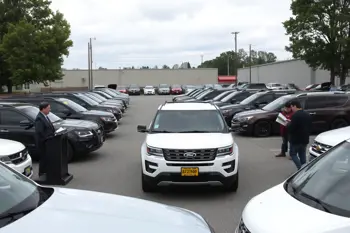
Public auction frameworks vary by municipality, dictated by regional laws and local logistics. For example, the Suffolk County Police Department in New York holds physical auctions at its Westhampton impound yard 1. These regional events routinely feature roughly 90 to 100 lots, encompassing civilian sedans and utility vehicles 16. Under Suffolk County guidelines, all vehicles start with a standardized baseline minimum bid of $500 and are sold strictly in as-is condition 1. The department provides designated preview windows on the days leading up to the sale, allowing prospective bidders to visually evaluate the physical assets 1.
Conversely, other regional agencies favor digital platforms to manage vehicle liquidations. The Kansas City Police Department utilizes a bi-weekly, online-only auction system conducted via third-party platforms 78. In contrast to live physical bidding, online systems require a pre-registration deposit of $300 to authorize bids 9. This platform enforces strict administrative compliance, including a permanent ban from future bidding and the forfeiture of the security deposit for any registered user who fails to execute payment on a winning bid 7. These diverse systems highlight the importance of reviewing local terms before bidding.
Comparative Analysis of Departmental Policies
The following comparative table details the varying auction parameters, deposit requirements, and operational structures utilized by representative regional departments across the United States. This historical performance data reflects standard operating terms rather than guaranteed inventory levels.
| Municipality / Department | Auction Type | Minimum Bid or Deposit | Vehicle Title Status |
|---|---|---|---|
| Suffolk County Police Department (NY) 1 | In-Person Only 1 | $500 Minimum Bid 1 | Varies / As-Is 1 |
| Kansas City Police Tow Lot (MO) 7 | Online Only 7 | $300 Bidding Deposit 9 | Mailed Post-Sale 10 |
| Columbus Division of Police (OH) 4 | In-Person Only 4 | Registry ID Required 4 | Salvage Title Focus 4 |
Legal Title Disclosures and Post-Sale Administrative Realities
The administrative process of transferring vehicle ownership represents a primary operational bottleneck for buyers at municipal sales. A critical distinction of law enforcement auctions is that vehicles are frequently sold with non-standard title designations 4. For example, the Columbus Division of Police specifies that the majority of vehicles liquidated through its yard are issued with salvage titles 4. A salvage designation requires the buyer to pass a specialized state inspection after completing repairs before the vehicle can legally operate on public roads. Bidders must consult state-level licensing authorities to calculate these post-sale costs.
Furthermore, title delivery timelines are rarely immediate. At municipal impound facilities like the Kansas City Tow Lot, buyers do not receive active physical titles at the payment window 10. Instead, the local agency initiates a processing sequence to mail legal ownership documents to the winning bidder at a later date 10. This administrative delay prevents immediate vehicle registration or resale, meaning buyers must plan for storage and operational downtime while the official state documentation is finalized and dispatched.
Risk Mitigation, Condition Inspections, and Friction Points
Participating in municipal vehicle liquidations requires a thorough understanding of the "as-is" framework. Municipalities do not offer performance warranties, refunds, or mechanical guarantees 7. In the vast majority of cases, impounded sport utility vehicles do not have keys, meaning buyers cannot perform diagnostic tests, verify exact mileage, or test the engine and transmission before bidding 7. Consequently, a portion of the inventory is suitable only for salvage parts, while other units may require extensive mechanical rebuilding 9.
To mitigate these structural risks, buyers must leverage designated preview windows. Suffolk County schedules multi-day previews prior to its auctions to allow for close visual inspections 1. During these periods, experienced bidders check fluid levels, inspect the frame for structural damage, and look for signs of electrical tampering or flood damage. Because mechanical diagnostics are prohibited, buyers must factor the cost of key creation, professional towing, and immediate diagnostic servicing directly into their baseline acquisition budgets.
Post-Auction Retrieval and Operational Timelines
Once the auctioneer confirms a winning bid, buyers must comply with strict operational timelines for payment and vehicle removal. For instance, the Columbus Division of Police requires all payments to be finalized by 1:00 PM on the day of the auction, with cash being the preferred payment method 4. Any delay in payment results in immediate forfeiture of the asset 4. Similarly, other jurisdictions impose high administrative fees, such as a 10% buyer's premium and flat administrative surcharges on each individual lot won 9.
Furthermore, winning bidders do not have unlimited time to arrange transport. Municipal facilities enforce quick removal deadlines to keep storage lanes clear. The Columbus Division of Police requires all vehicles to be cleared within four days of the sale 4. In Kansas City, vehicles must be removed by the Saturday following the auction, after which a daily storage penalty of $30 is assessed on each remaining lot 9. These stringent removal schedules make coordinating with professional transport services prior to the event an operational necessity.
Sources
- RiverheadLOCAL
- MentalFloss - Police Impounded SUVs: How These Vehicles Make Their Way to Auction
- Cebu Daily News
- Columbus Dispatch
- JPost - Everything About Buying Police Impounded Chevy SUVs
- Daily Voice
- Woolsey Auction - Kansas City Police Tow Lot Auction
- Burgess Auctions - Kansas City Police Tow Lot Auction
- Kansas City Police Auction March 03 2026
- Kansas City Police Auction January 20 2026
Authored by MyTrendSpot team