Easy home treatments for stiff fingers and hands: Evidence-informed guidance
Easy home treatments for stiff fingers and hands commonly begin with gentle movement, stretching, heat therapy, and changes to activities that place repeated stress on small joints. Physical therapists note that stiffness can result from arthritis, tendonitis, or keeping the fingers still for long periods, and that improving mobility may make tasks such as writing, turning a doorknob, or carrying groceries easier. 1
Why fingers and hands become stiff
Finger stiffness occurs when movement is restricted by joint changes, irritated tendons, swelling, injury, or prolonged inactivity. Arthritis can affect the joints in the fingers, thumbs, and hands, producing combinations of pain, swelling, and reduced motion. Repetitive activities such as typing, knitting, sewing, or gripping tools may also overload the same tissues and contribute to soreness or stiffness by the end of the day. 1
Morning stiffness can be particularly noticeable because the hands remain still during sleep. A pattern that is persistent, worsening, associated with swelling, or interfering with ordinary activities deserves clinical assessment rather than continued self-treatment alone. Identifying the cause matters because arthritis, tendon problems, and injuries may require different exercise limits, supports, or medical treatment. 5
Use warmth before gentle movement
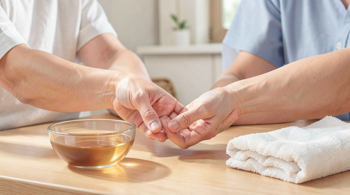
Warm water can make stiff hands feel more comfortable before exercises by warming muscles and tendons. A warm, not hot, soak may be used briefly, followed by slow finger movements. Water temperature should be tested carefully to prevent burns, particularly when sensation is reduced. Heat is generally most relevant to stiffness and tightness, while a visibly swollen or recently aggravated joint may respond differently. 1
Heat should support movement, not replace it. After warming the hands, the fingers can be opened and closed slowly through a comfortable range without forcing a joint into pain. Cold therapy is a separate option for acute swelling or inflammation, with an ice pack wrapped in cloth and applied for a limited period. Direct ice contact can injure skin, and cold should be stopped if numbness or unusual discomfort develops. 4
Try structured finger exercises
Several simple movements are used in arthritis hand-exercise guidance. For a knuckle bend, keep the fingers extended, bend the middle joints while keeping the knuckles straight, and return slowly to the starting position. A gentle fist stretch involves closing the fingers into a relaxed fist without squeezing, then reopening the hand. Mayo Clinic guidance lists five repetitions for knuckle bends and 10 for the gentle fist exercise when tolerated. 2
Other movements include curving the fingers as though holding a can, touching the thumb to each fingertip, and walking each finger toward the thumb while the palm rests on a flat surface. These exercises should be smooth rather than forceful. Pain that increases during or after a movement is a reason to reduce the range, lower repetitions, or pause and seek professional advice. 2
Use tendon glides and thumb mobility
Tendon-gliding exercises move the fingers through several positions to encourage mobility. One sequence starts with straight fingers, forms a hook fist, returns to a straight hand, forms a full fist, returns again, and then forms a straight fist before reopening. The sequence should be performed slowly, with attention to whether a finger catches, locks, or becomes more painful. 3
Thumb movement is also important because the thumb contributes to gripping and fingertip contact. A basic thumb stretch begins with the hand held as though signaling stop, moves the thumb across the palm, and returns it outward. Arthritis UK also describes gentle wrist turns, hand lifts, and hand waves as movements that can involve the surrounding hand and wrist. Starting gradually is recommended for anyone new to exercise. 3
Reduce strain during everyday tasks
Activity modification can reduce the repeated loading that keeps fingers irritated. Typing, texting, cooking, tool use, and prolonged gripping can be divided into shorter periods with regular changes in hand position. Wider handles on pens or utensils may reduce the need for a tight grip. The purpose is not complete rest, which can increase stiffness, but a balance between useful activity and recovery time. 1
Gentle self-massage of the palm, fingers, and forearm may help reduce muscle tension and make movement feel easier, provided pressure remains comfortable. Massage should not be used over an open wound, an acutely injured area, or a joint that becomes increasingly swollen. Exercises and daily movement are generally more useful when practiced consistently and within a tolerable range instead of performed forcefully or sporadically. 4
Safety limits and when to seek care
Home care is not suitable for every stiff hand. Medical evaluation is important when stiffness follows a significant injury, when pain or swelling progressively worsens, or when hand function declines. Numbness, tingling, locking, marked weakness, or difficulty using the fingers can also indicate a problem requiring assessment. Arthritis symptoms can often be managed with nonsurgical approaches, but the appropriate plan depends on the affected joints and underlying condition. 5
People with diagnosed arthritis or another hand condition should ask a healthcare professional before adding new exercises, splints, topical medicines, or intensive heat and cold routines. A night splint may be appropriate for some finger conditions, but an improperly fitted support can restrict movement or cause pressure. Stop any home treatment that produces sharp pain, substantial swelling, skin changes, or symptoms that continue to worsen. 5
Building a practical daily routine
A cautious routine can combine warmth, mobility, and task changes: warm the hands, perform several slow opening and closing movements, practice a tendon-glide sequence, and finish with thumb and fingertip motions. Repetitions should remain comfortable, and the routine can be shortened during a flare. The Mayo Clinic describes several exercises using five repetitions, while other movements should be adjusted according to tolerance rather than treated as a fixed test. 2
Progress should be judged by function, not by forcing a larger stretch. Useful signs include easier finger opening, improved ability to touch the thumb to the fingertips, and less difficulty with ordinary tasks. If stiffness remains persistent or returns despite consistent gentle care, a clinician or physical therapist can help determine whether arthritis, tendon irritation, injury, or another condition is responsible and can tailor movement and support accordingly. 1
Sources
- Hinge Health, “Stiff Fingers? Feel Better With These PT-Approved Tips and Exercises,” https://www.hingehealth.com/resources/articles/stiff-fingers/
- Mayo Clinic, “Hand exercises for people with arthritis,” https://www.mayoclinic.org/diseases-conditions/arthritis/in-depth/arthritis/art-20546847
- Arthritis UK, “Exercises for the fingers, hands and wrists,” https://www.arthritis-uk.org/information-and-support/living-with-arthritis/health-and-wellbeing/exercising-with-arthritis/exercises-for-healthy-joints/exercises-for-the-fingers-hands-and-wrists/
- Verywell Health, “10 Natural Remedies to Relieve Arthritis in Hands,” https://www.verywellhealth.com/natural-remedies-for-arthritis-in-hands-5095949
- Cleveland Clinic, “Arthritis in Hands: Symptoms, Types, Prevention & Treatments,” https://my.clevelandclinic.org/health/diseases/arthritis-in-hands
Authored by MyTrendSpot team