Best local plant nurseries for budget-friendly landscaping: A consumer research guide
The search for the best local plant nurseries for budget-friendly landscaping is primarily a question of regional fit, plant quality, and total ownership cost. The nurseries documented in the research serve distinct markets, including Bucks and Montgomery Counties, San Jose, Denver, Rockford, Modesto, Central Illinois, Northwest Ohio, and San Antonio. Their published information shows that local inventory, climate-adapted plants, soil products, and technical guidance can matter as much as the initial purchase amount.
What distinguishes a local nursery
Independent nurseries commonly organize inventory around local growing conditions rather than a national assortment. Green Acres states that its nursery stock is raised in local soil and selected for regional weather, while Central Wholesale Nursery describes drought-tolerant plants suited to the South Bay climate. Grant Line Garden Center identifies its plants as locally grown and acclimated to the climate in southern Indiana. These descriptions indicate why regional suitability should be assessed before comparing container sizes or plant categories. 1 2 6
| Nursery | Documented location | Relevant landscape focus |
|---|---|---|
| Green Acres | Bucks and Montgomery Counties, Pennsylvania | Zone-hardy nursery plants and landscaping materials |
| Central Wholesale Nursery | San Jose and South Bay, California | Trees, shrubs, Japanese maples, and water-wise plants |
| Platt Hill Nursery | Rockford, Illinois | Trees, shrubs, perennials, annuals, and houseplants |
| California Landscape Supply | Modesto, California | Nursery plants, soil, compost, rock, mulch, and delivery |
Plant selection and long-term cost
Plant selection affects recurring expenses through irrigation, replacement, fertilizer, and maintenance requirements. Central Wholesale Nursery presents native and water-wise plants as options for reducing water use and supporting local habitat, but its guidance also notes that drought-tolerant plants need regular watering during the first one to two growing seasons. The practical implication is that a low-water landscape still requires an establishment plan, and under-watering new plants can create replacement costs. 5
Research guidance from the USDA Natural Resources Conservation Service identifies native plants as useful for reducing long-term maintenance and water needs, while the Lady Bird Johnson Wildflower Center provides regional plant information for matching species to local conditions. A nursery’s plant label should therefore be reviewed for mature size, light exposure, soil tolerance, and water requirements. Choosing a plant that fits the site can reduce later amendments and corrective work. 11 12
Container size, timing, and quantity
Smaller container sizes are a central way to control initial landscaping expenditure, particularly when many shrubs, perennials, or groundcovers are needed. University of Minnesota Extension identifies liners and one-gallon plants as economical choices for larger projects because they can establish and grow in place. The tradeoff is visual scale: smaller plants require more time to create immediate coverage, so project planning should distinguish between installation appearance and mature landscape performance. 13
Seasonal timing also changes the range of plants available and may affect their condition and care requirements. The research identifies late-summer perennial markdown periods as one possible way to reduce project costs, while dormant-season bare-root trees and shrubs are described as an economical format for larger planting areas. These options require attention to planting windows, root protection, watering, and transport. A lower initial amount does not eliminate the labor needed for establishment. 14 15
- Compare one-gallon, larger-container, liner, and bare-root formats for the same plant type.
- Ask whether a plant is appropriate for the current season and local hardiness conditions.
- Estimate the number of plants needed at mature spacing instead of relying only on current pot size.
Nurseries with supplies beyond plants
Several documented businesses combine plant inventory with materials needed to complete a landscape. California Landscape Supply lists an on-site nursery alongside screened topsoil, planter mix, compost, mulch, rock, gravel, sand, base rock, turf, and grass seed, with products available by cubic yard or ton and pickup or delivery options. Jared’s Garden Center similarly lists bagged and bulk soils and mulches, as well as Colorado-hardy plants. These combinations can reduce the logistical burden of sourcing materials from multiple locations. 3 7
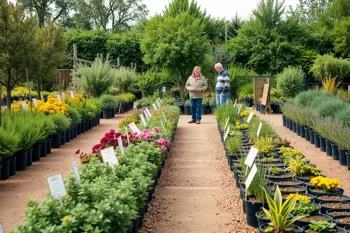
Grant Line offers trees, shrubs, perennials, tropicals, houseplants, garden supplies, and landscape design services across a seven-acre operation with 16 greenhouses. The Village Garden in Central Illinois describes annuals, full-sun perennials, evergreen and flowering shrubs, trees, seeds, vegetable plants, vines, succulents, herbs, and bulbs, along with bulk materials and hardscape selections. Such breadth is useful for comparing plant alternatives, but a larger assortment does not guarantee that every selection fits a specific site. 6 8
Service areas and local comparison points
Location determines transportation time, delivery feasibility, and climate relevance. Central Wholesale Nursery has operated in San Jose since 1974 and serves homeowners, contractors, and landscapers in the South Bay. Black Diamond operates stores in Toledo, Perrysburg, and Waterville and serves Northwest Ohio and Southeast Michigan. Milberger’s serves San Antonio with plants suited to South Texas conditions, including heat-tolerant Mexican heather and esperanza. These examples show that “local” should be defined by growing region, not simply by distance. 2 9 10
A useful comparison records whether the nursery offers regionally hardy plants, bulk soil, delivery, planting advice, landscape design, or warranty coverage. Green Acres states that installation is performed by its own crew and includes a one-year warranty, but that warranty applies to its installation service rather than automatically to every retail plant purchase. Customers should verify conditions, exclusions, watering responsibilities, and service boundaries before treating a warranty as protection against all plant losses. 1
Risks, maintenance, and purchasing safeguards
Plant purchases carry biological and logistical risks that are not visible in a simple price comparison. Plants may fail because of unsuitable light, drainage, hardiness, planting depth, pests, transplant shock, or insufficient establishment watering. The National Institute of Food and Agriculture notes that soil testing through cooperative extension services can prevent unnecessary fertilizer use. This makes testing and site assessment relevant safeguards before purchasing amendments or selecting species for difficult soil conditions. 16
Consumer protections and nursery policies vary by business and jurisdiction, so labels, receipts, plant guarantees, delivery terms, and return rules should be reviewed individually. The American Horticultural Society identifies Master Gardener plant sales as a source of quality inventory at lower retail levels, and the Garden Club of America describes plant swaps as a way to obtain established perennials through community exchange. These alternatives may reduce acquisition costs, but they still require accurate identification and inspection for disease or invasive behavior. 17 18
How to evaluate a nursery objectively
A structured comparison is more reliable than selecting a nursery solely because it has a large display area. First, identify the site’s sun, soil, drainage, hardiness, and water conditions. Next, compare equivalent plant sizes, mature spacing, material quantities, transport requirements, and establishment labor. Finally, check whether staff guidance, design assistance, soil products, delivery, or installation are included or separately charged. Loyalty programs may exist at independent nurseries, but their terms should be treated as optional administrative features rather than a reason to select unsuitable plants. 19
The most defensible choice is the nursery whose documented inventory and services align with the landscape’s actual constraints. A drought-prone San Jose property may require water-wise and native selections, while a Northern Illinois yard may require plants adapted to colder conditions. A Modesto project involving grading or broad planting may depend heavily on bulk soil and aggregate logistics. The comparison should therefore measure expected survival, maintenance, water use, and labor alongside the initial plant amount. 4 5 7
Sources
- Green Acres Nursery, https://www.greenacreslive.com/nursery-garden-center-bucks-county/
- Central Wholesale Nursery, https://centralwholesalenurserysj.com/
- Jared’s Garden Center, https://jaredsgarden.com/garden-center/
- Platt Hill Nursery, https://platthillnursery.com/machesney-park/
- Central Wholesale Nursery Water-Wise Plants, https://centralwholesalenurserysj.com/water-wise-plants-san-jose/
- Grant Line Garden Center, https://www.grantlinegarden.com/
- California Landscape Supply, https://californialandscapesupply.com/modesto/
- The Village Garden, https://thevillagegarden.com/garden-center-illinois/
- Black Diamond, https://www.blackdiamondgrows.com/
- Milberger’s Nursery, https://www.milbergernursery.com/
- USDA Natural Resources Conservation Service, https://www.nrcs.usda.gov/plant-materials/native-plants
- Lady Bird Johnson Wildflower Center, https://www.wildflower.org/collections/
- University of Minnesota Extension, https://extension.umn.edu/planting-and-growing-guides/how-buy-plants
- Better Homes & Gardens, https://www.bhg.com/gardening/design/tips/budget-gardening-tips/
- The Spruce, https://www.thespruce.com/what-are-bare-root-plants-1402273
- National Institute of Food and Agriculture, https://www.nifa.usda.gov/about-nifa/how-we-work/extension
- American Horticultural Society, https://ahsgardening.org/gardening-resources/master-gardeners/
- Garden Club of America, https://www.gcamerica.org/
- HGTV, https://www.hgtv.com/outdoors/gardens/planting-and-maintenance/money-saving-gardening-tips
Authored by MyTrendSpot team