Best organic psoriasis treatment ointments: Evidence, ingredients, and safety considerations
Claims that organic psoriasis treatment ointments can rapidly relieve itching, inflammation, and plaques are common in online skincare advertising. A careful review shows that these products range from moisturizers with limited clinical evidence to branded formulas making unverified speed or cure-like claims, so ingredient quality, evidence, and safety require separate consideration.
What organic means in psoriasis ointments
The word organic describes sourcing or production standards, not necessarily psoriasis treatment effectiveness. In the United States, the term is not strictly defined for every over-the-counter topical product, making USDA Organic certification or credible third-party certification more informative than packaging language alone. Consumers also need to examine full ingredient lists because a product can contain selected organic botanicals while still using a largely conventional base or essential oils that irritate sensitive skin. 1
Many natural psoriasis formulas emphasize the absence of parabens, synthetic fragrance, phthalates, or sulfates. That may matter for people whose skin reacts to particular additives, but avoiding those ingredients does not demonstrate that a product reduces the immune activity underlying psoriasis. Natural formulas should therefore be assessed as symptom-support products unless clinical evidence supports a stronger conclusion. 2
Products making rapid-relief claims
Gotucream’s product page describes a certified organic cream containing herbal ingredients and refers to more than 200 clinical studies, while also claiming noticeable improvement within three days and more complete relief within one week. The supplied product information does not identify those studies as trials of the finished psoriasis cream, so the claim should be treated as manufacturer-reported marketing information rather than independent evidence of effectiveness. 1
Bee venom products make similarly strong claims. Timilk PsoriaSoothe is described as steroid-free and as calming itching in 60 seconds, while Healrize PsorCure presents testimonials reporting relief within seconds and improvement over four weeks. Testimonials can describe individual experiences, but they do not establish how the products perform across different psoriasis types, skin tones, disease severities, or people with allergies. 2 3
Ingredients with the most practical support
Colloidal oatmeal and related oat ingredients are among the more defensible natural choices for dryness, scaling discomfort, and barrier support. A Journal of Drugs in Dermatology study followed 60 adults with sensitive skin and mild to moderate psoriasis who applied a lotion containing oat flour, oat oil, and oat extract with avenanthramides at least once daily for four weeks. Participants reported statistically significant improvements in all self-assessment measures, with no adverse effects reported in that study. 7
Moisturizing ointments can be particularly useful when plaques are thick, cracked, or located on elbows, knees, heels, or other areas where a sealing texture is acceptable. Oat-based products address comfort and moisture loss, but they should not be confused with prescription anti-inflammatory treatment. A product’s texture, fragrance profile, and tolerability often determine whether it can be used consistently enough to provide supportive benefit. 4
Botanical oils and possible irritation
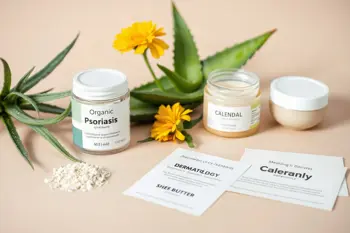
Natural ingredient guides identify aloe vera, coconut oil, olive oil, tea tree oil, turmeric, Oregon grape root, shea butter, and capsaicin as ingredients that may help some people manage dryness, itch, redness, or irritation. The evidence varies substantially, and these ingredients generally serve as complementary symptom measures rather than established replacements for dermatologist-directed therapy. Essential oils are especially important to evaluate cautiously because fragrance compounds can provoke contact dermatitis. 5
A patch test is a sensible screening step before applying a botanical formula to a large plaque area, particularly when it contains tea tree, lavender, chamomile, rosemary, or other concentrated aromatic oils. Seb Skincare, for example, lists those oils alongside MCT oil, squalane, vitamin E, and sunflower oil, and describes its serum as 70% organic. The organic percentage does not remove the possibility of sensitivity to any individual ingredient. 8
How natural ointments compare with medical treatment
Topical treatment commonly begins with creams, ointments, foams, or shampoos applied directly to affected skin. GoodRx’s reviewed clinical overview identifies prescription-strength corticosteroids as the most effective topical treatment for psoriasis and notes that topical vitamin D analogues and other medicines may be used alone or in combination. This distinction is central: a natural ointment may soften scale or reduce tightness, while a medical product targets inflammation and excessive skin-cell growth more directly. 4
The National Psoriasis Foundation describes complementary approaches as potentially useful for symptom management, not as cures for the underlying autoimmune condition. Psoriasis can require more than one treatment approach, especially when plaques are widespread, persistent, painful, or accompanied by possible psoriatic arthritis symptoms. Replacing prescribed therapy without clinical guidance can allow inflammation to continue despite short-term improvement in surface dryness. 6
Safety, regulation, and selection criteria
Regulatory oversight is a major friction point in the organic psoriasis market. Labels such as natural, herbal, or organic may communicate sourcing preferences but do not guarantee standardized potency, finished-product clinical trials, or freedom from allergens. Consumers should look for complete ingredient disclosure, certification details that can be independently verified, batch or manufacturer information, and clear directions. Claims involving rapid plaque removal, permanent correction, or universal suitability warrant particular skepticism. 9
Before using any ointment, the relevant considerations include the location of the psoriasis, plaque thickness, history of allergies, cracked or bleeding skin, and current medicines. Salicylic acid can help loosen scale, but concentrated products may irritate sensitive skin. Natural products can also interact with medicines or complicate another diagnosis, so persistent, severe, infected-looking, or rapidly worsening lesions should be assessed by a dermatologist rather than managed solely with an organic ointment. 10
Sources
- 1. Gotucream, Psoriasis Treatment Cream product information, gotucream.com
- 2. Timilk, PsoriaSoothe Bee Venom Skin-Restoration Cream, timilk.net
- 3. Healrize, PsorCure Targeted Bee Venom Relief Cream, healrize.org
- 4. GoodRx, 10 Best Psoriasis Creams, Ointments, and Lotions, goodrx.com
- 5. Everyday Health, The Best Natural Ingredients for Psoriasis, everydayhealth.com
- 6. National Psoriasis Foundation, Complementary and Alternative Medicine, psoriasis.org
- 7. Journal of Drugs in Dermatology, Open-Label Study of an Oat-Containing Lotion for Sensitive Skin and Psoriasis, jddonline.com
- 8. Seb Skincare, Natural Calming Serum, sebskincare.com
- 9. Consumer Reports, What the Natural Label Really Means, consumerreports.org
- 10. Mayo Clinic, Psoriasis Diagnosis and Treatment, mayoclinic.org
Authored by MyTrendSpot team