Top-rated orthopedic support for chronic joint pain: An evidence-aware consumer report
“Top-rated orthopedic support for chronic joint pain” covers several distinct categories rather than one universally suitable device. The available research includes compression sleeves, hinged braces, osteoarthritis offloader braces, wrist and thumb stabilizers, and foot orthotics, each designed for a different pattern of instability, pressure, swelling, or alignment concern.1
How orthopedic support categories differ
Compression sleeves generally emphasize pressure, warmth, circulation, and proprioceptive awareness, while hinged braces add structural control for ligament instability or excessive rotation. Bauerfeind’s Sports Knee Support, for example, uses 20 to 30 mmHg compression, breathable AirKnit fabric, and an Omega Pad intended to redistribute pressure around the knee.2 Orthogears describes a removable hinge, dual spring reinforcement, gel patella padding, and silicone anti-slip features, placing it in a more stabilizing category than a basic sleeve.3
Offloader braces address a narrower mechanical problem. The Brace Align Comfort Plus is described as using dual valgus and varus adjustment to shift load away from a painful medial or lateral knee compartment, with an adjustable range-of-motion hinge and PDAC codes L1843 and L1851.4 This type of support is not interchangeable with a flexible sleeve because its purpose is alignment and load redistribution, not simply compression or warmth.
Knee support for instability and osteoarthritis
Different chronic knee conditions call for different structural features. The Bauerfeind SofTec Genu is described as using a four-point system, lateral aluminum sidebars, viscoelastic inserts, and hinges that can be locked in 10-degree intervals. Its product information identifies ACL injury, ligament instability, and post-operative recovery as relevant use cases, with PDAC codes L1832 and L1833.5 These specifications indicate a higher-control orthosis rather than an everyday light-support sleeve.
For osteoarthritis, the supplied research emphasizes offloading and fit rather than maximum rigidity. Brace Align lists thigh measurements of 14 to 18 inches for one size and 19 to 27 inches for another, measured six inches above the knee center.4 Such criteria illustrate a practical limitation: an inaccurate measurement can reduce stabilization, create pressure points, or make extended wear uncomfortable. A fitting appointment with a qualified professional is particularly relevant for rigid, hinged, or medical-grade braces.
Foot orthotics and lower-body alignment
Orthotic inserts address support below the painful joint and may be considered when foot posture or overpronation contributes to lower-body strain. Spenco’s Total Support Original uses medium arch support, a deep heel cup, metatarsal support, cushioning, ventilation channels, and a multi-density design intended to control excess inward roll.6 The product information lists foot and leg pain, back and knee pain, Achilles tendinitis, plantar fasciitis, flat feet, and arch pain among associated conditions.
The Total Support Max is described as a more rigid option for serious athletes, with semi-rigid arch support, metatarsal support, and a three-pod modulation system using different hardness levels beneath key areas of the foot.7 Dr. Scholl’s Custom FiT assessment model represents another approach, using an online or kiosk-based assessment to select an insert number.8 The broader research cautions that medical-grade orthotics should be fitted appropriately because poor sizing may cause skin irritation or ineffective stabilization.
Support for wrist, thumb, and other joints
Chronic joint pain is not limited to the knee. The supplied industry research identifies thumb stabilizers from Mueller Sports Medicine as options for basilar joint arthritis and chronic thumb pain, while BraceUP wrist supports are described as combining adjustable compression with splinting to help maintain neutral wrist alignment.9 These devices illustrate how support is selected according to joint motion: a thumb stabilizer may limit painful gripping, while a wrist splint may reduce unwanted bending during work or rest.
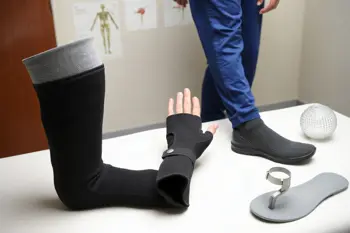
Material and construction affect whether a support can be tolerated throughout the day. The research identifies neoprene as a material associated with heat retention and soothing stiffness, while moisture-wicking and breathable fabrics are commonly incorporated for longer wear during physical activity.10 Bauerfeind’s AirKnit description similarly emphasizes breathability, moisture management, and lightweight construction.2 Heat, perspiration, skin sensitivity, and restricted movement remain practical reasons to reassess a device even when its support mechanism appears appropriate.
Ratings, claims, and regulatory context
“Top-rated” is not a standardized clinical designation in the supplied material. Several product pages use customer ratings or promotional language, including Kyvell’s stated 4.9 out of 5 rating from more than 1,082 customers and RevitaLife’s claim of more than 75,000 senior customers, but these figures are seller-reported and do not establish comparative clinical effectiveness.11 Customer testimonials can describe comfort or perceived relief, yet they do not replace controlled medical evaluation.
Regulatory and reimbursement references also require careful interpretation. Relevo’s page states that its brace is FDA cleared, while Brace Direct identifies PDAC-approved billing codes for selected Bauerfeind and Brace Align products.12 These labels describe clearance or coding status, not a guarantee that a brace will relieve an individual’s pain or qualify for insurance coverage. Eligibility can depend on diagnosis, documentation, clinician recommendation, payer rules, and correct fitting.
Risks, maintenance, and selection criteria
Support devices can create problems when they are too tight, poorly aligned, worn for unsuitable activities, or used instead of evaluating a worsening condition. Potential friction points include skin irritation, heat buildup, slipping, restricted range of motion, and ineffective stabilization. The research specifically emphasizes professional fitting for medical-grade orthotics and reports adjustable fitting assistance for selected braces.8 A device should therefore be assessed by purpose, joint involved, required motion control, measurement method, and tolerance during routine use.
Maintenance expectations vary by design. Flexible sleeves require attention to fabric stretch, moisture, odor, and anti-slip performance, while hinged braces require inspection of straps, hinges, pads, and alignment settings. Insoles must remain compatible with the shoe and activity for which they were selected. The most defensible comparison is therefore not a single ranking, but a match between condition and mechanism: compression for lighter support, hinges for instability, offloading for compartment-specific osteoarthritis, and orthotics when foot alignment is part of the concern.2
Practical comparison framework
| Support type | Primary design emphasis | Key consideration |
|---|---|---|
| Compression sleeve | Pressure, warmth, circulation, and flexible support | Breathability, sizing, and slippage |
| Hinged brace | Rotation control and ligament stabilization | Range-of-motion settings and fitting |
| Offloader brace | Valgus or varus load redistribution | Compartment-specific diagnosis and measurement |
| Orthotic insole | Arch support, pronation control, and cushioning | Shoe compatibility and gradual tolerance |
Across the supplied research, the strongest selection principle is specificity. A breathable sleeve may suit someone seeking flexible everyday compression, while an offloader or rigid hinged orthosis is designed for more defined mechanical problems. Insoles may influence the foot and lower-body chain, but they are not substitutes for a brace when direct joint stabilization is required. Claims should be separated from verifiable specifications, and professional assessment remains important when pain is persistent, function is declining, or a device causes new symptoms.4
Sources
- Bauerfeind Sports Knee Support, https://www.bauerfeind.us/knee-brace-sports-knee-support-rivera-l/
- Orthogears Knee Brace for Pain Relief, https://orthogears.com/products/orthogears-knee-brace-for-pain-relief-2
- Brace Direct Brace Align Comfort Plus, https://bracedirect.com/products/brace-align-comfort-plus-dual-adjustment-oa-knee-brace-for-osteoarthritis-valgus-varus-offloading-rom-hinge-pdac-l1843-l1851
- Brace Direct Bauerfeind SofTec Genu, https://bracedirect.com/products/bauerfeind-softec-genu-knee-brace-multifunctional-knee-brace-for-acl-and-ligament-instability
- Spenco Total Support Original Insole, https://spenco.com/products/total-support-original-insole
- Spenco Total Support Max Insole, https://spenco.com/collections/all-products/products/total-support-max-insole
- Dr. Scholl’s Custom FiT Orthotics, https://www.drscholls.com/products/custom-fit-orthotics
- Mueller Sports Medicine and BraceUP information, https://www.muellersportsmed.com and https://www.braceup.com
- General orthopedic support research from the supplied industry sources
- Relevo Advanced Knee Brace, https://tryrelevo.com/products/advanced-relieflex-knee-brace-that-moves-with-you-pain-relief-in-minutes
- Kyvell Ultra Knee Elite and RevitaLife Knee Sleeve Elite product information
- Healthline, WebMD, Verywell Health, and Arthritis Foundation guidance cited in the supplied research
Authored by MyTrendSpot team