Police auction warehouse equipment: An evidence-based guide to public sales
What police warehouse auctions include
Police departments and related public agencies may release equipment that is seized, abandoned, retired, or no longer required for departmental use. The category can extend beyond warehouse machinery to vehicles, cameras, lawn equipment, police supplies, furniture, tools, trailers, and industrial assets. A Miramar surplus auction, for example, listed police interceptors, a Chevrolet Tahoe, Nikon cameras, a school bus, chainsaws, tires, and a personal watercraft. The listing was conducted virtually through Bidera as part of a multi-city surplus effort. 3
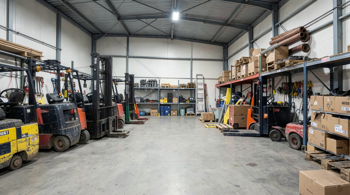
Warehouse-specific examples are documented in a Charlotte, North Carolina auction that included Raymond swing-reach turret trucks, order-picker forklifts, electric walkie-rider pallet jacks, a Toyota reach truck, battery chargers, rolling ladders, packaging systems, case sealers, band sealers, and engraving machines. Such catalogs demonstrate that the phrase warehouse equipment can describe both material-handling assets and production or packaging machinery. Equipment condition, completeness, and operating status still require separate verification for each lot. 9
Where public listings may appear
Public agencies use several distribution models rather than one universal police-auction system. Research identifies GovDeals, PropertyRoom, Public Surplus, GSA Auctions, Bid4Assets, and Municibid as platforms used by government or law-enforcement entities for surplus, seized, or forfeited property. Local departments may also publish notices on municipal websites or transfer responsibility to a private auction company. The platform, seller, and governing jurisdiction determine registration, bidding, payment, title, and removal requirements. 10
Private auction houses can manage bulky equipment that is difficult for a police department to process directly. Powell Auction and Realty described online-only police seizure and equipment sales that accepted farm equipment, construction equipment, tractors, skid steers, trailers, trucks, vehicles, landscaping equipment, ATVs, tools, generators, compressors, welders, and other heavy equipment. The documented Knoxville events used an equipment building for preview and collection, showing how third-party facilities can support specialized public-property liquidation. 2
Documented auction formats and schedules
Formats range from appointment-based municipal bidding to timed online auctions and in-person public sales. Minneapolis published a notice for a bicycle auction on September 17, 2026, with viewing at 4 p.m. and bidding at 6 p.m., followed by a general merchandise auction on October 8 at the same times. The stated location was the Minneapolis Police Property Warehouse at 3100 N. 2nd Street. The notice directed prospective participants toward in-person inspection and later online photographs. 1
Powell’s April 2026 event scheduled preview at its Knoxville equipment building from 1 p.m. to 4 p.m., with lots closing online from 7 p.m. and pickup on a later weekday. Its May event used the same online closing structure, with preview on May 29 and pickup on June 1. The Charlotte auction likewise separated inspection from bidding and prohibited removal on auction day. These schedules make timing a material part of participation, especially for large machinery. 4 2 9
Registration, payment, and bidder conditions
Bidder eligibility and payment terms vary by agency and auctioneer. Minneapolis required cash or local checks and a Minnesota identification card or driver license, with all sales final and items sold as-is. Jackson Township notices required payment within five days of auction close or the item could be relisted. These conditions illustrate why registration, identity verification, acceptable payment methods, title status, and payment deadlines should be reviewed before bidding rather than assumed from another auction. 1 6
Online events may add buyer premiums and taxes to the winning bid. Powell stated a 15 percent buyer’s premium, sales tax, third-party shipping availability, and no credit or debit card acceptance for its April event. Its May event also specified a 15 percent premium and added sales tax. Miramar reported a 13 percent buyer’s premium, while CLT Auctions listed an 18 percent premium and accepted wire transfer or Zelle. These percentages are event-specific, not general market rates. 4 2 3 9
Inspection, condition, and removal risks
As-is terms transfer substantial uncertainty to the bidder. The Miramar report stated that the working condition of several Nikon cameras was unknown, while the Minneapolis notice required inspection during viewing and declared all sales final. A Jackson Township vehicle notice described a 2005 Ford F-150 with 187,960 miles that ran but had no brakes and carried a salvage title. These examples show why photographs, brief descriptions, and visible operation do not establish complete mechanical, electrical, or legal condition. 3 1 6
Removal is another major friction point for warehouse equipment. CLT Auctions stated that no forklift would be onsite, although pallet jacks, loading docks, and a ramp were available. Its removal deadline was firm and spread across several weekdays. Powell identified third-party shipping as an available route, while general surplus guidance identifies freight and shipping arrangements as the winning bidder’s responsibility. Heavy equipment therefore requires advance planning for labor, loading capability, transport, insurance, and storage. 9 2 10
Oversight and due-diligence considerations
Government surplus auctions are intended to create a transparent process for disposing of taxpayer-funded or publicly held assets, but transparency does not remove transaction risk. Buyers should distinguish police surplus from seized property, forfeited property, abandoned property, and ordinary departmental surplus because ownership history, title documentation, restrictions, and release authority may differ. The source material also includes international examples, such as a Pakistan police auction of scrap and vehicle parts and a Kenya National Police Service sale on an as-is-where-is basis. 10 7 8
A practical review should confirm the issuing agency, auctioneer license where applicable, lot description, inspection access, payment deadline, buyer premium, taxes, title or bill-of-sale status, removal window, and equipment limitations. Caseyville, Illinois, for example, listed chairs, tables, desks, cabinets, printers, monitors, gun lock boxes, prisoner cages, phones, a speed sign, workout machines, car parts, and police equipment through a local bidding process. The range of assets reinforces that warehouse equipment may be sold individually, in lots, or alongside unrelated property. 5
Sources
- NoticeRegistry, Minneapolis Police Property Warehouse auction notice
- Powell Auction and Realty, May 30, 2026 police seizure and equipment auction
- Miramar News, surplus vehicles and equipment auction report
- Powell Auction and Realty, April 25, 2026 police seizure and equipment auction
- Village of Caseyville, Illinois, police department surplus property notice
- Jackson Township, Police and Fire GovDeals auction notice
- Daily Tender Alert, Peshawar police scrap and vehicle-parts auction
- TenderYetu, Kenya National Police Service GSU auction notice
- CLT Auctions, high-bay warehouse equipment auction
- Government surplus and auction platform research sources, including GovDeals, PropertyRoom, Public Surplus, GSA Auctions, Bid4Assets, Municibid, California Surplus, and Texas Surplus Property
Authored by MyTrendSpot team