Natural remedies for mouth ulcers: Evidence, safety, and practical guidance
Natural remedies for mouth ulcers include saltwater rinses, honey, aloe vera, coconut oil, baking soda, and selected herbal preparations. Most minor ulcers are self-limiting, but home measures should be viewed as supportive care rather than guaranteed cures, particularly when sores recur, become unusually painful, or persist beyond the expected healing period. 1
What mouth ulcers are and why they occur
Mouth ulcers, also called canker sores or recurrent aphthous stomatitis, are painful lesions affecting the inner cheeks, lips, tongue, gums, or other oral mucosa. They are generally non-contagious and may have a white or yellow center surrounded by redness. Reported triggers include cheek biting, aggressive brushing, stress, hormonal changes, food sensitivities, and deficiencies involving vitamin B12, iron, folate, or zinc. 2
The underlying cause is often multifactorial rather than a single infection. Reviews identify genetic predisposition, nutritional deficiencies, trauma, stress, immune disorders, and microbial factors as possible contributors. Associated conditions may include celiac disease and Crohn’s disease, so repeated episodes should not automatically be attributed to diet or poor oral hygiene alone. 3
Rinses and simple protective measures
A warm saltwater rinse is among the most commonly described home measures. A typical preparation uses one teaspoon of salt in a glass of warm water, followed by rinsing for about 30 seconds and spitting it out. Saltwater may help cleanse the area, reduce irritation, and soothe inflammation, although it does not remove every possible cause of recurrent ulcers. 4
- Maintain hydration to reduce oral dryness and discomfort. 5
- Avoid spicy or acidic foods while the ulcer is tender. 6
- Use a soft toothbrush and avoid brushing directly over the lesion.
- Do not swallow saltwater or any antiseptic rinse.
Topical natural ingredients
Honey has been described as a soothing barrier with antibacterial and anti-inflammatory properties, and reports associate topical use with reductions in ulcer size, pain, and redness. Aloe vera gel is also discussed as a potentially useful topical agent because of reported healing and anti-inflammatory effects. Any preparation placed in the mouth should be intended for oral use, and irritation or allergy is a reason to stop using it. 7
Coconut oil is another commonly mentioned topical option, with proposed antimicrobial and anti-inflammatory effects that may reduce discomfort. Baking soda mixed with a small amount of water can form a paste that may neutralize acids and reduce irritation. Clove oil contains eugenol, a compound associated with local pain-relieving effects, but concentrated essential oils can irritate oral tissue and should not be applied undiluted or swallowed. 8
Herbal preparations and the strength of evidence
A 2026 review examined plants including Hibiscus rosa-sinensis, Glycyrrhiza glabra, Psidium guajava, Aloe vera, Curcuma longa, and Azadirachta indica. The review described anti-inflammatory, antimicrobial, antioxidant, and wound-healing properties, but its conclusions also draw on in vitro and in vivo research, which does not establish that every preparation is effective for people. Formulation, concentration, treatment duration, and product quality can substantially affect results. 9
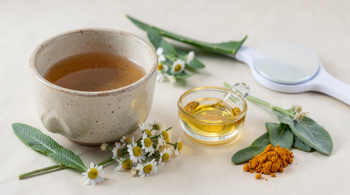
A separate review of recurrent aphthous stomatitis discussed aloe vera, green tea, and echinacea as promising herbal approaches with proposed anti-inflammatory, antimicrobial, and immunomodulatory actions. It emphasized the need for further confirmation of efficacy and safety. Sage and chamomile are also used traditionally for mouth and throat irritation, but traditional use should not be confused with consistent clinical proof or a substitute for diagnosis. 10
What recent clinical research indicates
A randomized clinical trial evaluated a Psidium guajava-based herbal gel for recurrent aphthous stomatitis. The study reflects growing interest in mucoadhesive or plant-based gels that remain in contact with oral tissue, but a single trial cannot establish universal effectiveness. Results may depend on the gel formulation, participant characteristics, ulcer type, and comparison treatment, making independent replication important before broad conclusions are drawn. 11
Another randomized trial compared placental extract gel with curcumin gel in 30 participants, assigning 15 people to each group. Ulcer size and pain were assessed at baseline, day three, and day seven, while recurrence was monitored at one, two, three, and six months. The small sample and focused clinical setting limit how confidently the findings can be generalized to all mouth ulcers. 12
Safety, limitations, and when to seek care
Natural does not mean risk-free. Concentrated clove oil, poorly prepared herbal products, contaminated gels, and excessive use of acidic or abrasive substances may worsen mucosal injury. Diluted hydrogen peroxide has been described as an antiseptic rinse, but it must not be swallowed and can irritate tissue if used too strongly or too often. Herbal products may also vary in composition, labeling, and quality control. 13
- Seek dental or medical assessment when an ulcer lasts longer than two weeks. 14
- Professional advice is appropriate for unusually large, severe, or frequently recurring ulcers.
- Repeated ulcers may warrant evaluation for nutritional deficiency or an associated health condition.
- Persistent or atypical lesions should not be treated indefinitely with home remedies alone.
How to use a cautious home-care approach
A practical approach is to protect the sore from friction, maintain hydration, choose soft non-acidic foods, and use a gentle saltwater rinse if it feels soothing. One topical remedy should be tried at a time so that irritation or allergy can be recognized. Pain relief and reduced inflammation may occur without faster healing, and no remedy described in the available research guarantees overnight recovery or prevents recurrence. 15
Evidence is strongest for avoiding aggravating triggers and supporting normal healing, while evidence for many herbal substances remains preliminary or formulation-specific. Clinical research on guava, curcumin, aloe vera, green tea, echinacea, and other botanicals is promising but uneven. Medical or dental assessment remains the appropriate route when symptoms fall outside the usual short-lived pattern or interfere substantially with eating, drinking, or speaking. 16
Sources
- WM Dentistry Blog, “How to Cure Mouth Ulcers Fast: Natural Remedies That Work”
- Kailash Hospital, “12 Best Home Remedies for Mouth Ulcers”
- Journal of Pharmacognosy and Phytochemistry, “Herbal remedies and natural approaches for the treatment of mouth ulcers: A review”
- Healthline, “How to Get Rid of Canker Sores”
- iHerb Wellness Hub, “Get Rid Of Canker Sores Fast: Natural Remedies That Work”
- American Academy of Oral Medicine, “Canker Sores”
- Medical News Today, “Honey and Mouth Ulcers”
- Verywell Health, “Canker Sore Remedies”
- Pharmacognosy Research, “Herbal Formulations in the Management of Recurrent Aphthous Stomatitis: A Comprehensive Review”
- Mount Sinai and National Center for Complementary and Integrative Health, information on sage and chamomile
- Pakistan Journal of Medical Sciences, “Clinical efficacy of Psidium guajava-based Herbal gel in the management of recurrent aphthous stomatitis”
- Frontiers in Dental Medicine, “Comparison of the efficacy of placental extract gel vs. curcumin gel in the treatment of oral aphthous ulcer”
- National Health Service, “Mouth ulcers”
- Inshorts, “Mouth ulcers: 5 simple home remedies for quick relief”
- Cleveland Clinic, “How to Get Rid of a Canker Sore”
- Scientific Reports, “Mucoadhesive Moringa Oleifera gel: nutraceutical with higher residence time for oral ulcer management”
Authored by MyTrendSpot team