Top Coastal Rail Routes in the United States: A Data-Driven Guide to Scenic Train Travel by Sea
Coastal rail routes in the United States have experienced a notable resurgence in public interest, driven by growing concerns about airline delays and highway congestion. The AARP 2026 Travel Trends survey found that travelers aged 50-plus are increasingly worried about airline complications, and Amtrak has reported a record increase in passenger numbers across multiple corridors. 1 From the Pacific cliffs of California to the salt marshes of New England, these routes collectively represent some of the most geographically diverse train journeys available anywhere in North America.
Pacific Surfliner: California's Premier Coastal Corridor
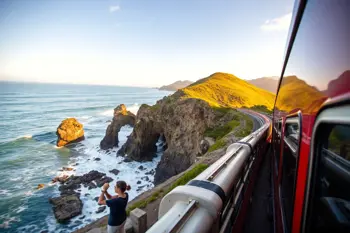
Amtrak's Pacific Surfliner is widely regarded as the most scenic state-supported intercity passenger rail service in the United States. The route covers 351 miles between San Diego in the south and San Luis Obispo in the north, passing through Los Angeles, Ventura, and Santa Barbara along the way. 2 The full end-to-end journey takes approximately nine hours, though the majority of daily travelers ride shorter segments, particularly the heavily used Los Angeles to San Diego corridor. The service operates 26 trains per day with a ridership of approximately three million, making it the second busiest intercity rail corridor in the country. 3
The Surfliner serves 29 stations across six counties and earned a spot on Amtrak's own list of the four most scenic train routes nationally. 4 Roughly half of the 351-mile route runs directly adjacent to the Pacific Ocean, with the most photogenic stretches documented between Oceanside and San Clemente, and again between Ventura and Grover Beach. 5 The route offers coach and business-class seating, Wi-Fi, and a cafe car, though planners should note the popular service can be crowded, particularly on weekends and holidays. Ticket prices have been reported starting at $36 for shorter segments, though fares vary significantly by date and seat class. 6
Coast Starlight: The Long-Distance Pacific Journey
The Amtrak Coast Starlight operates daily between Seattle's King Street Station and Los Angeles Union Station, covering 1,377 miles through Washington, Oregon, and California. 7 The full journey takes approximately 34 to 35 hours and has run continuously since Amtrak's formation in 1971, making it one of the oldest long-distance services in the national network. Key stops include Tacoma, Portland, Eugene, Klamath Falls, Sacramento, the San Francisco Bay Area, San Luis Obispo, and Santa Barbara. The route passes through some of the most geographically varied terrain on the continent, including Puget Sound, the Cascade Range, Mount Shasta, California's Central Valley, and extended stretches of Pacific coastline.
A defining feature of the Coast Starlight is its Superliner Sightseer Lounge, which provides floor-to-ceiling windows and skylights for panoramic viewing. 8 The route also includes a notable segment through restricted coastal areas of Vandenberg Space Force Base, where no public roads exist, giving passengers access to pristine shoreline that is inaccessible by car or highway. 9 The train offers both coach seating and private Superliner Roomette or Bedroom accommodations for overnight riders. Travelers should account for the route's documented susceptibility to delays, a characteristic common to long-distance Amtrak services that share freight rail infrastructure.
Amtrak Cascades: Pacific Northwest Coastal Access
The Amtrak Cascades route serves the Pacific Northwest, connecting Eugene, Oregon to Vancouver, Canada, with intermediate stops in Portland, Seattle, and Tacoma. The corridor provides access to Puget Sound and near-coastal terrain through Washington State, offering views that differ markedly from the arid California coastline farther south. 10 Travel writers and reviewers have specifically noted the Puget Sound segments as among the most visually striking portions of any Amtrak service on the West Coast, with the train running at the water's edge along portions of the Washington segment.
The Cascades corridor is one of the more reliable Amtrak routes in terms of frequency, with multiple daily departures in each direction on the busier Seattle-Portland segment. The service is state-supported by both Oregon and Washington, which contributes to more consistent scheduling compared to some purely federally managed long-distance routes. Riders should note that the international Vancouver extension requires appropriate travel documentation, and cross-border segments may add processing time at customs checkpoints.
Northeast Regional and Downeaster: The Atlantic Coast Network
Amtrak's Northeast Regional is the busiest train route in the national system, carrying over 12 million passengers annually along the East Coast corridor from Virginia to Boston, Massachusetts. 11 While primarily an urban connector linking Washington, D.C., Philadelphia, New York City, and Boston, the route offers coastal proximity through significant portions of Connecticut and Rhode Island, where the tracks run near Long Island Sound and Narragansett Bay. As of the 2025 to 2026 fiscal year, the trunk line from Boston to Washington met the Federal Railroad Administration's minimum standard of 80% on-time performance for two consecutive quarters. 12
Further north, the Amtrak Downeaster connects Boston to Brunswick, Maine, covering approximately 116 miles along a corridor that passes through the salt marshes of New Hampshire and the rocky coastal inlets of Maine. 13 The service operates five round-trips daily and functions more like a European regional rail line than a traditional long-distance Amtrak service, with closely spaced stops in coastal communities including Wells, Saco, and Old Orchard Beach. The Downeaster is operated in partnership with the Northern New England Passenger Rail Authority and is frequently cited for its car-free access to communities where the train station remains the historic center of town.
Alaska Railroad Coastal Classic and Gulf Coast Expansion
Outside the contiguous 48 states, the Alaska Railroad's Coastal Classic route from Anchorage to Seward is consistently identified by travel professionals as one of the most scenically extraordinary rail journeys in the country. The four-hour trip traverses the Kenai Peninsula, passing glaciers, waterfalls, bald eagles, mountain goats, and moose before arriving at Resurrection Bay on the Gulf of Alaska. 14 Unlike most Amtrak routes, the Alaska Railroad operates its own infrastructure and includes open-air terrace viewing cars during summer service. Travel advisors consistently recommend the summer months, particularly during the midnight sun period, for maximum daylight viewing hours.
On the Gulf Coast, Amtrak launched new Mardi Gras Service connecting New Orleans and Mobile, Alabama, with twice-daily frequencies. 15 The route includes stops in Bay Saint Louis, Biloxi, Gulfport, and Pascagoula in Mississippi, opening coastal destinations that previously lacked direct passenger rail access. The new service integrates with Amtrak's wider national network at New Orleans, enabling connections from Chicago, Los Angeles, and New York without requiring road transportation for the final coastal segment.
Practical Considerations and Service Limitations
While coastal rail travel in the United States offers compelling scenery and urban connectivity, prospective passengers should understand several structural limitations before planning itineraries. Long-distance Amtrak routes, including the Coast Starlight and Palmetto, share track infrastructure with freight operators, which is a documented primary cause of schedule delays. Passenger reviews across multiple routes consistently mention outdated train cars and inconsistent dining car quality on overnight services. The Palmetto, which connects Savannah, Georgia to New York City along the Atlantic coastline, operates only three times weekly, significantly limiting scheduling flexibility compared to the daily or multiple-daily West Coast services. 16
Florida presents a distinct coastal rail landscape. Tri-Rail operates 18 weekday stations between Miami and West Palm Beach along the southeastern Atlantic Coast, functioning as a commuter service rather than a scenic long-distance route. 17 Brightline, a privately operated intercity rail service, connects Miami and West Palm Beach with planned expansion toward Orlando, offering a higher-frequency alternative for Florida coastal travelers. Caltrain provides coastal rail access in the San Francisco Bay Area between San Jose and San Francisco, serving as a regional connector that supplements the longer-distance Pacific Surfliner and Coast Starlight services. Each of these regional operators functions under distinct fare structures, eligibility rules, and schedules that should be confirmed directly with the operating agency before travel.
Sources
- AARP Travel Trends Survey 2026 – aarp.org
- Travel + Leisure, Pacific Surfliner Guide – travelandleisure.com
- TripReporter, Pacific Surfliner Coastal Train – tripreporter.co.uk
- PlanetWare, Amtrak Pacific Surfliner Scenic Route – planetware.com
- Islands.com, Best Stops Along the Pacific Surfliner – islands.com
- Democratic Voice USA, California Train Line Named Most Beautiful – democraticvoiceusa.com
- MetroEasy, Amtrak Coast Starlight Route and Stations – metroeasy.com
- The Travel, Amtrak Coast Starlight Cruise on Land – thetravel.com
- The Travel, Coast Starlight Ocean Views – thetravel.com
- Amtrak, Cascades Train Route – amtrak.com
- Explore.com, Northeast Regional East Coast Cities – explore.com
- Explore.com, Northeast Regional On-Time Performance – explore.com
- Northern New England Passenger Rail Authority, Downeaster Route – amtrakdowneaster.com
- Travel + Leisure, Alaska Railroad Coastal Classic – travelandleisure.com
- Travel and Tour World, Amtrak Mardi Gras Gulf Coast Service – travelandtourworld.com
- Amtrak, Palmetto Train Route – amtrak.com
- Tri-Rail, Miami to West Palm Beach Service – tri-rail.com
Authored by MyTrendSpot team