Warning Signs of Osteoporosis: Clinical Evidence and Screening Guidance
The warning signs of osteoporosis are often subtle because the disease may develop without noticeable symptoms for years. A fracture, loss of height, persistent back pain, or a stooped posture can provide important clues, although testing is needed to determine whether bone density is reduced. 1
Why osteoporosis is called a silent disease
Osteoporosis occurs when bone breakdown happens faster than new bone formation, leaving bones thinner, weaker, and more likely to break. Early osteoporosis usually does not cause pain or visible changes, so many people learn they have it only after a screening test or a fracture. This lack of early symptoms is why osteoporosis is commonly described as a silent disease. 2
The condition is not limited to one part of the skeleton. The hip, spine, and wrist are among the most commonly affected areas, and fractures may occur after a fall, a minor injury, or ordinary physical stress that would not typically damage healthy bone. A fracture from a low-impact event should therefore be medically assessed as a possible sign of reduced bone strength. 3
Fractures that may signal weakened bones
A fracture after falling from standing height or less is often called a fragility fracture and can be an important warning sign. The wrist, hip, spine, shoulder, pelvis, and ribs may be involved. A fracture does not prove that osteoporosis is present, but a low-impact break should prompt consideration of bone-density evaluation and other causes of skeletal weakness. 4
Hip fractures are particularly serious because they can impair mobility and independence and may require surgery, rehabilitation, or long-term supportive care. Spinal fractures can occur gradually or after modest strain, sometimes producing sudden pain and functional limitations. The absence of a dramatic accident does not rule out a meaningful fracture, especially in an older adult or someone with recognized risk factors. 5
Height loss and posture changes
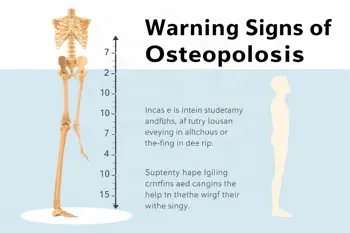
A noticeable reduction in height over time may reflect compression fractures in the vertebrae. Penn Medicine identifies getting shorter as a possible sign, while other clinical guidance describes a loss of about 1.5 inches, or 3.8 centimeters, as particularly concerning. Height can also change for reasons unrelated to osteoporosis, so the finding requires clinical context rather than self-diagnosis. 6
A forward curve of the upper back, known as kyphosis, may develop when weakened vertebrae collapse. This can create a hunched or stooped appearance and may occur together with chronic back pain. Severe spinal curvature can affect physical function, and spinal compression may reduce the room available for normal chest expansion. 7
Back pain and vertebral compression
Sudden or persistent back pain can result from a fractured or collapsed vertebra. Pain may begin abruptly, worsen with movement, or continue as small spinal fractures accumulate. Early osteoporosis itself is not usually painful, which means new back pain is more relevant as a possible consequence of bone fragility than as a symptom of uncomplicated early bone loss. 8
Vertebral compression fractures are not always recognized immediately. Some cause mild symptoms or are found incidentally on imaging, while others produce substantial pain, height loss, and posture changes. A healthcare professional may consider the history of the pain, physical findings, imaging, and bone-density results when determining whether a spinal fracture has occurred. 9
Risk factors that can exist before symptoms
Risk rises with older age, female sex after menopause, a family history of hip fracture, low body weight, smoking, heavy alcohol use, and prolonged corticosteroid treatment. These factors do not establish a diagnosis, but they increase the importance of discussing bone health with a clinician, particularly when combined with a fracture, height loss, or new back pain. 10
Men can also develop osteoporosis, especially at older ages or when medical conditions and medicines affect bone remodeling. Osteopenia, which refers to bone density below the expected healthy range but not low enough for an osteoporosis diagnosis, may precede osteoporosis. Identifying reduced density can help clinicians assess fracture risk and determine whether monitoring or treatment is appropriate. 11
How osteoporosis is detected
The standard test for measuring bone mineral density is dual-energy X-ray absorptiometry, commonly called a DXA or DEXA scan. It is generally used to assess the lumbar spine, hip, and femoral neck. The procedure is brief and uses substantially less radiation than a standard chest X-ray, while providing measurements used to estimate bone strength and fracture risk. 12
Screening recommendations depend on age, sex, menopausal status, and individual risk. The U.S. Preventive Services Task Force recommends screening women aged 65 years or older and younger postmenopausal women whose risk is increased. A clinician may also evaluate someone of any age after a low-impact fracture, marked height loss, unexplained spinal pain, or prolonged exposure to corticosteroids. 13
Sources
- Penn Medicine, Osteoporosis: Symptoms and Causes, https://www.pennmedicine.org/conditions/osteoporosis
- National Institute of Arthritis and Musculoskeletal and Skin Diseases, Osteoporosis, https://www.niams.nih.gov/health-topics/osteoporosis
- MedlinePlus, Osteoporosis, https://medlineplus.gov/osteoporosis.html
- Cleveland Clinic, Osteoporosis, https://my.clevelandclinic.org/health/diseases/4443-osteoporosis
- Bone Health and Osteoporosis Foundation, Diagnosis Information, https://www.bonehealthandosteoporosis.org/patients/diagnosis-information/diagnosis/
- GoodRx, What Are the Early Signs of Osteoporosis?, https://www.goodrx.com/conditions/osteoporosis/what-are-the-early-signs-of-osteoporosis
- The Well by Northwell, The Signs of Osteoporosis, https://thewell.northwell.edu/joint-health-orthopedics/osteoporosis-bone-attack-open-letter
- Mayo Clinic, Osteoporosis Symptoms and Causes, https://www.mayoclinic.org/diseases-conditions/osteoporosis/symptoms-causes/syc-20351968
- Johns Hopkins Medicine, Osteoporosis, https://www.hopkinsmedicine.org/health/conditions-and-diseases/osteoporosis
- American Academy of Orthopaedic Surgeons, Osteoporosis, https://orthoinfo.aaos.org/en/diseases--conditions/osteoporosis/
- Florida Medical Clinic Orlando Health, Early Warning Signs of Osteoporosis, https://www.floridamedicalclinic.com/blog/early-warning-signs-of-osteoporosis/
- Harvard Health, How to Know if Your Bones Are Thinning, https://www.health.harvard.edu/womens-health/how-to-know-if-your-bones-are-thinning
- U.S. Preventive Services Task Force, Osteoporosis Screening, https://www.uspreventiveservicestaskforce.org/uspstf/recommendation/osteoporosis-screening
Authored by MyTrendSpot team