Police impound construction equipment for sale: A buyer's research guide
The phrase police impound construction equipment for sale describes several different public-sale channels, including police seizure auctions, county property sales, court-ordered levies, and municipal surplus auctions. Available machinery may include excavators, graders, dozers, skid steers, tractors, trailers, and related tools, but each event has its own legal basis, inspection rules, payment terms, and removal deadline. Public notices show that equipment is commonly offered without warranties, making the auction documents and lot descriptions essential sources of information. 1
How impounded equipment reaches an auction
Law enforcement and local governments may liquidate property connected with seizures, forfeiture proceedings, abandoned assets, surplus inventories, or court judgments. The stated purpose can include recovering costs, satisfying a judgment, or disposing of equipment no longer needed by a public agency. A West Virginia sheriff's notice, for example, listed Caterpillar haul trucks, a D10N dozer, a water truck, an endloader, and other machinery after property was levied to satisfy a civil judgment. 7
Not every public equipment auction is a police impound event. Mineral County, Montana, separately announced a county property auction involving a 1980 Caterpillar grader, a 1995 Komatsu excavator, a pickup, and other property at county facilities. Corbin, Kentucky, also authorized a surplus and seized-vehicle auction that included public works equipment and a Toro mower. These examples show why the issuing agency, legal notice, and auction organizer must be identified before assuming that a listing involves police seizure. 2 3
Where listings and auction notices appear
Government agencies frequently use third-party auction services and online government-property marketplaces to manage registration, catalogs, bidding, payment, and pickup. Research identifies GovDeals, Public Surplus, Purple Wave, GSA Auctions, Ritchie Bros., IronPlanet, Municibid, EquipmentFacts, and Bid4Assets as platforms associated with government, seized, surplus, or industrial equipment listings. Agency websites and county legal-notice pages remain important because they may publish the governing notice, sale location, inspection schedule, and payment instructions. 10
Specific auction formats vary substantially. Powell Auction and Realty documented an online-only police seizure and equipment auction with lots closing at 7:00 p.m., a preview period at its Knoxville equipment building, and a later pickup date. Kansas City's police tow-lot auction was also online only, while a Mineral County sale used physical county locations for equipment, impounded vehicles, and courthouse property. A notice for Columbus, Ohio, described an in-person impounded-vehicle auction with gates opening before the sale. 1 5 2 9
Equipment categories and lot descriptions
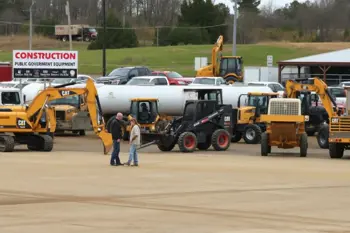
Construction-related lots can range from complete machines to incomplete or specialized assets. The documented examples include excavators, graders, dozers, endloaders, haul trucks, water trucks, trailers, compressors, generators, welders, farm equipment, tractors, attachments, skid steers, landscaping machinery, and shop tools. A public notice may identify only the make, model, and year, while an auction catalog may add photographs, reported condition, title information, or notes about missing components. 1 7
Descriptions must be read literally rather than treated as a mechanical inspection. The West Virginia notice identified a Caterpillar 992G endloader with no bucket and a Caterpillar 777C haul truck with no bed. Kansas City auction terms stated that abandoned vehicles could lack keys, might not run or drive, and were sold as-is, where-is. Comparable uncertainty can affect construction machinery, especially when service records, operating demonstrations, attachments, or complete ownership documents are absent. 7 5
Inspection, title, and condition risks
As-is language transfers significant responsibility to the purchaser. The auction records advise that buyers may receive no express or implied warranty and may have limited knowledge of operating condition before payment. Independent inspection should therefore address visible structural damage, missing attachments, engine or hydraulic condition, tires or tracks, identification plates, and transport requirements. The research also recommends independent title searches and inspection checks because service histories may be incomplete or unavailable. 5
Legal status can differ between an impounded vehicle, seized property, surplus equipment, and property sold under a court order. The sale notice should be reviewed for liens, title delivery, bill-of-sale language, ownership restrictions, and the authority under which the property is being sold. Powell's earlier police seizure terms stated that titled items might not have titles ready until 10 to 14 days after the auction. Jackson Township separately identified a trailer as bill-of-sale property and a truck as having a salvage title. 6 1
Payment, fees, and collection requirements
Payment rules are event-specific and can materially change the total obligation. Powell's documented terms included a 15% buyer's premium and added sales tax, while Miramar's multi-city surplus auction reported a 13% buyer's premium. Mineral County required payment in full by cash, cashier's check, certified check, bank draft, or credit card subject to a 2.5% fee, with identification required. Kansas City's terms warned that late or partial payment could result in forfeiture and an auction ban. 1 4 2 5
Removal is another central obligation because heavy equipment requires suitable trailers, loading machinery, permits, and transport coordination. Mineral County required purchased items to be removed by 5:00 p.m. on June 22, 2026, while the West Virginia notice required equipment movement within 90 days unless an extension was granted. Powell scheduled equipment pickup for a defined weekday and directed buyers to obtain a paid receipt before collection. Storage charges, forfeiture provisions, or access restrictions should be checked in the official terms. 2 7 1
How to evaluate an auction notice
A careful review begins with the issuing authority, sale type, auctioneer, physical location, bidding method, preview schedule, and lot-closing time. The notice should then be compared with the catalog for serial numbers, model details, attachments, title status, photographs, condition statements, and exclusions. Registration may require government-issued identification or other verification, and the bidder should confirm whether shipping is available. Powell identified third-party shipping, while Woolsey's Kansas City listing stated that shipping was not available. 1 5
Records also show why dates must be verified directly with the responsible agency or auction house. Powell's May 30, 2026 event page was marked expired in the supplied record, and several other notices described completed or dated events. A notice may be republished, amended, or separated into multiple sale locations, as occurred in Mineral County. The most reliable review process compares the official notice, auction terms, lot catalog, inspection instructions, payment deadline, and removal deadline rather than relying on a general search result alone. 1 2 9
Sources
- Powell Auction & Realty
- Mineral County, Montana
- The News Journal, Corbin
- Miramar News
- Woolsey Auction and OAI Auctions
- Jackson Township
- West Virginia Daily News
- Tacoma Daily Index
- NoticeRegistry, Columbus public notice
- Government auction platforms identified in the supplied research
Authored by MyTrendSpot team