Understand glaucoma treatment options: A clinical overview
Understanding glaucoma treatment options requires comparing prescription eye drops, laser procedures, and surgery according to glaucoma type, disease severity, target eye pressure, and overall eye health. Treatment cannot restore optic nerve damage or vision already lost, but lowering intraocular pressure can help preserve remaining sight and support long-term independence. 1
How treatment goals are established
Glaucoma treatment primarily targets intraocular pressure, or IOP, because pressure reduction is the only established modifiable factor for slowing further optic nerve damage. The American Academy of Ophthalmology identifies elevated IOP, older age, family history, Black race or Latino or Hispanic ethnicity, diabetes, myopia, thinner central cornea, disc hemorrhage, and larger cup-to-disc ratio among recognized risk factors for primary open-angle glaucoma. 1
- Target pressure is individualized rather than set at one universal number.
- More advanced optic nerve damage generally requires a lower pressure target.
- Follow-up commonly evaluates pressure, optic nerve structure, and visual function.
Prescription eye drops and medicines
Topical medicines remain a central treatment approach, with prostaglandin analogs widely described as a cornerstone or common first choice. Other prescription categories include beta-blockers, alpha-adrenergic agonists, and carbonic anhydrase inhibitors. These medicines either reduce aqueous fluid production or improve its movement out of the eye. Fixed-combination drops can combine more than one mechanism when a single medicine does not achieve the intended pressure reduction. 2
- Daily adherence is important because glaucoma may progress without noticeable symptoms.
- Incorrect drop use can reduce treatment effectiveness and allow pressure to rise.
- Oral carbonic anhydrase inhibitors may be used when drops are insufficient, but systemic side effects can be more significant.
Selective laser trabeculoplasty
Selective laser trabeculoplasty, or SLT, uses focused laser energy on the trabecular meshwork, the eye's principal drainage system. Improving aqueous fluid outflow can lower IOP in suitable cases of open-angle glaucoma. The procedure is generally performed in an ophthalmologist's office, is relatively brief, and usually involves limited recovery compared with incisional surgery. 3
- SLT may be considered as an initial treatment for some people with mild or moderate open-angle glaucoma.
- Evidence summarized by the American Academy of Ophthalmology indicates that SLT can control pressure comparably to drops in appropriate patients.
- Its effectiveness may be limited in advanced disease or when the drainage angle is unsuitable.
Minimally invasive glaucoma surgery
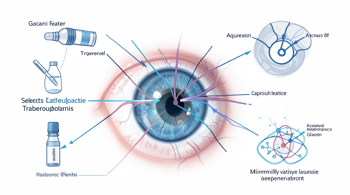
Minimally invasive glaucoma surgery, commonly called MIGS, includes procedures intended to improve fluid drainage through small incisions or devices. MIGS is increasingly used when medication or laser has not provided adequate control, particularly alongside cataract extraction. Compared with traditional filtering operations, MIGS generally emphasizes a less invasive approach and faster recovery, although the achievable pressure reduction may not be sufficient for every patient. 2
- Eligibility depends on glaucoma type, severity, anatomy, previous treatment, and the surgeon's assessment.
- MIGS is not a single operation, so expected benefits and risks vary by technique.
- Patients may still need drops, laser treatment, or additional surgery after MIGS.
Traditional filtering surgery and drainage devices
When pressure remains uncontrolled or glaucoma continues progressing, conventional incisional surgery may be considered. Trabeculectomy creates a new drainage pathway that allows aqueous fluid to bypass resistance in the usual outflow system. Glaucoma drainage devices, including tubes or shunts, divert fluid to an external reservoir under the eye's tissues and may be used in difficult-to-control cases or when other procedures are unsuitable. 5
- Traditional surgery can provide substantial pressure reduction but involves greater surgical complexity than drops or laser.
- Potential complications and recovery requirements must be discussed before treatment.
- Long-term surveillance remains necessary because drainage pathways and implanted devices require clinical monitoring.
Choosing among options and maintaining treatment
Selection is a clinical decision balancing the desired pressure reduction against side effects, procedural risks, adherence demands, cost, lifestyle disruption, and the likelihood of disease progression. The treatment pathway may begin with drops, SLT, or another approach depending on the diagnosis and severity. Reviews of current practice describe prostaglandin analogs, fixed combinations, sustained-delivery approaches, laser treatment, MIGS, and traditional surgery as parts of an increasingly individualized strategy. 2
- Regular tonometry checks pressure, while visual field testing evaluates functional vision.
- Optic nerve examination and imaging help identify structural change over time.
- Sudden eye pain, redness, halos around lights, or abrupt vision changes require urgent medical assessment, especially because angle-closure glaucoma can present differently from open-angle disease.
Risks, limitations, and expectations
Every treatment has limitations. Drops can cause local or systemic adverse effects and depend on consistent use. Laser may not produce enough pressure reduction or may require repeat management. MIGS has a generally less invasive profile but may not achieve the very low target pressure needed in advanced glaucoma. Trabeculectomy and tube surgery can be effective when other methods fail, yet their higher procedural burden makes careful follow-up essential. 5
- No treatment reverses established optic nerve damage.
- Pressure control does not eliminate the need for continued examinations.
- The safest option depends on the glaucoma subtype, disease stage, eye anatomy, general health, and treatment preferences.
Sources
- American Academy of Ophthalmology, Primary Open-Angle Glaucoma Preferred Practice Pattern 2025
- Springer Nature, New trends in the treatment of open-angle glaucoma: a critical review
- Glaucoma Research Foundation, Glaucoma Treatments, Surgeries, and Costs
- American Academy of Ophthalmology, SLT and DSLT Laser Surgeries for Glaucoma
- Ophthalmology Advisor, Glaucoma Surgery
Authored by MyTrendSpot team