Warning Signs of an Aneurysm: Clinical Signals and Emergency Risks Explained
Warning signs of an aneurysm can be difficult to recognize because many aneurysms cause no symptoms until they enlarge, leak, or rupture. A sudden, severe headache, abrupt chest or abdominal pain, fainting, or stroke-like symptoms may indicate a life-threatening complication and require emergency medical assessment.
Why aneurysms may remain unnoticed
An aneurysm is a weakened area in an artery wall that bulges outward. Brain aneurysms are often small and discovered during imaging performed for another condition, while aortic aneurysms may also remain silent until they become large or cause a complication. The absence of symptoms does not establish whether an aneurysm is present or determine its risk of rupture. 1 3
Symptoms depend mainly on the aneurysm’s location, size, growth, and effect on nearby tissue. A large brain aneurysm can press on nerves and produce pain around the eye, vision changes, dizziness, balance problems, facial numbness or weakness, and difficulty concentrating or speaking. These signs can have other causes, so clinical evaluation is needed rather than self-diagnosis. 1 2
Brain aneurysm warning signs
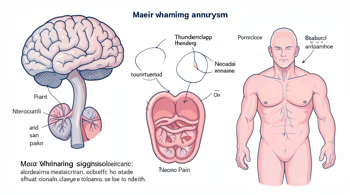
The clearest warning sign of a ruptured brain aneurysm is a sudden, extremely severe headache, often described as a thunderclap headache or the worst headache of a person’s life. A rupture can also cause nausea, vomiting, a stiff neck, sensitivity to light, double vision, seizures, or loss of consciousness because bleeding occurs in or around the brain. 1 2
Emergency neurological symptoms can include facial drooping, weakness or numbness on one side of the body, slurred or confused speech, difficulty finding words, blurred vision, or loss of sight. These symptoms overlap with stroke warning signs, but either condition requires emergency assessment. A person with these symptoms should not drive themselves to an emergency department. 1
Abdominal aortic aneurysm signals
An abdominal aortic aneurysm may cause a deep, persistent pain in the abdomen, side, or back when it enlarges or affects surrounding structures. Some people report a pulsing sensation near the navel, although a sensation or visible movement in the abdomen does not by itself confirm an aneurysm. Many abdominal aneurysms are identified through imaging or screening before symptoms develop. 3 4
A sudden increase in abdominal or back pain, particularly when accompanied by lightheadedness, dizziness, fainting, a rapid heartbeat, clammy skin, or signs of low blood pressure, can indicate rupture and internal bleeding. A ruptured abdominal aortic aneurysm is a medical emergency because blood loss can progress rapidly. Other causes can produce similar symptoms, making urgent professional assessment essential. 3 4
Thoracic aortic aneurysm symptoms
Thoracic aortic aneurysms develop in the portion of the aorta located in the chest. They may remain asymptomatic, but pressure on nearby structures can produce chest or upper-back pain, difficulty breathing or swallowing, a persistent cough, or hoarseness. These symptoms can also result from heart, lung, digestive, or musculoskeletal conditions, so their presence alone does not identify an aneurysm. 4 3
Sudden, intense chest, back, or abdominal pain may signal an aortic dissection or rupture. Pain can be accompanied by dizziness, fainting, a rapid heartbeat, or low blood pressure. Aortic dissection involves a tear in the aortic wall and can progress to rupture, causing severe internal bleeding. Sudden severe pain with collapse or neurological symptoms warrants emergency medical evaluation. 4
Risk factors and clinical context
Risk factors associated with brain aneurysm formation include smoking, high blood pressure, increasing age, and a family history of aneurysms. Harvard Health also identifies being older than 50 and cocaine use as risk factors, while noting that women are more likely than men to develop brain aneurysms. About 20% of people with one brain aneurysm may have at least one additional aneurysm. 5
Smoking and high blood pressure are particularly important modifiable factors because they contribute to blood-vessel damage and pressure-related stress. A family history or certain inherited conditions may influence whether clinicians recommend additional assessment. Risk factors do not prove that an aneurysm exists, and their absence does not eliminate the possibility. Decisions about evaluation depend on personal history, symptoms, and clinical judgment. 5 6
Assessment, monitoring, and treatment decisions
Doctors may use computed tomography, magnetic resonance imaging, ultrasound, CT angiography, or cerebral angiography to investigate suspected aneurysms, depending on the suspected location and clinical circumstances. Brain aneurysms may be monitored when they are small, stable, and not causing symptoms. Aneurysms that present a greater risk may be treated with surgery or minimally invasive endovascular procedures. 2 3 6
Monitoring is not the same as ignoring the condition. Follow-up imaging, blood-pressure management, smoking cessation, and specialist review may form part of ongoing care, while treatment choices depend on size, location, shape, growth, rupture risk, and overall health. Because many aneurysms are silent and ruptures can be sudden, persistent or worsening headaches, pain around the eye, or unexplained chest, back, or abdominal pain should be medically assessed. 1 4 6
Sources
- NHS, Brain aneurysm: https://www.nhs.uk/conditions/brain-aneurysm/
- National Institute of Neurological Disorders and Stroke, Cerebral Aneurysms: https://www.ninds.nih.gov/health-information/disorders/cerebral-aneurysms
- Penn Medicine, Brain Aneurysm and Aneurysm: https://www.pennmedicine.org/conditions/brain-aneurysm
- Scripps Health, Aortic Aneurysms Symptoms, Causes and Treatment: https://www.scripps.org/news_items/7687-what-are-the-warning-signs-and-symptoms-of-an-aortic-aneurysm
- Harvard Health, Intracranial Aneurysms: https://www.health.harvard.edu/brain-health/intracranial-aneurysms-a-to-z
- American Medical Association, What doctors want patients to know about brain aneurysms: https://www.ama-assn.org/public-health/chronic-diseases/what-doctors-want-patients-know-about-brain-aneurysms
Authored by MyTrendSpot team