Natural remedies for gum health: Evidence, limitations, and safe use
Natural remedies for gum health include traditional practices, plant-based rinses, nutritional support, and newer formulations studied for plaque-related inflammation. Research indicates that some approaches may help reduce plaque, bleeding, or gingival inflammation, but natural methods do not remove hardened tartar or replace periodontal treatment when disease has progressed. 1
What natural gum care can and cannot do
Gingivitis is described as a reversible inflammation of the gums driven mainly by microbial biofilm, while untreated inflammation can progress to periodontitis and eventual tooth loss. A 2026 review of traditional medicine and natural products reports that conventional management combines plaque removal with antiseptics or antibiotics, whose prolonged use may alter oral microflora and contribute to antimicrobial-resistance concerns. 1
Natural measures are therefore best understood as adjuncts rather than standalone cures. A clinical guide on periodontitis states that deposits below the gumline cannot be removed by brushing, rinsing, supplements, or oil pulling, and identifies professional scaling and root planing as essential when periodontitis is present. 2 Gum recession also cannot be fully reversed through home remedies once tissue has significantly receded. 9
Daily plaque control remains the foundation
Mechanical cleaning has the most direct role in controlling the biofilm that initiates gingival inflammation. The research material recommends brushing at least twice daily with soft bristles, positioning the brush toward the gumline, using small motions, and avoiding excessive pressure. Interdental brushes, flossing, or a water flosser address surfaces that brushing alone may miss. 10
Consistency matters more than occasional intensive treatments. A natural oral-care routine described in the supplied material links gum maintenance with daily plaque disruption, interdental cleaning, inflammation control, and regular professional checkups. This approach also reduces the risk that a person will mistake temporary symptom relief from a rinse or oil for control of the underlying plaque burden. 10
- Brush with a soft-bristled manual or electric toothbrush.
- Clean between teeth every day using an appropriate interdental method.
- Avoid aggressive brushing, which can contribute to irritation or recession.
- Keep professional examinations part of ongoing maintenance.
Rinses and plant-based topical ingredients
Salt-water rinses are traditionally used to soothe inflamed or bleeding gums, and the supplied clinical information describes salt water as a natural disinfectant that may help relieve discomfort. The evidence does not make a salt rinse equivalent to professional plaque removal, and persistent bleeding should not be treated as a minor irritation without assessment. 11
Tea tree oil has antimicrobial and anti-inflammatory properties and has been studied in a randomized, triple-blind trial involving 30 adults with plaque-induced gingivitis. After 15 days, a 1% tea tree oil mouthwash and 0.12% chlorhexidine both significantly reduced plaque, gingival indices, and bacterial counts; chlorhexidine reduced bacterial load more, while tea tree oil produced fewer reported adverse effects, including mild taste alteration and transient sensitivity. 3
Aloe vera gel and turmeric gel also appear in the supplied research. Aloe vera was associated with reduced inflammation and gingival-index scores, while turmeric gel was reported as a potentially safe, cost-effective approach for plaque-induced gingivitis. These findings concern specific preparations and study conditions, not every commercial or homemade version of the ingredients. 1213
Oil pulling, clove, and hydrogen peroxide
Coconut-oil pulling is a traditional practice that may reduce plaque scores, gingivitis scores, and oral Streptococcus mutans in some clinical studies. Its proposed mechanism involves the mechanical emulsification of lipids in plaque. However, the available evidence supports it as a supplementary practice rather than a replacement for brushing, interdental cleaning, or professional care. 1415
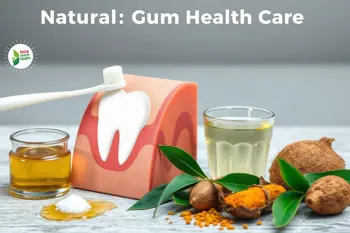
Clove oil contains eugenol, which has analgesic and antiseptic properties and is used for dental or gum discomfort. Relief of pain does not establish that an infection has been treated, so masking symptoms can create a maintenance risk if evaluation is delayed. Tea tree oil and clove oil should not be swallowed, and concentrated essential oils should not be applied casually to sensitive oral tissue. 1617
Diluted hydrogen peroxide can act as an oral antiseptic and may neutralize acids produced by plaque bacteria when used at an appropriate concentration. The supplied medical guidance emphasizes correct dilution, making concentration and frequency important safety factors. Uncontrolled use of concentrated peroxide may irritate oral tissues, so it should not be treated as a risk-free natural rinse. 18
Nutrition, traditional foods, and oral microbiome support
Vitamin C supports collagen production and immune function, and deficiency is strongly associated with increased gum bleeding and periodontal tissue breakdown. This relationship does not mean that high-dose supplementation treats periodontal disease, but it does make overall dietary adequacy relevant to gum tissue maintenance. 19
A 2026 review examined traditional foods, bioactive compounds, the oral microbiome, and pathways linked with oral disease prevention. Its focus supports a broader dietary perspective, in which food patterns and microbial interactions may influence oral health, although a review of molecular pathways is not the same as proof that one food or supplement prevents gum disease. 4
Additional adjuncts discussed in the supplied evidence include vitamin D, coenzyme Q10, omega-3 fatty acids, and oral probiotics containing Lactobacillus reuteri. A clinical guide ranks L. reuteri probiotics among the stronger natural adjuncts, while a 2026 randomized triple-blind trial evaluated probiotics and ozonated olive oil in stage I and II periodontitis patients. These interventions require attention to dose, formulation, medical history, and professional supervision. 26
Newer formulations and evidence limitations
A randomized double-blind trial of 96 people with gingivitis examined toothpaste containing extra-virgin olive oil, xylitol, and betaine over four months. The test formulation showed a slight reduction in gingival-crevicular-fluid elastase, while the commercial control showed an increase, and the test group had a higher salivary nitrite-to-nitrate ratio than both comparison groups. These results describe biological markers and do not prove that every olive-oil, xylitol, or betaine toothpaste prevents periodontal progression. 5
The overall evidence base has important friction points: studies vary in ingredient concentration, treatment duration, sample size, comparison product, and measured outcome. The tea tree oil trial involved only 30 adults and lasted 15 days, while the toothpaste trial involved 96 completed participants and lasted four months. Reviews and educational articles also differ from controlled clinical trials, so claims should be matched to the strength of the underlying evidence. 35
Safety signals and when professional care is needed
Persistent bleeding, gum recession, loose teeth, deep pockets, or continuing bad breath may indicate disease that home care cannot resolve. The supplied periodontitis guidance specifically identifies bleeding, pockets deeper than 4 millimetres, recession, loose teeth, and persistent bad breath as reasons to seek dental or periodontal evaluation rather than relying on natural treatment alone. 2
Safety also depends on avoiding harmful substitutions. Apple-cider-vinegar rinses are identified as a practice that can damage enamel, while homemade oil pulling used as sole treatment may delay necessary care. Essential oils must not be swallowed, peroxide must be diluted correctly, and topical ingredients should not be assumed safe merely because they are natural. Ongoing dental maintenance remains necessary even when symptoms improve. 21718
Sources
- Frontiers in Antibiotics
- Oral Health HQ
- Frontiers in Oral Health
- International Journal of Molecular Sciences
- Journal of Periodontology
- Dentistry Journal
- Ayurvedic India
- PubMed Central, aloe vera review
- WellnessZing
- Dental Pro 7
- Healthline
- PubMed Central, aloe vera study
- ScienceDirect, turmeric gel study
- National Library of Medicine, oil pulling study
- Dental Research Journal
- WebMD
- Medical News Today
- Cleveland Clinic
- American Dental Association
Authored by MyTrendSpot team