Effective home management for respiratory fatigue: Evidence-based routines for daily living
Effective home management for respiratory fatigue begins with practical ways to reduce the breathing effort involved in dressing, bathing, cooking, housekeeping, and moving around the home. Guidance on energy conservation, breathing control, rest scheduling, and home-based rehabilitation offers a structured framework, particularly for people living with COPD, post-COVID symptoms, or other persistent respiratory limitations. 1
Energy conservation for everyday activities
The American Lung Association describes energy conservation as simplifying tasks so that less energy is used for each activity. Its framework is commonly summarized through five principles: pace, planning, position, prioritization, and pursed-lip breathing. Resting before severe fatigue develops is emphasized because recovery may take longer after a person becomes overtired. A slow, steady pace is generally more manageable than rushing through a household task. 1
Planning separates demanding activities rather than grouping laundry, grocery shopping, appointments, and extensive housekeeping into one day. Prioritization means completing the tasks that matter most, or those requiring the most energy, during the period when energy is highest. Upright sitting and standing can reduce excessive bending and reaching, while changing position periodically may prevent additional fatigue. 1
Organizing the home around lower exertion
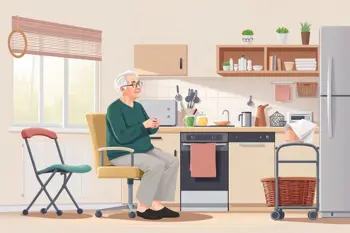
Home layout can determine how much walking, lifting, bending, and reaching a routine requires. Frequently used kitchen items can be kept at counter height, and commonly needed supplies can be placed between waist and shoulder level. A chair positioned near a tiring activity, such as food preparation or a route across the home, can provide a planned place to pause. These adaptations reflect occupational and pulmonary rehabilitation approaches to reducing task demands. 2
Carrying objects adds physical demand to household movement. Wheeled carts or rolling baskets can transport laundry, groceries, or cleaning supplies without requiring the same sustained carrying effort. A shower chair is another example of task modification reported in respiratory-fatigue guidance, because bathing may otherwise consume a substantial share of daily energy. Assistive technology, including voice-activated controls, may also reduce unnecessary movement, although technology access and usability remain practical barriers. 25
Breathing techniques and task timing
Pursed-lip breathing is included in the American Lung Association's five-part energy-conservation framework. The technique is intended to slow breathing and support inhalation and exhalation of more air. Regular practice is recommended so that the method becomes familiar before it is needed during a tiring activity. It can be paired with a slower pace and planned pauses rather than treated as a replacement for medical care or individualized rehabilitation. 1
Task timing is another central element of home management. High-energy activities are best aligned with the person's strongest period of the day, while rest is scheduled before fatigue becomes pronounced. A daily plan can place a recovery interval before meal preparation or bathing, rather than waiting until symptoms force a stop. This approach seeks to avoid cycles in which overexertion leaves too little capacity for essential activities later. 2
Indoor conditions and sleep routines
Indoor air quality is relevant when household dust, mold, smoke, or volatile compounds aggravate respiratory symptoms. General environmental guidance in the research payload identifies HEPA air cleaning, reduced household irritants, and humidity management as possible parts of an indoor-air strategy. A humidity range of 30% to 50% is cited as a practical target for limiting conditions associated with mold and dust mites. These measures do not address the underlying cause of respiratory disease. 3
Sleep quality can influence perceived fatigue and daily function in people with chronic respiratory illness. Reported sleep-support measures include maintaining consistent bedtimes and wake times and avoiding television or cellphone use before bed. The purpose of these routines is to support more regular rest, which may reduce the fatigue burden during daytime activities. Persistent poor sleep, worsening breathlessness, or new symptoms require assessment by an appropriate clinician. 2
Home exercise and respiratory muscle training
Home-based respiratory muscle training is an area of active research, but the evidence is condition-specific and should not be treated as a universal prescription. A 2025 randomized controlled trial examined long-term, remote inspiratory muscle training in people with COPD, while a 2025 single-group post-COVID study used inspiratory and expiratory trainers, diaries, return demonstrations, and weekly phone calls. The post-COVID study reported more than 95% adherence and high feasibility and acceptability. 67
A 2026 systematic review specifically examined home or tele-delivered inspiratory muscle training after COVID-19 and assessed inspiratory strength, dyspnea, pulmonary function, exercise capacity, and quality of life. Another 2026 triple-blinded randomized study enrolled 40 people with post-COVID syndrome and pulmonary involvement; its training group used a threshold device at 50% of maximal inspiratory pressure for eight weeks, seven days per week. These protocols were supervised research interventions, not general household instructions. 34
Limits, monitoring, and realistic expectations
Home rehabilitation can improve accessibility for people with mobility limitations, yet research reviews identify important implementation challenges. These include difficulty individualizing exercise for older adults, variable adherence, limited technology access, insufficient clinician training in remote assessment, and gaps in tele-rehabilitation policy. Such limitations mean that a program's design, monitoring, and suitability matter as much as the fact that it occurs at home. 5
Realistic home management does not require completing activities exactly as before respiratory fatigue developed. The practical objective is to distribute effort, protect time for essential tasks, and adapt the environment to reduce avoidable exertion. Pacing, rest before exhaustion, upright positioning, pursed-lip breathing, and carefully selected rehabilitation exercises can work together, while the evidence for device-based training remains tied to specific diagnoses and supervised protocols. 145
Sources
- 1. American Lung Association, “Conserving Energy and Managing Your Daily Activities,” https://www.lung.org/lung-health-diseases/lung-disease-lookup/copd/living-with-copd/daily-activities
- 2. Everyday Health, “6 Tips for Managing Chronic Fatigue With IPF,” https://www.everydayhealth.com/lung-respiratory/tips-for-managing-chronic-fatigue-with-ipf/
- 3. Andreadou et al., “The Effect of Home-Based Inspiratory Muscle Training in Post-COVID Population: Systematic Review,” Journal of Respiration, https://doi.org/10.3390/jor6010005
- 4. “Effects of inspiratory muscle training on exercise capacity, muscle oxygenation and strength, physical activity, and dyspnea in patients with post-COVID-19 syndrome and pulmonary involvement,” BMC Pulmonary Medicine, https://link.springer.com/article/10.1186/s12890-026-04249-4
- 5. Guo et al., “Advances in home-based respiratory muscle training for improving physical function in older adults with long COVID,” Frontiers in Physiology, https://doi.org/10.3389/fphys.2025.1662537
- 6. Dosbaba et al., “Long-Term Efficacy of Novel and Traditional Home-Based, Remote Inspiratory Muscle Training in COPD,” Journal of Clinical Medicine, https://www.mdpi.com/2077-0383/14/17/6099
- 7. “Inspiratory and Expiratory Muscle Strength Training for Persistent Dyspnea in Post-COVID-19,” Clinical Nursing Research, https://doi.org/10.1177/10547738251371244
Authored by MyTrendSpot team