Warning signs of osteoarthritis: A clinical guide to symptoms and evaluation
Recognizing the earliest warning signs
Warning signs of osteoarthritis commonly begin as mild, intermittent discomfort rather than sudden severe pain. A joint may ache during or after walking, climbing stairs, standing, gripping, or another repeated activity, then feel better with rest. This activity-related pattern reflects the gradual breakdown of cartilage and surrounding joint tissues. Symptoms most often develop slowly over months or years, although the pace varies among individuals. 1
Early symptoms can be easy to dismiss as ordinary soreness or aging. A person may first notice that a familiar movement has become less comfortable, that a joint does not bend as freely, or that daily tasks require more effort. Osteoarthritis most often affects the knees, hips, hands, and spine, but it can occur in any joint. The condition can eventually interfere with walking, stair climbing, opening jars, or sleeping comfortably. 3
Pain linked to movement or joint use
Joint pain is the most widely recognized symptom of osteoarthritis. In its earlier stages, pain generally becomes more noticeable with activity or prolonged use and may ease after resting the joint. Knee pain can emerge after walking or using stairs, hip pain may affect mobility, and hand pain may follow gripping or pinching. As osteoarthritis progresses, discomfort can become more persistent and may disturb sleep or routine activities. 3
The location and pattern of pain provide useful information, but pain alone cannot confirm osteoarthritis. Similar symptoms may arise from injuries, inflammatory arthritis, infection, or other joint disorders. Johns Hopkins Medicine notes that osteoarthritis symptoms can resemble other health conditions, making clinical assessment important. A healthcare professional considers the affected joint, symptom history, physical findings, and, when appropriate, imaging such as X-rays. 1
Stiffness after sleep or inactivity
Stiffness after waking or sitting still is another characteristic warning sign. The joint may feel locked, tight, or difficult to move after sleep, a car ride, or a period of inactivity. Osteoarthritis-related stiffness commonly improves as the joint is gently moved. Consumer and professional references describe stiffness after awakening or inactivity as typically lasting less than 30 minutes, which helps distinguish its usual pattern from some inflammatory conditions. 2
Reduced flexibility may appear alongside stiffness. The affected joint may not straighten, bend, rotate, or close as fully as it once did. This loss of motion can gradually alter ordinary activities, including walking, reaching, writing, or handling household objects. A temporary stiff feeling after rest is compatible with osteoarthritis, but prolonged stiffness, multiple visibly swollen joints, or symptoms affecting the whole body should be assessed because they may point to another diagnosis. 5
Swelling, tenderness, and visible changes
Osteoarthritis can cause swelling around a joint because of changes in bone, cartilage, and surrounding tissues. The joint may feel tender when pressed, particularly after use, and may look enlarged compared with the opposite side. Bony overgrowths, known as bone spurs, can contribute to this enlargement. Swelling may be subtle and intermittent at first, while later disease can produce more noticeable changes and reduced function. 3
Hand osteoarthritis may produce firm bony enlargements at the finger joints and can make gripping, pinching, writing, or opening containers more difficult. In the knees, hips, and feet, swelling or structural changes may affect walking and weight-bearing. These findings are not necessarily proof of osteoarthritis, because other conditions can also cause swelling and tenderness. A physical examination helps determine whether the pattern is mechanical, inflammatory, traumatic, or infectious. 5
Grinding, crackling, and reduced range of motion
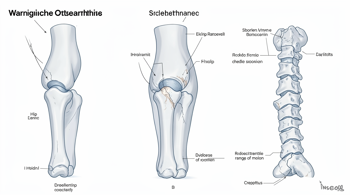
A grinding, grating, rubbing, or crackling sensation during movement is called crepitus. It may be heard as a joint moves or felt as a rough, sandy sensation. Johns Hopkins Medicine identifies a grinding feeling as a symptom that can occur when cartilage wears away, particularly in more advanced stages. Penn Medicine also lists rubbing, crackling, and grating among common symptoms. Sound without pain does not by itself establish a diagnosis. 1
Reduced range of motion is more clinically important when it limits function. Someone may find it harder to fully bend a knee, rotate a hip, close the fingers, or turn the neck. Joint movement can become restricted as cartilage damage, bone spurs, swelling, and other structural changes accumulate. Over time, these limitations may reduce independence in ordinary tasks. Progressive loss of motion warrants evaluation even when pain remains moderate. 4
Risk factors and how symptoms may progress
Age is strongly associated with osteoarthritis, which often becomes symptomatic in the 40s and 50s and is nearly universal on imaging by age 80, although not everyone with X-ray changes has symptoms. Other recognized risk factors include excess weight, inherited joint characteristics, prior fractures or ligament injuries, deformity, repetitive stress, and overuse. Secondary osteoarthritis can result from another disease, infection, injury, or abnormal joint structure. 2
Symptoms usually progress gradually rather than appearing as one sudden event. Early pain may be limited to activity, while later discomfort can become more constant, accompanied by stiffness, swelling, crepitus, and functional loss. Arthritis Australia reports that osteoarthritis commonly affects the knees, hips, finger joints, and big toe, and notes that prior joint damage can increase risk. Risk factors do not guarantee osteoarthritis, and their absence does not exclude it. 5
When symptoms require prompt medical attention
Sudden severe joint pain, marked redness or warmth, fever, or rapidly increasing swelling is not typical of uncomplicated osteoarthritis. Such features may indicate infection, crystal arthritis, an acute injury, or another condition requiring prompt medical evaluation. A joint that becomes dramatically inflamed, especially when accompanied by systemic illness, should not be assumed to represent ordinary cartilage degeneration. 17
Medical assessment is also appropriate when pain persists, mobility steadily declines, symptoms disturb sleep, or routine activities become difficult. Diagnosis is based on the symptom pattern and examination, with X-rays sometimes used to identify joint-space narrowing, bone spurs, or other changes. Imaging findings and symptoms do not always match: many people have osteoarthritis-related changes on X-rays without significant pain. This is why clinical context remains essential. 2
Sources
- Johns Hopkins Medicine, Osteoarthritis
- MSD Manual Consumer Version, Osteoarthritis
- Penn Medicine, Osteoarthritis: Symptoms and Causes
- American Medical Association, What doctors want patients to know about osteoarthritis
- Arthritis Australia, Osteoarthritis
- Dartmouth Health, What Are the Early Signs of Arthritis?
- Merck Manual Professional Edition, Osteoarthritis
- Harvard Health, Living Well with Osteoarthritis
- Centers for Disease Control and Prevention, Signs and Symptoms of Arthritis
- National Institute of Arthritis and Musculoskeletal and Skin Diseases, Osteoarthritis
- National Institute on Aging, Osteoarthritis
- Mayo Clinic, Osteoarthritis Symptoms and Causes
- National Health Service, Osteoarthritis Symptoms
- American Academy of Orthopaedic Surgeons, Osteoarthritis of the Knee
- Arthritis Foundation, Osteoarthritis
- Cleveland Clinic, Osteoarthritis
- Hospital for Special Surgery, Osteoarthritis
Authored by MyTrendSpot team