Best hospitals for Interventional Radiology: A Data-Based Guide to Programs, Procedures, and Patient Considerations
“Best hospitals for Interventional Radiology” is a search for programs that combine image-guided precision, subspecialty expertise, multidisciplinary care, and appropriate hospital support. The institutions reviewed here describe services ranging from vascular treatment and cancer care to biopsies, drainage, embolization, and catheter-based procedures, but the most suitable hospital depends on the condition, urgency, location, and clinical eligibility of the individual patient.
How interventional radiology programs differ
Interventional radiology uses real-time imaging, including X-ray, CT, MRI, and ultrasound, to guide wires, catheters, needles, and other small instruments. Penn Medicine describes the approach as a way to diagnose and treat conditions with precision while often avoiding traditional surgery, and Keck Medicine of USC similarly characterizes IR as a minimally invasive alternative to open surgery. 12 These descriptions indicate why program comparisons should focus on procedure expertise rather than hospital reputation alone.
Program breadth is another differentiator. UT Physicians reports collaboration with oncology, transplant, vascular medicine, and other specialties, while Keck notes that its interventional radiologists are consulted for complex inpatient and outpatient cases. 32 A hospital with relevant surgical, oncology, transplant, critical-care, and emergency resources may be particularly important when an intervention involves significant bleeding, complex vascular disease, or a medically fragile patient.
Documented programs and institutional strengths
Penn Medicine states that it operates one of the nation’s oldest and largest interventional radiology programs and performs among the highest volumes of procedures in its region. 1 Keck Medicine of USC describes board-certified interventional radiologists, individualized treatment plans, clinical research, and collaboration across specialties. 2 These are institutional descriptions, not an independent ranking, but they identify program age, procedural volume, physician credentials, research activity, and care coordination as useful comparison categories.
UVA provides a separate academic indicator: its 2025-2026 Doximity Residency Navigator ranking placed the Integrated Interventional Radiology Residency No. 1 nationally. The ranking incorporated resident and alumni satisfaction, reputation, and objective data. 6 Residency recognition does not directly measure outcomes for every patient or every procedure, yet it can signal an established educational and academic environment. Patients should still ask whether the hospital regularly performs the specific intervention being considered.
Geographic access and hospital networks
Interventional radiology is available through large academic centers, regional hospitals, physician groups, and multi-hospital networks. Northwell Health lists IR locations at Lenox Hill Hospital, North Shore University Hospital, Long Island Jewish Medical Center, Staten Island University Hospital, Huntington Hospital, Mather Hospital, and other sites across Manhattan, Nassau County, Queens, Staten Island, Suffolk County, and Westchester County. 4 The presence of multiple locations can reduce travel burdens, although the procedures and specialist teams may differ by site.
UT Physicians reports that care is delivered in outpatient clinics and affiliated hospitals, including Harris Health Lyndon B. Johnson Hospital and Memorial Hermann. 3 In Colorado, Interventional Radiology of Colorado lists hospital affiliations including Good Samaritan Hospital, North Suburban Medical Center, Platte Valley Medical Center, PSL Medical Center, Rose Medical Center, and St. Joseph Hospital. 7 Geographic convenience should therefore be assessed alongside anesthesia support, emergency backup, admission capability, and local experience with the intended procedure.
Matching the hospital to the clinical problem
Different hospitals may have particular relevance for different clinical needs. MD Anderson describes IR applications in cancer diagnosis and treatment, including image-guided ablation and embolization. 8 UCSF lists treatments involving cancer, vascular disease, and venous disease, while Stanford describes capabilities spanning vascular conditions, cancer, hepatobiliary disorders, and women’s health. 910 These service categories suggest that condition-specific expertise is more informative than a general label such as “top” hospital.
| Clinical focus | Capabilities documented in the research |
|---|---|
| Oncology | Tumor biopsy, ablation, chemoembolization, and radioembolization are described by the reviewed centers. 258 |
| Vascular care | Angioplasty, stenting, embolization, thrombectomy, and IVC filter management appear among documented services. 35 |
| Women’s and men’s health | Uterine fibroid embolization, pelvic interventions, and prostate artery embolization are listed by reviewed programs. 57 |
Range of procedures and care settings
Hospital IR departments can cover diagnostic and therapeutic procedures. Johns Hopkins identifies embolization, ablation, angioplasty, biopsy, drainage, and vascular access among interventional radiology procedures. 11 Burjeel Medical City in Abu Dhabi reports oncology, vascular, hepatobiliary, gastrointestinal, genitourinary, musculoskeletal, and endocrine interventions. It also reports 1,521 interventional procedures in 2024 and more than 152,447 imaging examinations, although those figures describe that institution specifically and should not be generalized to other hospitals. 5
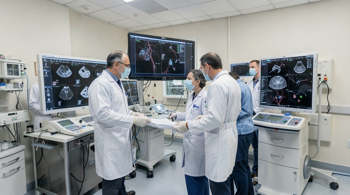
Care may occur in an outpatient clinic, an ambulatory setting, or an inpatient hospital. Penn Medicine says many patients may return home the same day, and Florida Interventional Specialists describes same-day outpatient procedures as part of its Tampa Bay service model. 112 Same-day discharge is not appropriate for every patient. The decision depends on the procedure, sedation or anesthesia needs, bleeding risk, other medical conditions, monitoring requirements, and the availability of follow-up care.
Safety, eligibility, and practical constraints
Minimally invasive treatment does not mean risk-free treatment. The reviewed institutions emphasize reduced pain, shorter recovery, or reduced hospitalization compared with traditional surgery, but these are general descriptions rather than guarantees for an individual. 123 Eligibility can depend on the diagnosis, anatomy, kidney function, medications, bleeding or clotting status, infection risk, prior procedures, and overall health. Those determinations require review of medical records and imaging by the treating team.
Patients and referring clinicians can also encounter practical friction points, including travel to a specialized center, referral requirements, differences between hospital locations, scheduling for multidisciplinary review, and the need for post-procedure monitoring. Northwell publishes separate phone contacts for its listed locations, while UT Physicians provides a dedicated referral number. 43 These details show that access is organized locally and should be confirmed with the relevant department rather than assumed from a health system’s general service page.
Questions for comparing hospitals
A useful comparison begins with the exact clinical objective. Questions can include whether the hospital performs the named procedure regularly, which physician subspecialty would lead it, whether the case is reviewed with oncology, surgery, vascular medicine, or another specialty, and whether inpatient backup is available. The reviewed programs repeatedly emphasize multidisciplinary coordination, advanced imaging, and individualized treatment planning. 239
- Ask which imaging method will guide the procedure and what type of sedation or anesthesia is expected. 23
- Ask whether the procedure is outpatient or inpatient and what observation or follow-up is required. 112
- Ask how complications are handled and which hospital team provides emergency or surgical backup.
- Ask whether a second opinion is appropriate when treatment alternatives include surgery, medication, surveillance, or another image-guided technique.
How to interpret the word “best”
No single institution can be identified as the best choice for every interventional radiology patient from the supplied information. The evidence describes capabilities, locations, academic indicators, procedure categories, and selected activity figures, but it does not provide a standardized cross-hospital outcomes database. A reasoned choice therefore weighs disease-specific expertise, physician training, hospital resources, procedural experience, communication, travel feasibility, and the patient’s eligibility.
The strongest comparison is evidence matched to the decision at hand. A cancer patient may prioritize tumor-board coordination and ablation or embolization experience, while a patient with vascular disease may need expertise in angioplasty, stenting, thrombectomy, or embolization. Academic rankings and institutional claims can inform research, but they should be considered alongside a physician’s individualized assessment, published quality information when available, and the risks and alternatives explained during consultation.
Sources
- Penn Medicine, Interventional Radiology, https://www.pennmedicine.org/services/imaging-radiology/interventional-radiology
- Keck Medicine of USC, Interventional Radiology, https://www.keckmedicine.org/treatments/interventional-radiology/
- UT Physicians, Interventional Radiology, https://www.utphysicians.com/interventional-radiology/
- Northwell Health, Interventional Radiology Locations, https://www.northwell.edu/interventional-radiology/locations
- Burjeel Medical City, Interventional Radiology, https://burjeelmedicalcity.com/specialities/interventional-radiology/
- University of Virginia, UVA Interventional Radiology Residency, https://news.med.virginia.edu/education/uva-diagnostic-radiology-residencies-ranked-no-1-in-virginia-nation-by-doximity-residency-navigator/
- Interventional Radiology of Colorado, https://divrad.com/interventional-radiology/
- MD Anderson Cancer Center, Interventional Radiology, https://www.mdanderson.org/patients-family/diagnosis-treatment/care-centers-clinics/interventional-radiology.html
- Stanford Medicine, Interventional Radiology, https://med.stanford.edu/radiology/patient_care/interventional-radiology.html
- UCSF Department of Radiology, Interventional Radiology, https://radiology.ucsf.edu/patient-care/interventional-radiology
- Johns Hopkins Medicine, Interventional Radiology, https://www.hopkinsmedicine.org/health/treatment-tests-and-therapies/interventional-radiology
- Florida Interventional Specialists, https://flinterventionalspecialists.com/
Authored by MyTrendSpot team