Top Compression Socks to Help with Leg Fatigue: An Evidence-Based Selection Guide
Leg fatigue after long periods of sitting or standing is the central reason many people consider compression socks. Medical and consumer testing sources describe graduated compression as a way to apply the greatest pressure near the ankle and progressively less pressure up the leg, which can help limit fluid pooling and support venous blood flow. The most appropriate pair depends on compression strength, sizing, calf shape, fabric, and the reason for wearing it. 45
How compression socks may reduce leg fatigue
Graduated compression is designed to support the lower-leg circulation system by squeezing the ankle and calf in a decreasing pattern. Experts cited by NBC Select explain that this pressure can help move blood back toward the heart, while HealthCentral describes potential reductions in swelling, fluid buildup, and fatigue during prolonged sitting, standing, or recovery. These effects address heaviness and discomfort rather than eliminating the underlying cause of leg fatigue. 45
Compression socks are commonly considered by travelers, nurses, people who stand for long shifts, athletes, pregnant people, and individuals experiencing lower-leg swelling. However, evidence and expert guidance do not mean that every wearer will experience the same benefit. A small unpublished running study cited by Wirecutter found no clear performance or fatigue advantage among 20 runners after a hard 30-minute run, so athletic claims require caution. 12
Compression levels and what they indicate
For everyday fatigue, travel, and prolonged standing, commonly discussed categories include light compression around 10 to 15 mmHg, moderate pressure around 15 to 20 mmHg, and firmer ranges around 20 to 30 mmHg. Product specifications do not always use identical terminology, so the numerical mmHg rating is more informative than labels such as athletic, recovery, or medical. PRO Compression lists a 10 to 15 mmHg light model, while Wellow lists 18 to 25 mmHg for its Aerolite+ sock. 76
Higher compression can feel restrictive and may be harder to put on, especially for people with limited hand strength, reduced mobility, or a larger calf circumference. Consumer Reports found that comfort, tightness, looseness, itchiness, and difficulty putting socks on varied substantially among tested pairs. Medical-grade products such as JOBST and Sigvaris should be selected according to clinical guidance when a specific pressure class is needed. 3211
Leading options by intended use
Independent reviews identify several distinct product profiles rather than one universally appropriate sock. Wirecutter includes Sockwell for a soft merino and bamboo blend, Go2Socks as a rugged lower-cost category option, Comrad for modern styling and a cotton-nylon blend, Wellow for warmth and wide-calf availability, Dr. Segal’s for easier application, Vim & Vigr for extensive foot and calf sizing, and Bombas for a shorter length. These differences matter because fatigue relief depends partly on sustained wearability. 1
Health’s tested and researched selections place Dr. Motion in an overall category, Sockwell in a women’s option, Wellow in a wide-calf category, Smartwool Run in a varicose-vein category, Wellow in a nursing category, and JOBST Relief in a medical-grade category. Athletic users may also encounter CEP, Zensah, and 2XU models, which emphasize graduated support, anatomical construction, moisture management, targeted calf support, or recovery use. Such labels describe design intent, not guaranteed clinical outcomes. 2141519
Fit, length, and fabric considerations
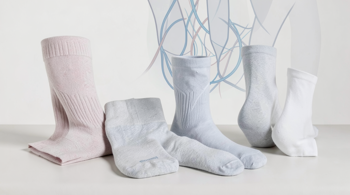
Knee-high socks are the dominant format in current testing and product comparisons because they cover the ankle and calf while fitting beneath many work, travel, and athletic outfits. Correct sizing normally requires consulting the manufacturer’s chart for shoe size, calf circumference, and sometimes height or weight. Wide-calf versions can prevent the top band from rolling or creating excessive pressure, while shorter options may provide less coverage than a knee-high design. 341
Fabric affects heat, moisture, softness, durability, and tolerance during all-day wear. Merino and bamboo blends are represented in everyday models, while athletic designs commonly emphasize breathable or moisture-wicking construction. Wellow’s Aerolite+ specification describes a bamboo-viscose blend, open-knit airflow, 19,000 micro-perforations, a seamless toe, and 18 to 25 mmHg compression. Outway lists moisture-wicking yarns, venting, arch support, a reinforced footbed, and 20 to 25 mmHg compression. 68
Risks, exclusions, and clinical guidance
Compression socks are not automatically appropriate for every person with tired legs. HealthCentral identifies severe peripheral arterial disease, severe heart failure, active skin infections, open wounds, significant numbness, fragile skin, and loss of sensation as situations requiring medical evaluation before use. Broader clinical guidance also advises caution when arterial circulation is impaired or when leg pain has not been explained. A sock that causes pain, color change, numbness, or worsening symptoms should not be treated as normal tightness. 511
Medical supervision is especially relevant when compression is being used for conditions such as deep vein thrombosis, lymphedema, chronic venous insufficiency, varicose veins, or postoperative recovery. Those conditions can require a specific compression class, measurement method, garment length, or treatment plan. Anti-embolism garments are distinct from ordinary graduated socks and may require a doctor’s recommendation. Routine fatigue after a long day is not equivalent to a diagnosed vascular disorder. 24
Practical wear and maintenance realities
Putting on compression socks generally works best when the sock is turned inside out to the heel, the foot is positioned first, and the fabric is gradually smoothed upward rather than pulled forcefully from the cuff. This method can reduce bunching and uneven pressure, although some firm models remain difficult to apply. Consumer Reports specifically identified ease of putting socks on as a meaningful difference between products, making application ability part of selection rather than a minor convenience. 3
Care instructions vary, but tested and reviewed models commonly support machine washing, while brand specifications may recommend cold or gentle cycles, mild detergent, low heat, or air drying. Wellow advises cold gentle washing and low heat or air drying to preserve its fabric properties. Outway lists machine washing in cold water and tumble drying on low. Regular inspection is useful because stretched fabric, damaged seams, rolled cuffs, or persistent loss of elasticity can change how pressure is distributed. 68
Sources
- The New York Times Wirecutter
- Health
- Consumer Reports
- NBC Select
- HealthCentral
- Wellow
- PRO Compression
- Outway
- Mayo Clinic
- Cleveland Clinic
- Johns Hopkins Medicine
- REI
- CEP
- Zensah
- 2XU
Authored by MyTrendSpot team