Discover Your Next Woodworking Interest: A Report on Paths, Projects, and Practical Fit
Discover Your Next Woodworking Interest by looking beyond basic repairs and carpentry: woodworking includes carving, marquetry, pyrography, scrolling, intarsia, whittling, furniture making, instrument building, bow making, toy construction, and other specialized practices. 1 The most suitable direction depends on the desired balance of utility, artistic detail, hand skills, machinery, available space, and project scale.
How woodworking interests are organized
Woodworking is best understood as a collection of disciplines rather than one uniform activity. Structural and functional work includes carpentry, timber framing, and boatbuilding; joinery and assembly include cabinetmaking, furniture making, and box making; decorative work includes carving, pyrography, and marquetry; precision specialties include woodturning and instrument making. 2 This classification helps distinguish a preference for building strong objects from an interest in surface design or fine-detail shaping.
| Direction | Typical focus | Representative projects |
|---|---|---|
| Functional | Utility and strength | Shelves, cabinets, benches |
| Decorative | Pattern and expression | Carved panels, burned designs, inlay |
| Precision | Small-scale accuracy | Boxes, turned objects, instruments |
| Structural | Large assemblies | Frames, boats, outdoor structures |
Artistic paths for detail-oriented makers
Carving uses handheld cutting tools to create figurative, abstract, or ornamental forms, while whittling removes small shavings from compact pieces. Pyrography uses heated pens or irons to produce tonal designs on wood or leather. Scrolling uses a narrow blade to cut curved shapes for portraits, puzzles, clocks, and fretwork. Marquetry, parquetry, and inlay arrange thin veneers according to contrasting color and grain, while intarsia assembles differently colored wood pieces in a puzzle-like image. 1
- Carving suits sculptural shaping and relief decoration.
- Whittling and spoon carving provide compact, hand-tool-centered work.
- Pyrography emphasizes drawing, shading, and controlled heat.
- Scrolling, marquetry, and intarsia emphasize pattern accuracy.
Furniture, cabinetry, and traditional joinery
Furniture making combines design, accurate measurement, joinery, assembly, hardware installation, and finishing. Cabinetmaking places particular emphasis on case construction, drawers, doors, and repeatable precision. A project-based learning approach can connect a desired technique to an appropriate object: dovetails naturally fit a box or drawer, mortise-and-tenon joints fit a small table, and dados or grooves fit casework such as a shop cabinet. 5 These paths suit people who value useful objects and progressive improvement in accuracy.
| Skill interest | Suitable project direction |
|---|---|
| Dovetails | Box or drawer |
| Mortise and tenon | Small table with legs and aprons |
| Dados and grooves | Cabinet or shelving case |
| Milling and glue-ups | Long-grain or end-grain cutting board |
Turning, instruments, and specialty forms
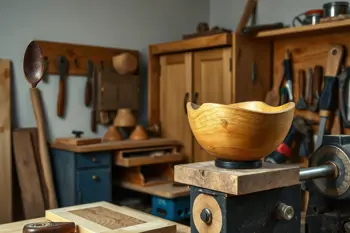
Woodturning rotates stock on a lathe while cutting tools shape the moving material, enabling bowls, spindles, pens, and other rounded forms. Luthiery focuses on stringed instruments such as guitars and violins, and bowyers make bows and arrows. Other specialty areas include gun furniture, cue sticks, puzzles, and wooden toys. 1 These interests can demand more specialized equipment, careful material selection, and tighter control of geometry than many flat-panel projects.
Turning and instrument work also illustrate how woodworking can overlap with engineering, acoustics, ergonomics, and design. The American Association of Woodturners provides an organized community and educational resources for people exploring turning, while the Furniture Society supports contemporary furniture design and professional practice. 8 Such organizations indicate that specialty woodworking often develops through communities of practice rather than isolated project attempts.
Choosing a first experiment by tools and time
A practical test is to complete several small projects from different categories instead of committing immediately to an extensive workshop. Beginner project references commonly identify cutting boards, simple shelves, planter boxes, picture frames, coasters, phone stands, key holders, serving trays, birdhouses, and desk organizers as accessible starting points. 7 A weekend-sized project should fit the available time, use tools already present, require material on hand or one ordinary supply trip, and stretch skills by roughly one step rather than several. 4
- Choose a turned object to test interest in rotational shaping.
- Choose a carved spoon or small relief to test hand-tool work.
- Choose a small cabinet or shelf to test measurement and assembly.
- Cut one hand joint to test precision and repetition.
Safety, materials, and long-term realities
Woodworking involves wood dust, machine hazards, noise, and moving cutting equipment. The Occupational Safety and Health Administration identifies these risks, while the National Institute for Occupational Safety and Health provides guidance on reducing occupational exposure to wood dust. 9 Safe practice therefore includes dust control, machine guards, suitable personal protective equipment, and operating procedures appropriate to each tool. These considerations can influence whether a discipline is practical in a home garage, shared shop, classroom, or outdoor workspace.
Material choice is itself a possible interest, including domestic hardwoods, reclaimed lumber, veneer, plywood, green wood, and locally available species. The Wood Database provides reference information for comparing wood characteristics, and the Environmental Protection Agency regulates formaldehyde emissions from composite wood products such as plywood, particleboard, and fiberboard. 10 Ongoing realities include sharpening, dust management, finish curing, storage, moisture movement, tool maintenance, and the need to match project scale to available workspace.
Where structured learning can clarify a direction
Community classes, maker spaces, guilds, and specialized schools allow beginners to test techniques before acquiring extensive equipment. North Bennet Street School lists cabinet and furniture making among its craft-focused programs, while the International Yacht Restoration School represents a specialized route into wooden boats and restoration. 3 Historical furniture is another distinct path, supported by the Society of American Period Furniture Makers, which focuses on studying and making period furniture and related restoration work.
The strongest indicator of a promising direction is sustained interest during the complete process, including preparation, mistakes, correction, finishing, and maintenance. A person drawn to visible grain may prefer veneer, inlay, or furniture; someone seeking quiet handwork may prefer carving or whittling; someone motivated by engineering may prefer joinery, boats, or cabinetry. Project outcomes matter, but the repeated tasks that remain engaging provide the more reliable evidence of a woodworking interest.
Sources
- Woodcraft, “Woodworking Pursuits,” https://www.woodcraft.com/blogs/small-projects/woodworking-pursuits
- WoodHint, “Woodworking Styles and Disciplines,” https://woodhint.com/type-of-woodworking/
- North Bennet Street School, “Cabinet and Furniture Making,” https://nbss.edu/programs/cabinet-and-furniture-making
- The Owner Builder Network, “What Should You Build This Weekend?” https://theownerbuildernetwork.co/project/2026/08/07/what-to-build-this-weekend/
- The Woodworker’s Journal Substack, “Building Skills and Choosing What to Make in the New Year,” https://thewoodwhisperer.substack.com/p/building-skills-and-choosing-what
- Woodworking Advisor, “18 Woodworking Projects for Adults, By Tool Tier,” https://woodworkingadvisor.com/woodworking-projects-for-adults/
- VEVOR, “10 Beginner-Friendly Woodworking Projects Anyone Can Try,” https://www.vevor.com/diy-ideas/beginner-friendly-woodworking-projects-2/
- American Association of Woodturners, https://www.woodturner.org/
- U.S. Occupational Safety and Health Administration, “Woodworking,” https://www.osha.gov/woodworking
- The Wood Database and U.S. Environmental Protection Agency, https://www.wood-database.com/ ; https://www.epa.gov/formaldehyde
Authored by MyTrendSpot team