Police auction motorcycles for sale: A neutral guide to sources, procedures, and risks
The phrase “police auction motorcycles for sale” generally refers to motorcycles disposed of through government surplus auctions, municipal proceedings, seized-property auctions, or commercial vehicle-auction platforms. The category includes retired patrol motorcycles, unclaimed vehicles, recovered property, and motorcycles sold as salvage, so the label does not describe one uniform type of motorcycle or one standardized process.
Where police motorcycles enter the auction system
In the United States, police motorcycles may move through federal, state, county, or municipal surplus programs after an agency determines that fleet equipment is no longer required. USA.gov provides a central guide to government auctions and sales involving surplus vehicles and property from public agencies. 1 Federal surplus and forfeited property may also appear through GSA Auctions, although motorcycle inventory varies by auction and location. 2
Other channels serve different agency groups. GovDeals, Public Surplus, Municibid, and AllSurplus operate online marketplaces for participating public agencies and can include vehicles, equipment, or other surplus assets. 3 4 6 7 PropertyRoom.com focuses on seized, recovered, and surplus property associated with law-enforcement agencies and other public organizations. 5
What the motorcycles may represent
A retired police motorcycle is not necessarily a seized motorcycle. Fleet units can have long service histories involving traffic enforcement, escorts, or urban patrols, while other motorcycles may be unclaimed, recovered, or held as evidence. A government-auction buying guide reports that former police motorcycles commonly include Harley-Davidson Electra Glide models, with BMW and Can-Am motorcycles also used by some agencies. 8
Condition and legal classification can differ substantially between lots. Commercial platforms such as Copart and IAA include motorcycles associated primarily with salvage, damaged, repossessed, or insurance-related inventory, rather than only police-owned fleet units. 9 10 A listing described as surplus, seized, recovered, condemned, or scrap should therefore be interpreted according to its individual documentation, not according to the word “police” alone.
Examples of auctioned and retired motorcycles
Recent reported examples illustrate the range of proceedings. In Rewa, India, police auctioned 39 unclaimed motorcycles, including Hero Honda CD Deluxe, HF Deluxe, Splendor, Honda Activa, TVS Apache 160 CC, and Bajaj Discover models. The bidding opened at ₹43,000 and closed at ₹85,000, with four participants reported. 12 Advocates questioned publicity, condition, and whether some motorcycles were reasonably usable rather than scrap-grade. 12
In Kenya, a Windsor House Auctioneers notice concerning Masii Police Station described seven motor vehicles, more than 40 motorcycles, assorted goods, scrap metal, and five bicycles subject to disposal under the Disposal of Uncollected Goods Act. 13 In Wyoming, the Jackson Police Department sought authority to dispose of unclaimed property after a public notice period, with more than 30 bicycles and other equipment listed. 11 These cases show that police-property auctions can involve different laws, agencies, and asset categories.
Former police fleet motorcycles
Municipal departments may retire motorcycles when fleet replacement schedules, damage, or service-life limits make continued operation unsuitable. Corpus Christi reported approval for four new pursuit-rated Harley-Davidson police motorcycles and related upfitting totaling $181,405. The replaced units included 2018 models, one of which had been involved in an accident, and the older motorcycles were scheduled for public auction after replacement. 14
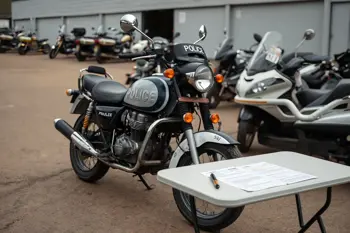
Former patrol motorcycles can retain useful service history, but patrol duty may also mean high mileage, frequent idling, repeated low-speed maneuvering, accessory removal, and cosmetic changes. A reported guide notes that police motorcycles are commonly sold without warranties and may be stripped of emergency equipment before disposal. 8 Mechanical inspection is therefore important because a maintained engine does not establish the condition of suspension, transmission, brakes, wiring, cooling systems, or bodywork.
Documents, eligibility, and auction terms
Government and police-auction motorcycles are generally sold as-is, placing responsibility for title clarity, mechanical condition, registration compliance, and transport on the purchaser. 8 Agency rules may specify whether a motorcycle has a transferable title, bill of sale, salvage title, abandoned-property documentation, or no title. State registration requirements can differ, so a lot that appears legally documented for auction may still require additional steps before road use.
Registration, payment, buyer premiums, storage charges, inspection access, and pickup arrangements are controlled by the individual agency or platform. Research guidance specifically recommends checking title status, VIN history, mechanical condition, inspection rules, buyer premiums, storage charges, and collection requirements before bidding. 8 A motorcycle may also be restricted to licensed dealers or buyers in particular jurisdictions, making the eligibility terms more significant than the headline description.
Mechanical and regulatory risks
The principal risk is uncertainty. Photographs may not show seized components, missing keys, inactive electronics, worn tires, corrosion, accident damage, or evidence-related alterations. Commercial salvage auctions may present motorcycles with damage classifications, while public-agency auctions may provide limited testing or inspection opportunities. Copart and IAA inventory categories demonstrate why damage and insurance history should be distinguished from ordinary government surplus. 9 10
Regulatory oversight also varies by location. Public agencies generally follow their governing auction procedures, public-notice rules, surplus-property policies, or uncollected-goods laws. Jackson’s reported proceeding required notice giving possible owners an opportunity to claim property before items could be sold, converted, or destroyed. 11 The Rewa report, by contrast, shows how questions about publicity and vehicle condition can create scrutiny even after an auction has concluded. 12
How to evaluate a motorcycle auction record
A disciplined review begins with the official lot description and supporting documents rather than the motorcycle’s former agency identity. The following points identify the main information gaps that can affect roadworthiness, legal transfer, and total responsibility after an auction:
- VIN, title type, ownership documentation, and any recorded damage or seizure history.
- Inspection access, starting or operating restrictions, keys, mileage, and missing equipment.
- Buyer premiums, taxes, storage deadlines, payment methods, and transport requirements.
- Eligibility rules, registration limitations, and whether road use requires repairs or inspection.
Historical examples also show why lot descriptions should be read precisely. The reported PRF auction in Porto Velho included a 2007 Harley-Davidson Road King Police FLHP with police-specific styling and accessories, demonstrating that some motorcycles retain identifiable agency features. 15 A motorcycle’s appearance, however, does not independently verify title status, maintenance quality, or legal eligibility. Those questions remain tied to the issuing agency and applicable jurisdiction.
Sources
- USA.gov, Auctions and Sales, https://www.usa.gov/auctions-and-sales
- GSA Auctions, https://www.gsaauctions.gov/
- GovDeals, https://www.govdeals.com/
- Public Surplus, https://www.publicsurplus.com/
- PropertyRoom.com, https://www.propertyroom.com/
- Municibid, https://municibid.com/
- AllSurplus, https://www.allsurplus.com/
- Alibaba Buying Guide, How to Bid on a Police Motorcycle at a US Government Auction, https://carinterior.alibaba.com/buyingguides/how-to-buy-a-police-motorcycle-at-auction
- Copart Motorcycle Auctions, https://www.copart.com/vehicle-search-type/motorcycles/
- IAA Motorcycle Search, https://www.iaai.com/VehicleSearch?Keyword=Motorcycle
- Jackson Police Department auction report, Jackson Hole News&Guide, https://www.jhnewsandguide.com/news/cops_courts/one-riders-loss-could-be-anothers-bargain/article_ff89aa67-cbb3-40a6-a15b-0266871ac60a.html
- Rewa Police Auctions report, Dainik Jagran English, https://english.dainikjagranmpcg.com/states/madhya-pradesh/vindhya-rewa/-rewa-police-auctions-39-unclaimed-bikes-for-%E2%82%B985000/article-16752
- Masii Police Station auction notice report, Tuko, https://www.tuko.co.ke/business-economy/602313-windsor-house-auctioneers-companies-list-cars-motocycles-set-sale-uncollected/
- Corpus Christi police motorcycle report, KRIS-TV, https://www.kztv10.com/news/local-news/corpus-christi-city-council-approves-181-405-for-four-new-harley-davidson-police-motorcycles
- PRF Road King Police auction report, RondoMotor, https://rondomotor.com/noticia/harley-davidson-road-king-police-esta-entre-os-lotes-do-leilao-da-prf-em-porto-velho/466/
Authored by MyTrendSpot team