Warning signs of glaucoma: clinical patterns and when symptoms require evaluation
Warning signs of glaucoma can be difficult to recognize because the most common form often develops quietly, without pain or obvious changes in vision. The condition damages the optic nerve, and early loss usually affects peripheral vision before central sight. Sudden eye pain, blurred vision, halos, nausea, or vomiting represent a different and potentially urgent pattern that requires emergency medical evaluation.
Why glaucoma may have no early warning signs
Glaucoma is a group of eye conditions that damage the optic nerve, the structure that carries visual information to the brain. Increased intraocular pressure is often associated with the damage, but glaucoma can also occur when pressure readings are within the usual range. Open-angle glaucoma, the most common type, generally develops slowly, and the gradual change may not be felt by the person affected. 1
Early damage can remain unnoticed because the brain adapts to missing visual information and one eye may compensate for the other. Central vision may remain clear while peripheral vision is progressively reduced. Consequently, a person can continue ordinary activities and still have measurable optic nerve damage. A comprehensive eye examination, rather than symptoms alone, is needed to identify early disease. 2
Subtle vision changes linked with open-angle glaucoma
The characteristic visual change in progressing open-angle glaucoma is gradual narrowing of the field of vision. Affected individuals may have difficulty noticing objects at the side, bump into objects more often, or find navigation in dim lighting increasingly difficult. These changes can be subtle because progression is slow and the visual system may fill in missing areas. 3
As optic nerve damage advances, peripheral loss may become more extensive and vision can take on a tunnel-like quality. Patchy blind spots may be detected during visual-field testing even when a person does not describe a clear symptom. Damage that has already occurred is generally permanent, while treatment is intended to slow or stop additional loss. 4
Emergency symptoms of acute angle-closure glaucoma
Acute angle-closure glaucoma occurs when the eye’s drainage pathway becomes blocked and pressure rises rapidly. Unlike the usually silent course of open-angle disease, an acute attack may produce sudden, severe eye pain, blurred vision, headache, eye redness, and rainbow-colored halos around lights. This combination is a medical emergency because rapidly increasing pressure can threaten vision. 5
Nausea or vomiting accompanying severe eye pain and visual disturbance adds to the concern for an acute attack. The symptoms may resemble a neurological or gastrointestinal problem, but the eye findings are important clues. Emergency medical evaluation is warranted for sudden severe eye pain, sudden blurred vision, halos, redness, nausea, vomiting, or a rapid loss of sight. 7
How symptoms differ by glaucoma type
Primary open-angle glaucoma usually causes no early pain or obvious visual symptom, then gradually affects side vision. Chronic angle-closure glaucoma can also develop silently, despite a narrower drainage angle. Congenital glaucoma and secondary glaucoma have different causes and clinical contexts, including inherited factors, other eye conditions, or systemic influences. The symptom pattern therefore cannot establish the type by itself. 1
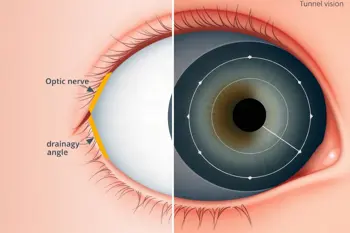
Secondary forms may be associated with another eye disorder, injury, medication exposure, or a medical condition, so the clinical history is relevant when symptoms appear. Some people develop glaucoma despite normal pressure readings, meaning that a normal pressure measurement does not by itself exclude optic nerve disease. Examination of the optic nerve and visual function remains essential. 9
Risk factors that make screening important
Risk is higher with increasing age and a family history of glaucoma. Penn Medicine identifies family history and African ancestry as important risk considerations for open-angle glaucoma. Long-term steroid use, certain medical conditions, and other eye abnormalities can also increase risk, depending on the glaucoma subtype. Risk factors do not prove that disease is present, but they influence monitoring and examination decisions. 2
A person may have no symptoms even when risk is substantial, which is why waiting for blurred vision or pain is unreliable. High eye pressure is a risk indicator rather than a complete diagnosis, and normal pressure does not guarantee that the optic nerve is healthy. The University of Utah describes glaucoma-suspect assessments as weighing pressure, optic-nerve appearance, and family history together. 6
How clinicians detect glaucoma before symptoms
Comprehensive eye examinations may include measurement of intraocular pressure, evaluation of the optic nerve, visual-field testing, and imaging. Dilated examination can reveal structural changes before a person recognizes functional loss. Comparing results over time helps clinicians identify progression, distinguish risk from established disease, and determine whether monitoring or treatment is appropriate. 3
Pressure checks alone are insufficient because optic nerve damage can occur at normal pressure, and elevated pressure does not always mean that glaucoma damage is present. A clinical assessment considers the drainage angle, optic-nerve structure, visual field, pressure history, family history, and other risks. Regular examinations are important because lost vision cannot currently be restored. 10
What to do when warning signs appear
Gradual difficulty seeing to the side, repeated collisions with objects, worsening low-light navigation, or a narrowing field of view should be discussed with an eye-care professional. These symptoms have multiple possible causes, so they do not confirm glaucoma. Their significance is that they may indicate a visual-field problem requiring formal testing rather than relying on a routine reading-glasses assessment.
Sudden severe eye pain or sudden visual disturbance is a separate situation from slowly progressive peripheral loss. Blurred vision with halos, redness, headache, nausea, or vomiting should be treated as a possible acute angle-closure pattern and evaluated through emergency medical care. Treatment can control pressure and protect remaining vision, but it cannot reverse optic-nerve fibers that have already been lost. 8
Sources
- Penn Medicine, “Glaucoma”
- Geisinger, “What Is Glaucoma”
- Wills Glaucoma, “Signs & Symptoms of Glaucoma”
- American Academy of Ophthalmology, “What Is Chronic Angle-Closure Glaucoma?”
- Acibadem Hospitals Group, “Understanding Glaucoma: A Complete Patient Guide”
- University of Utah Health, “What It Means to Be a Glaucoma Suspect”
- Cleveland Clinic, “Glaucoma”
- Johns Hopkins Medicine, “Glaucoma”
- National Eye Institute, “Glaucoma”
- Centers for Disease Control and Prevention, “Glaucoma”
Authored by MyTrendSpot team