Ways to manage dry eyes at home: an evidence-informed care and cost guide
Key facts
- Dry eye may involve inadequate tears, unstable tear quality or evaporation linked to eyelid oil glands.
- Preserved artificial tears are generally limited to about four to six daily applications because preservatives may irritate the ocular surface 1.
- A dry-eye evaluation at one New Jersey eye-care practice is typically reported at $125 to $150 in 2026 2.
- Prescription dry-eye medicines are reported at roughly $40 to $80 per month in one 2026 clinical cost guide 2.
Ways to manage dry eyes at home range from lubricating drops and warm compresses to changes in airflow, humidity and screen habits. These measures may help control some symptoms, but dry eye has several possible causes, and home care does not replace assessment by a qualified optometrist or ophthalmologist when symptoms persist, worsen or affect vision.
What dry eye involves
Dry eye is an umbrella term for an unstable or insufficient tear film. Tears lubricate the eye surface, help protect it from irritants and support clear vision. Some cases involve inadequate watery tears, while others involve tears that evaporate too quickly because the oil-producing meibomian glands in the eyelids are not functioning normally. Both patterns can occur together, and burning, grittiness, tired eyes, light sensitivity, fluctuating vision and excessive watering are reported symptoms 3.
- Common contributors include aging, contact lenses, prolonged screen use, low humidity and certain medicines 4.
- Underlying inflammatory or systemic conditions can require clinical investigation rather than household treatment alone.
- A comprehensive examination can assess the tear film, eyelids, conjunctiva and cornea.
Artificial tears and safe lubrication
Artificial tears supplement the tear film and are available as watery drops, lipid-containing emulsions, gels and ointments. Watery formulations are commonly used when tear volume is low, while lipid-containing products may be considered when evaporation is prominent. Gels and ointments last longer but can temporarily blur vision, so their use is often more suitable at night or when visual clarity is not immediately required. Product selection depends on symptoms, contact-lens use, sensitivities and examination findings.
- Preservative-free products may be preferable when frequent application is needed.
- Preserved drops can irritate the ocular surface with repeated use; one clinical review advises limiting them to about four to six applications daily 1.
- Redness-relief drops that constrict blood vessels are not the same as lubricating tears and may be unsuitable for ongoing dry-eye management.
- Sharing bottles, touching the dropper tip to the eye or using expired products increases contamination concerns.
Warm compresses, eyelid care and the environment
Warm compresses are commonly used to soften oils around the eyelid margins and support the meibomian glands, particularly when evaporative dry eye or gland dysfunction is suspected. A clean, comfortably warm cloth or purpose-made mask can be held over closed eyelids, followed by gentle lid-margin cleaning. Excessive heat, forceful pressure and vigorous scrubbing can irritate the ocular surface, so professional advice is appropriate when crusting, inflammation or recurrent symptoms are present.
- Reduce direct airflow from fans, heaters and vehicle vents, since moving dry air can increase evaporation.
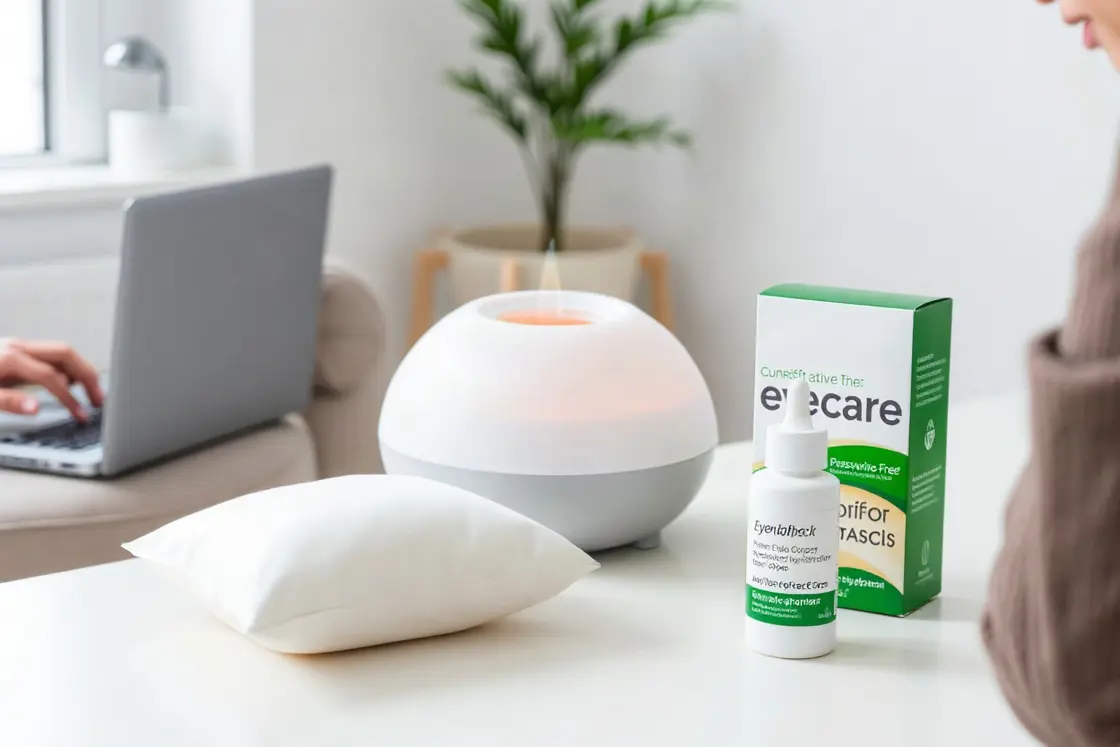
- A humidifier may help in dry indoor environments, but it requires regular cleaning to limit microbial growth.
- Smoke, dust and polluted air can aggravate ocular irritation; protective eyewear can reduce exposure in windy settings 5.
- Contact-lens wear may need review when comfort or tear-film stability changes.
Screen habits and daily routines
Prolonged visual concentration can reduce blinking and expose the tear film for longer periods. Ophthalmologists commonly discuss regular breaks, deliberate complete blinking and sensible screen positioning as part of symptom management. The American Medical Association identifies artificial tears, warm compresses and regular screen breaks among measures that may help control dry-eye symptoms 4. These steps are supportive rather than diagnostic, and persistent blurred vision should not be attributed automatically to screen use.
- Place screens slightly below eye level when practical, which may reduce the width of the exposed eye surface.
- Pause regularly during reading, gaming or computer work and blink fully rather than staring continuously.
- Limit smoke exposure and avoid directing air-conditioning or heating toward the face.
- Do not put household oils, saliva, homemade saline, honey or herbal preparations into the eyes, because sterility and irritation risks are difficult to control.
When home care is not enough
Professional evaluation is important when discomfort continues despite basic measures, repeatedly interrupts reading or driving, or occurs alongside contact-lens problems or a relevant medical condition. Prompt assessment is needed for marked redness, significant eye pain, light sensitivity, a sudden change in vision or an eye injury. These signs can reflect conditions other than routine dry eye, and relying only on home remedies could delay appropriate care.
- Optometrists and ophthalmologists can perform tear-film tests, slit-lamp examination and eyelid assessment.
- Examples of US academic care settings include Massachusetts Eye and Ear in Boston, affiliated with Harvard, and Jefferson Health in Philadelphia, where ophthalmology services include clinicians who discuss dry eye 4 3.
- Appointment availability varies by department, referral requirements, location and clinical urgency, so each facility determines its own scheduling process.
Clinical treatments, costs and coverage
Professional treatment is selected according to the suspected mechanism and severity. Options can include prescription anti-inflammatory medicines, therapies intended to increase tear production, tear-conservation procedures such as punctal occlusion, and treatment directed at eyelid-gland dysfunction. A 2025 clinical review describes staged care that combines nonprescription measures with prescription therapies and procedures when appropriate 6. Risks can include irritation, temporary blurred vision, inflammatory reactions or procedure-specific complications, which should be explained by the treating clinician.
| Care item | Published 2026 estimate or coverage note |
|---|---|
| Dry-eye evaluation | Typically $125 to $150 at one New Jersey eye-care practice; medical coverage may be partial or complete depending on the plan 2 |
| Prescription medication | Roughly $40 to $80 per month in one clinical cost guide, depending on medicine and duration 2 |
| IPL session | About $300 to $600 per session in a Nashville treatment pricing guide; suitability and coverage require clinical and plan review 7 |
Costs vary with location, testing, treatment frequency and whether a procedure is considered medically necessary. Public programs and private health plans apply different eligibility and authorization rules, while some specialized procedures may be excluded or require out-of-pocket payment. A qualified eye-care professional should confirm the diagnosis, treatment risks and likely follow-up schedule, and the facility should provide a written estimate before care begins.
Sources
- Non-pharmacological Treatment| Dry Eye | Healio: https://www.healio.com/clinical-guidance/dry-eye-disease/non-pharmacological-treatment-treatment-options
- Dry Eye Treatment Cost | Totowa Eyecare: https://www.totowaeyecare.com/investing-in-relief-a-guide-to-dry-eye-treatment-costs/
- Coping with dry eyes - Harvard Health: https://www.health.harvard.edu/eye-health/coping-with-dry-eyes
- What doctors want patients to know about dry eyes | American Medical Association: https://www.ama-assn.org/public-health/prevention-wellness/what-doctors-want-patients-know-about-dry-eyes
- Remedies to Reduce Dry Eye Symptoms - American Academy of Ophthalmology: https://www.aao.org/salud-ocular/consejos/dry-eye-tips
- Personalized Management of Dry Eye Disease: From Pathophysiologic Mechanisms to Targeted Therapeutic Approaches | AJMC: https://www.ajmc.com/view/personalized-management-of-dry-eye-disease-from-pathophysiologic-mechanisms-to-targeted-therapeutic-approaches
- Dry Eye Treatment Cost in Nashville, TN | Pricing Guide: https://www.centersfordryeye.com/blog/dry-eye-treatment-cost-in-nashville-tn-pricing-guide?p=zGfWiAWoWDrehdmPC
Authored by MyTrendSpot team