Best cryotherapy for muscle inflammation: Evidence, options, and safety considerations
Questions about the best cryotherapy for muscle inflammation usually involve choosing between a wrapped cold pack, cold-water immersion, whole-body cryotherapy, or a compression-based treatment. Research suggests that no single method is universally superior: localized cold is generally the most practical approach for a recent strain, while immersion has stronger evidence for reducing post-exercise delayed-onset muscle soreness. 1
What cryotherapy can and cannot do
Cryotherapy lowers tissue temperature and can temporarily reduce pain through analgesic effects. It may also limit local swelling during the early phase of some soft-tissue injuries. However, pain relief should not be interpreted as proof that muscle healing has accelerated, and cold does not necessarily restore strength or function faster. Evidence for ice in acute soft-tissue injury remains limited, so treatment effects should be interpreted as symptom management rather than a guaranteed recovery intervention. 2
Post-exercise inflammation and muscle soreness are not identical to a traumatic muscle strain. Delayed-onset muscle soreness usually follows unfamiliar or high-intensity exercise and develops over time, whereas a strain can cause immediate pain, weakness, or functional loss. The appropriate cold method therefore depends on the location of symptoms, the treatment goal, and risk factors such as impaired circulation, reduced sensation, or cold sensitivity. 3
Wrapped cold packs for localized inflammation
For a recent muscle strain or a small area of swelling, a wrapped cold pack is usually the safest and most practical cryotherapy option. A thin towel or cloth should separate the cold source from the skin, and applications are generally kept to short periods of about 10 to 20 minutes. This approach allows the affected area to be treated without exposing the entire body to cold. 4
Cold packs should not be applied directly to bare skin, used while sleeping, or placed over areas with reduced sensation or poor circulation. Treatment should stop if the skin becomes excessively numb, painful, pale, or mottled. These precautions matter because excessive cold exposure can cause tissue damage or nerve injury, even when the original purpose is pain and swelling control. 5
Cold-water immersion for exercise-related soreness
Cold-water immersion can reduce delayed-onset muscle soreness compared with passive recovery, although study protocols and evidence quality vary. Water transfers heat more efficiently than air, allowing relatively moderate cold exposure to affect the body more rapidly than an air-based chamber. Immersion is less targeted than a cold pack, but it may be relevant when soreness involves multiple muscle groups after strenuous exercise. 6
A 2026 systematic review and network meta-analysis evaluated whole-body cryotherapy, cold-water immersion, contrast water therapy, and local cold therapy across outcomes including soreness, countermovement jump performance, creatine kinase, interleukin-6, and C-reactive protein. The review included 51 randomized controlled trials and assessed outcomes immediately after treatment and at one, 24, 48, and 72 hours. 1
Whole-body and local cryotherapy
Whole-body cryotherapy is commonly delivered as a brief exposure to extremely cold air, while local cold therapy targets a specific body region. The distinction is clinically important because a chamber session may create a strong skin-level cold stimulus without producing the same direct cooling of deeper muscle tissue as water immersion. Whole-body treatment is therefore not automatically a stronger intervention for a localized muscle problem. 2
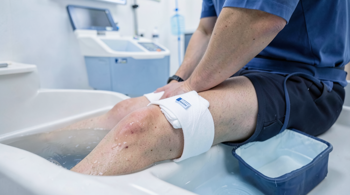
Recent findings also indicate that local, short-duration cooling can influence early recovery without changing every performance measure. In a randomized study of 64 physically active participants, a 15-minute phase-change material treatment at 5, 10, or 15 degrees Celsius improved mean power and rate of force development immediately after fatigue compared with passive recovery. Perceived exertion was also lower, but maximal torque, jump performance, endurance ratio, and muscle stiffness did not differ between groups. 3
Compression-assisted cooling
Cryocompression combines cold with external pressure and is intended to address pain, swelling, and recovery in the treated region. A 2025 randomized study examined cryocompression after eccentric exercise-induced muscle damage in healthy young men, adding to research on cold-based approaches for post-exercise recovery. Such results are relevant to controlled exercise studies, but they should not be treated as direct evidence that every commercial or clinical device improves an acute injury. 7
Cold compression and ischemic preconditioning with ice therapy were also examined in a 2025 randomized study published in the Annals of Rehabilitation Medicine. The findings contribute to an expanding research area involving muscle recovery and functionality after exercise. Interpretation still requires attention to the participants, exercise protocol, pressure settings, cooling duration, and measured outcomes, because different equipment and treatment schedules may not produce interchangeable results. 7
How the evidence compares
The available evidence supports a goal-based comparison rather than a universal ranking. A wrapped cold pack is most suitable for focused pain and swelling after a recent strain. Cold-water immersion has evidence for reducing exercise-related soreness, while whole-body cryotherapy has a less certain advantage over immersion. Local phase-change cooling may improve early perceived readiness and explosive measures, but it has not consistently improved maximal strength or muscle mechanical properties. 1
| Method | Most relevant use | Evidence limitation |
|---|---|---|
| Wrapped cold pack | Localized pain and swelling | Does not establish faster healing |
| Cold-water immersion | Multi-muscle post-exercise soreness | Protocols and study quality vary |
| Whole-body cryotherapy | Brief systemic cold exposure | May cool skin more than deeper muscle |
| Local phase-change cooling | Early neuromuscular and perceptual recovery | No consistent effect on maximal strength |
| Cryocompression | Cooling combined with pressure | Device settings and protocols differ |
Risks, precautions, and medical evaluation
Cold therapy warrants additional caution for people with circulation problems, altered sensation, or cold sensitivity. Prolonged exposure, direct skin contact, and excessive compression can increase the possibility of skin injury, nerve symptoms, or circulation-related complications. Whole-body exposure also presents a broader physiological challenge than treatment confined to one muscle. The risk profile should therefore be considered alongside the expected symptom benefit. 5
Medical evaluation is appropriate when swelling is severe, a deformity is visible, weight-bearing is impossible, weakness is marked, numbness occurs, or symptoms fail to improve. Those features may indicate an injury requiring assessment rather than repeated self-treatment with cold. For ordinary post-exercise soreness, gentle activity, recovery time, and monitoring of function remain important because cryotherapy primarily offers temporary symptom relief. 4
Sources
- Frontiers in Sports and Active Living, “Impact of different cryotherapy interventions on post-exercise acute delayed-onset muscle soreness, athletic performance, and inflammatory biomarkers.”
- Sports Medicine, Springer Nature, “Isolated and Combined Effects of Cold, Heat and Hypoxia Therapies on Muscle Recovery Following Exercise-Induced Muscle Damage.”
- PLOS ONE, “Short-duration phase-change material cryotherapy selectively enhances early neuromuscular and perceptual recovery.”
- Mayo Clinic, “First-aid ice packs.”
- NCBI Bookshelf, “Cryotherapy.”
- PubMed, “The use of cold-water immersion for post-exercise recovery.”
- Annals of Rehabilitation Medicine and Sports, studies on cryocompression and cold-compression recovery after exercise-induced muscle damage.
Authored by MyTrendSpot team