Simple home remedies for sciatic nerve discomfort: A clinical guide to safe self-care
Simple home remedies for sciatic nerve discomfort can help manage a mild flare, particularly when symptoms involve shooting pain, aching, tingling, or numbness that travels from the lower back or buttock into the leg. Most people improve without surgery over several weeks, although home care is appropriate only when symptoms are not rapidly worsening and no warning signs are present. 1
What sciatic nerve discomfort means
Sciatica is pain caused by irritation or compression of the sciatic nerve or one of its spinal nerve roots. The nerve begins in the spine and travels through the buttock and down the leg to the foot and toes. A herniated disc is a frequent cause, but spinal narrowing, vertebral changes, muscle spasms, or conditions affecting nearby nerves can produce similar symptoms. 1 2
Symptoms may feel sharp, burning, electric, or deep and aching. Numbness, tingling, and weakness can occur in the affected leg or foot, and discomfort may become more noticeable after prolonged sitting, standing, bending, or sudden movement. Because several conditions can resemble sciatica, persistent symptoms should not automatically be attributed to a pinched sciatic nerve. 2 3
Keep moving without forcing the spine
A short period of rest can be reasonable during a painful flare, but prolonged bed rest is generally discouraged. Harvard Health advises moving as much as possible as soon as practical, while clinical summaries indicate that continued activity can improve pain intensity and function more effectively than rest for acute nonspecific low back pain. Gentle walking and ordinary movement can reduce stiffness without placing the back under the sustained load associated with inactivity. 1 7
Low-impact activity should remain within tolerable limits. Walking, swimming, and other movements that do not increase leg pain are commonly used to maintain mobility, while high-force or abrupt actions may aggravate an irritated nerve. A useful safety principle is to stop an exercise that causes clearly increasing pain, new numbness, or worsening weakness rather than treating discomfort as evidence that the exercise is working. 3 5
Use heat and cold carefully
Cold packs may be considered when a flare feels newly inflamed or follows an aggravating event. A source on home nerve-pain care describes cold therapy as a way to numb the area and recommends sessions of about 15 to 20 minutes. The pack should be wrapped rather than placed directly on skin, and skin sensation should be checked during use because numbness can conceal irritation. 4 5
Heat may be more soothing when muscle tightness, stiffness, or an ongoing ache is prominent. A heating pad, warm bath, or similar approach can relax tense muscles, but excessive temperature or prolonged application can cause burns. Heat and cold are comfort measures, not treatments that correct a herniated disc or other structural cause, so temporary improvement does not establish the diagnosis or remove the need for assessment when symptoms persist. 1 4
Try gentle stretching and positioning
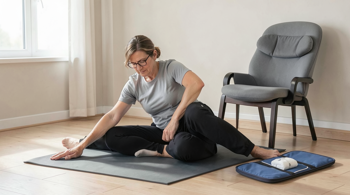
Comfortable stretching may help some people, especially when tight hamstring, hip, or piriformis muscles contribute to restricted movement. Examples discussed in the supplied clinical material include hamstring stretches, piriformis stretches, knee-to-chest movements, and gentle back mobility exercises. Stretching should be slow and controlled, without bouncing, and should not reproduce intense shooting pain farther down the leg. 3 6
Exercise selection is individual. OrthoNJ describes a directional-preference approach in which movements are continued when they reduce or centralize symptoms toward the back, while movements that spread pain farther down the leg are avoided. A physical therapist can demonstrate technique and help distinguish a tolerable stretch from nerve irritation. Exercise therapy has supportive evidence for low back pain with or without sciatica, but no single routine is suitable for every cause. 5 7
Improve sitting and sleeping positions
Long periods in one posture can intensify symptoms. A supportive chair, a small cushion or rolled towel behind the lower back, and regular position changes may reduce strain during sitting. Keeping both feet supported and avoiding prolonged slouched positions can make daily activity more manageable. These adjustments are intended to reduce aggravating pressure, not to guarantee prevention of future episodes, because recurrence can depend on the underlying spinal or muscular condition. 3
Sleep positioning can also influence comfort. Side sleeping with a pillow between the knees may help keep the hips and spine more aligned, while lying on the back with the knees comfortably supported may suit some people. There is no universally correct position, so the relevant test is whether a position reduces symptoms without increasing leg numbness or pain. Changing position during the night may be preferable to remaining fixed in an uncomfortable posture. 3 6
Medicines and longer-term support
Over-the-counter anti-inflammatory medicines such as ibuprofen or naproxen are frequently used for short-term symptom management, but they are not appropriate for everyone. Stomach, kidney, cardiovascular, pregnancy-related, and medication-interaction considerations can affect safety. The supplied evidence emphasizes nonpharmacologic care, including exercise therapy and multidisciplinary treatment for persistent low back pain, rather than presenting medication as a universal solution. 1 7
Physical therapy may provide individualized instruction in mobility, hip and core strengthening, posture, and gradual return to normal activity. Massage or acupuncture may help some people, although evidence and responses vary, and traction is described as ineffective for nonspecific low back pain in the cited review. Home care should therefore be viewed as symptom management and functional recovery, not as a substitute for diagnosis when discomfort continues or interferes substantially with daily life. 3 7
When home care is not enough
Urgent medical evaluation is warranted for new bladder or bowel changes, numbness in the groin area, progressive leg weakness, severe unrelenting pain, fever, or night sweats. These findings can indicate rare but serious problems requiring prompt assessment. Rapidly worsening symptoms, significant trauma, or pain that prevents ordinary movement also justify professional evaluation rather than continued experimentation with stretches or heat. 5
For milder symptoms, clinical assessment is still appropriate when pain persists, recurs frequently, or does not improve with gradual activity and basic comfort measures. Most disc-related cases improve over weeks without surgery, but the course depends on the cause and the presence of neurological changes. A clinician or physical therapist can assess strength, sensation, movement patterns, and the need for additional treatment while helping limit exercises that aggravate the nerve. 1 2 5
Sources
- Harvard Health Publishing, “How to get relief from sciatica”
- Cleveland Clinic, “Sciatica: What It Is, Causes, Symptoms, Treatment & Pain Relief”
- Focus Physiotherapy, “Relieve Sciatica at Home: Practical Exercises and Natural Remedies”
- St. Vincent’s Medical Center, “6 At-Home Treatments That Actually Help Sciatica”
- OrthoNJ, “Sciatica: A step-by-step plan you can follow at home”
- BuzzRx, “Sciatica Stretches to Help Relieve Nerve Pain”
- American Family Physician, “Nonpharmacologic and Nonsurgical Treatment of Low Back Pain in Adults”
Authored by MyTrendSpot team