Natural remedies for managing seasonal throat irritation: Evidence, safety, and practical guidance
Natural remedies for managing seasonal throat irritation generally focus on moisture, reducing exposure to allergens, and calming inflammation rather than treating a single underlying disease. Seasonal symptoms may arise from pollen, mold, dry indoor air, smoke, infections, or postnasal drip, so the most appropriate home measure depends on the suspected trigger. 1
Why seasonal throat irritation develops
An itchy or scratchy throat is a symptom rather than a diagnosis. Common causes include seasonal allergies, respiratory infections, dry air, airborne irritants, and mucus draining from the nose into the throat. Allergies to pollen, dust, mold, and pet dander can stimulate histamine release, while postnasal drip may create persistent tickling, coughing, or soreness. Cleveland Clinic advises medical evaluation when symptoms last more than a week, become severe, or interfere with swallowing, speaking, or sleep. 1
- Seasonal allergy patterns often coincide with outdoor pollen exposure.
- Heating and air-conditioning can dry mucous membranes.
- Smoke, strong fragrances, pollution, and vaping may worsen irritation.
Hydration and warm fluids
Drinking water regularly and choosing warm, non-caffeinated fluids can keep throat tissues moist and make swallowing more comfortable. Warm liquids may also thin mucus associated with postnasal drip, although they do not remove the underlying allergy or infection. Mayo Clinic, MedlinePlus, Johns Hopkins Medicine, and Cleveland Clinic all identify adequate fluids and warm liquids as supportive measures for throat discomfort. 2
- Water helps counter dryness and supports normal mucus clearance.
- Warm tea, broth, or another comfortable-temperature drink may provide temporary soothing.
- Very hot liquids can irritate already inflamed tissue and should be avoided.
Honey as a soothing option
Honey can coat the throat and may reduce irritation and cough, making it a commonly studied household remedy. Cleveland Clinic describes honey as potentially helpful because it may calm inflammation and provide a protective coating. The National Center for Complementary and Integrative Health reports that honey may relieve cough symptoms, but it must never be given to infants younger than 12 months because of the risk of infant botulism. 3
- Honey is appropriate only for children older than 1 year and adults.
- It may soothe symptoms but does not diagnose or cure strep throat, influenza, or another infection.
- People with relevant dietary or medical restrictions should consider individual clinical advice.
Gargling and humidified air
Gargling with warm salt water may temporarily relieve throat discomfort by moistening the area and clearing irritating secretions. Salt-water gargling is generally described for adults and older children who can gargle without swallowing. A clean cool-mist humidifier may also help when dry indoor air contributes to scratchiness. Mayo Clinic, NHS, and MedlinePlus list salt-water gargles and humidified air among conservative self-care measures. 4
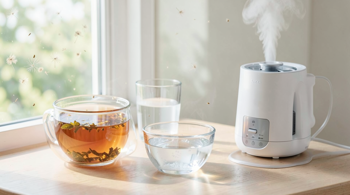
- Young children who cannot gargle safely should not use this method.
- Humidifiers require regular cleaning to avoid adding contaminants to indoor air.
- Humidity addresses dryness, not the root cause of pollen allergy or infection.
Saline rinses and allergen reduction
Saline nasal sprays or rinses can help clear mucus and allergens from the nasal passages, potentially reducing postnasal-drip-related throat irritation. People with seasonal allergies may also limit exposure by keeping windows closed during high-pollen periods, showering after outdoor activity, and identifying the specific trigger with an allergist. Sutter Health emphasizes that determining whether pollen, grasses, dust, mold, or another exposure is responsible can guide a more effective plan. 5
- Use only appropriately prepared saline and clean equipment for nasal irrigation.
- Showering after outdoor exposure can remove pollen from skin and hair.
- Reducing exposure is different from eliminating every allergen, which may be impractical.
What to avoid and when to seek care
Smoke, vaping aerosols, strong fragrances, and other airborne irritants can prolong throat inflammation. Natural remedies should be viewed as symptom support, not a substitute for assessment when symptoms are severe or persistent. Healthdirect identifies breathing difficulty, swallowing difficulty, dehydration, and symptoms that do not improve as reasons to seek medical care. A high fever, worsening illness, or concern about strep throat also warrants professional evaluation rather than relying only on home care. 6
- Seek urgent help for trouble breathing, inability to swallow fluids, or signs of dehydration.
- Consider testing or clinical assessment when infection is possible.
- Do not assume that every seasonal sore throat is caused by allergies.
Most sore throats are viral, and antibiotics do not treat viral illness. The CDC recommends supportive care when strep throat is not present, while the American College of Allergy, Asthma and Immunology notes that allergic rhinitis can produce postnasal drip and throat irritation. A practical approach is therefore to combine hydration and gentle soothing measures with trigger reduction, while monitoring duration and severity. 7
Sources
- Cleveland Clinic, “Itchy Throat (Scratchy Throat) Causes & Treatment”
- Mayo Clinic, “Sore Throat: Diagnosis and Treatment”
- Cleveland Clinic, “Does Honey Help With a Sore Throat?” and National Center for Complementary and Integrative Health, “Honey”
- NHS, “Sore Throat,” and MedlinePlus, “Sore Throat”
- Sutter Health, “Holistic Help for Allergies”
- Healthdirect, “Sore Throat”
- Centers for Disease Control and Prevention, “Sore Throat,” and American College of Allergy, Asthma & Immunology, “Allergic Rhinitis”
Authored by MyTrendSpot team