Best kidney health test kits: An evidence-based guide to home and laboratory screening
The phrase “Best kidney health test kits” covers several very different screening formats, from one-minute urine strips to mail-in laboratory testing and smartphone-guided analysis. The meaningful distinction is not simply the brand, but whether the kit measures useful kidney markers such as urine albumin, creatinine, the albumin-to-creatinine ratio, or blood-based filtration indicators.
What kidney health kits actually measure
Kidney tests may examine urine, blood, or both. Clinistix strips use a urine sample to detect albumin and creatinine within about one minute, then provide a color chart for assessing the albumin-to-creatinine ratio, commonly called ACR. Elevated urine protein can be relevant to kidney damage and cardiovascular risk, although a home strip is not a diagnosis.1
Other urine products measure protein, creatinine, and specific gravity, also called urine density. Specific gravity indicates how concentrated a urine sample is, while creatinine and protein provide additional context. GetTested describes its urine test as a rapid awareness tool and explicitly states that it does not replace laboratory kidney-function testing.2 The result is read by comparing pad colors with an included chart.
Rapid urine strips: useful for preliminary awareness
Urine strips are generally the simplest format because they require a sample cup or direct dipping, a timed reaction, and visual comparison with instructions. A five-test Clinistix kit is listed at $33.36 by Honest Medical, while the GetTested product is listed at EUR 14.99 in Ireland and GBP 11.99 in the United Kingdom. These figures describe individual product listings, not a standardized market price.12
| Feature | What to expect |
|---|---|
| Sample | Urine, collected midstream or in a container |
| Readout | Visual color comparison |
| Markers | Protein, creatinine, albumin, or specific gravity, depending on the product |
| Main limitation | Usually qualitative or semi-quantitative rather than a full laboratory assessment |
Strip instructions matter because timing, sample collection, storage, and lighting can affect interpretation. One listed kidney-strip product advises reading the instructions completely and repeating an abnormal first result with another strip. That repeat can identify a testing error, but it should not be treated as a substitute for clinical confirmation when results remain abnormal.3
Laboratory-analyzed home collection kits
Mail-in laboratory testing occupies a different category from visual strips. A MedGrade review of the LetsGetChecked Kidney Test reports a $99 price, blood and urine collection, CLIA-certified and CAP-accredited laboratory processing, medical review, eGFR reporting, and secure digital results. The same review assigns a 98/100 accuracy score and a 2-to-5-day turnaround assessment, while noting that collection is more complex than using a dipstick.4
The additional handling creates practical friction. Samples must be collected correctly, shipped promptly, and processed before results are released. The LetsGetChecked assessment describes a one-time collection taking approximately 10 to 15 minutes and identifies the prepaid return shipment and laboratory waiting period as part of the process.4 Consumers comparing kits should verify the exact specimen requirements and whether the report includes both blood and urine markers.
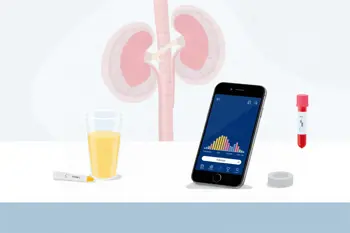
Smartphone-guided urine analysis
Healthy.io’s Minuteful Kidney system combines a home urine strip with a smartphone application. The application guides collection, uses the phone camera to scan the strip, and applies computer vision, artificial intelligence, and colorimetric analysis to account for lighting and device differences. The described output includes albumin, creatinine, and their ratio, with results transmitted to a healthcare professional for review and follow-up.5
This format attempts to reduce the subjectivity of a visual color chart while retaining home collection. Its stated purpose includes improving adherence to annual ACR testing among people at increased risk, including those with diabetes or hypertension.5 Important evaluation questions include whether the service is available in the user’s location, how clinical review works, how personal health information is protected, and whether the result is intended for screening, monitoring, or both.
Comprehensive blood and urine panels
A renal function panel is broader than a single urine strip because it evaluates kidney filtration and electrolyte balance through a group of blood tests. Vitals Vault lists a renal function panel from $21.99 with Quest Diagnostics access, online scheduling, and results described as available within a week. The same source emphasizes that hydration, illness, and medications can influence results, making trends and clinical context more useful than one isolated measurement.6
More extensive panels may be designed for people with established disease rather than general screening. Private MD Labs lists a diabetes and advancing chronic kidney disease management panel at $469, including kidney filtration, bone and mineral balance, anemia, and kidney-stress monitoring, with laboratory fees and doctor guidance included.7 PharmEasy lists a complete kidney health checkup with 66 tests, blood and urine samples, home collection, and reports described as available within 15 hours through NABL- and ISO-certified laboratories.8
How to judge results and choose a format
The most clinically useful kidney screening combines estimated glomerular filtration rate from blood creatinine with a urine albumin-to-creatinine ratio. NIDDK identifies blood creatinine, eGFR, and urine albumin testing as common components of kidney evaluation, while the CDC identifies urine albumin and eGFR as key tests for detecting and monitoring chronic kidney disease.910 A UACR of 30 mg/g or higher may indicate kidney disease and generally warrants repeat testing and professional interpretation.11
Selection therefore depends on the purpose. A urine strip may provide an inexpensive preliminary check of protein or related markers, while a laboratory panel is more appropriate when quantitative results, eGFR, medical review, or disease monitoring are required. Home tests should be interpreted according to their instructions, and the FDA notes that follow-up with a healthcare professional may be necessary for confirmation.12 People with diabetes, high blood pressure, cardiovascular disease, family history, or previous abnormal kidney results have stronger reasons to discuss testing with a clinician.13
Sources
- Honest Medical, Clinistix Kidney Health Test Kit
- GetTested, Kidney Test
- LDW07, Kidney Function Test Strips
- MedGrade, LetsGetChecked Kidney Test Review
- Physician AI Tools, Minuteful Kidney Test
- Vitals Vault, Renal Function Panel
- Private MD Labs, Diabetes and Kidney Panel
- PharmEasy, Complete Kidney Health Checkup
- National Institute of Diabetes and Digestive and Kidney Diseases, Kidney Tests
- Centers for Disease Control and Prevention, Chronic Kidney Disease Testing
- National Kidney Foundation, Urine Albumin-Creatinine Ratio
- U.S. Food and Drug Administration, Home-Use Tests
- American Academy of Family Physicians, Chronic Kidney Disease Risk Factors
Authored by MyTrendSpot team