Early symptoms of deep vein thrombosis you should know: A clinical guide to warning signs
Early symptoms of deep vein thrombosis you should know include one-sided swelling, pain or tenderness, warmth, redness, and a feeling of heaviness in the affected limb. DVT often develops in a deep vein of the lower leg, thigh, pelvis, or, less commonly, the arm, and symptoms can range from mild to pronounced. 1
What DVT is and why early signs matter
Deep vein thrombosis is the formation of a blood clot in a deep vein, most often in the legs or pelvis. Deep veins lie within muscles and alongside bones, unlike superficial veins near the skin. A clot can obstruct the normal return of blood to the heart, producing swelling and discomfort in the affected area. 1
The principal concern is that part of a DVT may break loose and travel through the bloodstream to the lungs, where it becomes a pulmonary embolism. DVT is the primary cause of pulmonary embolism, although not every clot travels. A clot can also damage the vein and contribute to persistent swelling, pain, skin darkening, or ulcers known as post-thrombotic complications. 4
One-sided swelling, pain, and heaviness
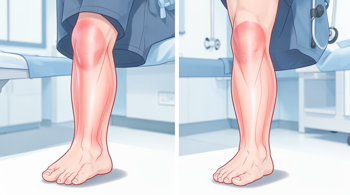
Swelling in one leg is among the most recognizable early warning signs. It may involve the calf, ankle, thigh, or an extensive portion of the limb, and it can appear suddenly or develop gradually. Symptoms affecting one side are more concerning for DVT than equal swelling in both legs, although appearance alone cannot establish the diagnosis. 2
Pain or tenderness may feel like cramping, soreness, pressure, or a persistent ache. It frequently begins in the calf and may become more noticeable while standing or walking. Some people describe heaviness in the limb rather than sharp pain. These sensations can resemble a muscle strain or another condition, which is why persistent or unexplained symptoms require clinical evaluation rather than self-diagnosis. 7
Warmth, redness, and visible vein changes
Skin over the affected area may feel warmer than the surrounding skin and may look red, darker, or otherwise discolored. The color change can be subtle, particularly in people with darker skin tones, so comparison with the other limb and attention to swelling or tenderness may be useful observations for a clinician. 3
Surface veins near the suspected clot can become more prominent, enlarged, firm, or tender as blood is redirected around an obstruction. Itching may occur in some cases, but it is not a defining symptom and can have many unrelated causes. Warmth, color change, swelling, and pain are more established features than itching alone. 6
Symptoms can be absent or occur outside the leg
DVT does not always produce noticeable symptoms. Some clots are described as silent, meaning they are discovered during assessment for another reason or after a complication occurs. The absence of swelling or pain therefore does not reliably exclude a clot, especially when significant risk factors such as hospitalization, cancer, recent surgery, or prolonged immobility are present. 2
Although most DVTs occur in the lower extremities or pelvis, clots can also develop in deep veins of an arm or, less commonly, other locations. Arm symptoms may include swelling, pain, warmth, or color changes on one side. Upper-extremity DVT represents less than 5% of DVT cases in the professional reference summarized here, making it less common but clinically relevant. 4
Risk situations that change the level of concern
DVT becomes more likely when blood flow slows, a vein is injured, or the blood becomes more prone to clotting. Relevant circumstances include extended sitting during travel, bed rest, hospitalization, recent surgery or fractures involving the hip or pelvis, pregnancy or childbirth within the past six months, cancer, obesity, and a family history of blood clots. 3
Age and chronic illness also influence risk. UC Davis identifies older adults, people with cancer or chronic illnesses, and hospitalized or intensive-care patients as higher-risk groups. Screening studies cited by that source suggest that up to one-third of ICU patients may have DVT when examined with ultrasound, illustrating why symptoms must be interpreted alongside medical history. 2
- Recent surgery, injury, fracture, or prolonged bed rest
- Long periods of sitting or limited movement
- Pregnancy, recent childbirth, or hormone therapy
- Cancer, chronic illness, obesity, or an inherited clotting tendency
- Previous clots or a family history of blood clots
When symptoms may signal a pulmonary embolism
Sudden shortness of breath, chest pain, rapid breathing, fainting, or coughing up blood can indicate that a clot has traveled to the lungs. These symptoms are not ordinary early leg symptoms of DVT. They represent possible pulmonary embolism, a complication that can obstruct blood flow in the lungs, strain the heart, and become life-threatening. 8
Emergency medical assessment is appropriate when these chest or breathing symptoms occur, particularly if they follow one-sided leg swelling or pain. A person should not attempt to confirm or rule out DVT based on symptoms alone. Clinicians commonly use the medical history and physical examination together with duplex or Doppler ultrasound, while a D-dimer blood test may help exclude DVT in selected situations but is not specific when positive. 4
How clinicians distinguish DVT from similar problems
Muscle injury, superficial thrombophlebitis, skin infection, chronic venous disease, and other causes of limb swelling can resemble DVT. Redness or warmth by itself is therefore not diagnostic. The pattern is more informative when symptoms are new, concentrated in one limb, and accompanied by swelling, tenderness, or a relevant risk factor. 7
Diagnosis generally requires testing because a clot is located in a deep vein and may not be visible from the skin. Duplex ultrasound is a principal diagnostic method, while blood testing and, in some cases, additional imaging may be used. Treatment commonly involves anticoagulants, which help prevent clot enlargement and reduce the risk of pulmonary embolism. 1
Practical interpretation of early warning signs
No single symptom proves that a DVT is present, and no single absent symptom proves that it is absent. The clearest pattern is new swelling, pain or tenderness, warmth, and redness or discoloration affecting one leg. Symptoms that worsen, persist without an obvious explanation, or arise after surgery, travel, injury, or hospitalization deserve assessment by a healthcare professional. 3
Prompt recognition matters because appropriate diagnosis and anticoagulant treatment can reduce the chance of clot progression and pulmonary embolism. Untreated or inadequately treated clots may also contribute to long-term venous insufficiency, including continuing limb pain, swelling, skin changes, and difficult-to-heal ulcers. Self-treatment cannot determine whether these complications are developing. 5
Sources
- Merck Manual Consumer Version, “Deep Vein Thrombosis (DVT)”
- UC Davis Health, “What is a DVT? Symptoms, dangers and when to get help”
- Penn Medicine, “Deep Vein Thrombosis (DVT): Symptoms and Causes”
- MSD Manual Professional Edition, “Deep Venous Thrombosis (DVT)”
- Harvard Health, “Leg clots (aka deep-vein thrombosis): an immediate and long-term health hazard”
- Cleveland Clinic, “8 Signs of a Blood Clot”
- UK Vein Clinic, “Early Signs of Deep Vein Thrombosis (DVT) and When To Seek Help”
- Acibadem Hospitals Group, “Deep Vein Thrombosis: Early Signs, Risk Factors, and Urgent Treatment”
Authored by MyTrendSpot team