Regional price differences for professional septic system repairs: A Data-Driven National Analysis
Regional price differences for professional septic system repairs are among the most pronounced in the home services industry, with documented gaps of 10 to 20 times between the lowest and highest markets in the country. A homeowner in rural Mississippi may pay $130 for a basic repair service call, while the same category of work in coastal Massachusetts or Hawaii regularly exceeds $18,000 for complex drain field restoration. These are not outliers. They reflect structural differences in labor markets, regulatory environments, and soil engineering requirements that shape every invoice a septic contractor issues.
National Baseline: What Repair Costs Look Like Across the U.S.
In 2026, the national average cost for a professional septic system repair falls between $1,500 and $7,500, with most homeowners spending around $3,500 for mid-complexity work. 1 The full spectrum is considerably wider: minor repairs such as baffle replacement or small leak sealing typically run $300 to $1,200, while major interventions including drain field restoration or full tank replacement can exceed $15,000. 2 Septic specialists nationally charge between $70 and $140 per hour, and total project costs range from $1,500 to $25,000 depending on scope and complexity. 3
The U.S. EPA reports that more than 21 million households rely on septic systems, meaning a significant share of the population is exposed to these pricing dynamics. 4 Regular maintenance fees of $250 to $500 every three to five years are substantially lower than the $5,000 to $15,000 range associated with repairing or replacing a malfunctioning conventional system. 5 According to the EPA, neglecting a system long enough can result in full replacement costs of $15,000 to $30,000, making preventive pumping the most cost-effective intervention available to homeowners on any regional tier.
Five-Region Pricing Framework: Northeast to West Coast
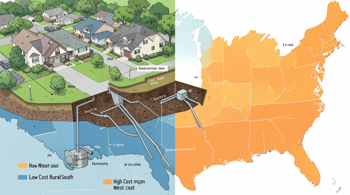
Published 2026 market data segments the continental U.S. into five broad pricing tiers. The Northeast represents the highest-cost region, with repair ranges of $200 to $18,000, driven by strict state regulations such as Massachusetts Title 5 requirements and elevated labor costs throughout New England and the Mid-Atlantic. 6 The West Coast follows closely at $200 to $20,000, with California-specific environmental compliance adding $100 to $200 to base repair costs in many jurisdictions. 6
The Midwest and Southwest occupy a middle tier. Midwest repair costs range from $135 to $13,000, with seasonal fluctuations impacting scheduling availability and labor pricing, while the Southwest spans $145 to $14,000 with rural areas falling toward the lower end of that range. 6 The Southeast is consistently the most accessible market, with documented ranges of $130 to $12,000 attributed to greater contractor competition and a lower regional cost of living. 6 Septic inspection costs alone illustrate the regulatory divergence: the same standard inspection that costs under $50 in parts of Colorado can exceed $900 in Massachusetts, driven primarily by documentation and filing mandates rather than the inspector's time on-site. 7
State-Level Data: High-Cost vs. Low-Cost Markets
State-level pricing data reveals consistent patterns. California's state average cost for a septic specialist ranges from $948 to $15,928, with hourly rates of $83 to $141. Major urban centers including Los Angeles, San Diego, San Francisco, and Sacramento cluster around a $13,250 average project cost at $105 per hour. 8 Texas shows a similarly wide range of $1,113 to $18,673 at the state level, with major cities like Houston, San Antonio, Dallas, and Austin also averaging $13,250 per project at $105 per hour, while smaller markets show considerably lower figures. 9
At the lower end of the national spectrum, West Virginia's state average runs $517 to $8,945 with hourly rates of $97 to $147, and its largest city, Charleston, averages $11,263 per project. 10 Missouri's range is $759 to $12,677, while Wisconsin and Minnesota track similarly at $756 to $12,739 and $797 to $13,122 respectively. 11 South Carolina's state cost span of $662 to $11,444 with Charleston as its most expensive city at $11,925 reflects the Southeast's competitive contractor market. 12 Pumping costs by state show parallel patterns: Alabama, Mississippi, and Arkansas average $200 to $350, while Hawaii averages $700 and Alaska reaches $650 or higher. 13
Intra-State and Urban-Rural Gaps
Price variation within a single state can be as significant as the differences between regions. In California's San Jose metro area, neighborhood-level hourly rates for septic work range from $80 in Coyote Valley's rural southern pockets to $150 in Saratoga and Los Gatos border estate properties with engineered alternative treatment units on shallow soils. 14 Portland, Oregon demonstrates a similar dynamic, with Scappoose and Columbia County at $55 to $90 per hour representing the lowest cost band, while West Linn, Stafford, and Troutdale corridor neighborhoods run $65 to $100. 15
North Carolina illustrates how rural concentration affects pricing in a state with unusually high septic dependency. Approximately 2.1 million NC homes rely on septic systems, representing roughly 50% of all households, double the national average. A standard pump-out in Charlotte differs measurably from rural Cherokee County pricing, and repair costs follow the same gradient. 16 New Jersey's urban markets show the Northeast premium clearly: Newark, Jersey City, and Paterson average $11,925 per project at $95 per hour, while smaller communities show more variability with some falling below $2,000. 17
Key Cost Drivers Behind Regional Disparities
Several structural factors explain why the same physical repair produces invoices that differ by multiples rather than percentages across regions. State-level regulations are the primary driver. Massachusetts Title 5 compliance, California's Regional Water Quality Control Board review requirements, and Chesapeake Bay watershed regulations all mandate documentation, engineered components, or follow-up inspections that simply do not exist in lower-cost markets. 7 Soil conditions and groundwater depth create equally significant divergence: high water table areas require pressurized or mound systems, engineered fill, and extended drain field lines that can add tens of thousands of dollars to a project compared to a well-draining flat lot in the same county. 18
Emergency response premiums add 50 to 100 percent to base repair costs regardless of region, with after-hours service charges ranging from $150 to $300 in most markets. 4 System age is a compounding factor: installations older than 20 years frequently require multiple simultaneous repairs, and contractors in all regions typically advise a cost-benefit analysis against full replacement once a system crosses that threshold. 1 Accessibility also matters independently of region: tanks buried under driveways or positioned on steeply graded lots require excavation that adds to labor time regardless of local wage rates. Concrete tank repairs are generally more expensive than plastic or fiberglass repairs, though concrete units have a longer service life of 40 or more years when properly maintained. 2
Risks, Regulatory Considerations, and Budgeting Realities
Homeowners evaluating repair quotes should recognize that regional price differences do not always reflect quality differences. A low quote in a competitive Southeast market may represent accurate local pricing, not reduced workmanship, just as a high Northeast invoice may reflect mandatory regulatory compliance costs rather than excessive contractor margins. The septic inspection cost disparity of $48 in Colorado versus $900 in Massachusetts documents this clearly: the inspector's labor is similar, but the certification, filing, and liability structure is not. 7 Failing systems pose documented public health risks including groundwater contamination and surface water pollution, and these risks are present regardless of where repairs rank on the regional pricing spectrum. 5
High-cost-of-living states like California and New York run 25 to 45 percent above the national average installation and repair benchmark, while southern and rural states typically come in 15 to 28 percent below it. 19 Northeast and California markets regularly exceed $500 for inspection services alone, while Midwest and rural South markets routinely come in under $200 for the same scope. 7 Scheduling repairs during shoulder seasons, specifically early fall between September and October, consistently produces lower quotes and faster contractor availability in weather-sensitive markets. Obtaining multiple itemized quotes, verifying state licensing status, and confirming that a contractor carries liability insurance are practices relevant in every regional tier, regardless of whether a homeowner is in a $130 or a $20,000 market.
Sources
- SepticTankHub.com - Septic Repair Cost 2026: Pricing by Problem + Severity
- Modernize.com - Septic Tank Repair Cost (2026 Homeowner Guide)
- MasterFinder.com - Septic Specialist Cost Guide 2026
- WasteDoor.com - Septic Pumping Cost by State: 2024 Complete Price Guide
- U.S. EPA - Why Maintain Your Septic System
- SepticTankHub.com - Septic Tank Pumping Cost by State (2026 Guide)
- SepticTrust.com - Septic System Inspector Costs by State
- MasterFinder.com - How Much Does a Septic Specialist Cost in California? (2026)
- MasterFinder.com - How Much Does a Septic Specialist Cost in Texas? (2026)
- MasterFinder.com - How Much Does a Septic Specialist Cost in West Virginia? (2026)
- MasterFinder.com - Septic Specialist Costs in Missouri, Wisconsin, and Minnesota (2026)
- MasterFinder.com - How Much Does a Septic Specialist Cost in South Carolina? (2026)
- WasteDoor.com - 50-State Septic Pumping Cost Comparison (2024)
- LocalServiceCost.com - Septic Cost in San Jose 2026: Real Rates by Outlying Area
- LocalServiceCost.com - Septic Cost in Portland 2026: Real Rates by Rural Area
- SepticAndWell.com - Septic Tank Pumping Cost NC: 2026 Pricing Guide
- MasterFinder.com - How Much Does a Septic Specialist Cost in New Jersey? (2026)
- UseCalcPro.com - Average Septic Tank Cost by State in 2026
- UseCalcPro.com - Average Septic Tank Cost by State in 2026 (All 50 States Compared)
Authored by MyTrendSpot team