Best hospitals for Sports Medicine: A Data-Based Guide to Programs, Expertise, and Access
For people researching the best hospitals for Sports Medicine, the relevant comparison is not limited to reputation. Sports-medicine care may involve primary care, physical medicine and rehabilitation, orthopaedic surgery, physical therapy, athletic training, nutrition, imaging, and sport-specific conditioning, so the most suitable program depends on the injury and the treatment pathway required. 11
How sports-medicine hospitals differ
Sports-medicine programs generally combine diagnosis, nonsurgical treatment, surgery when clinically appropriate, and rehabilitation. Penn Medicine describes a multidisciplinary team that includes primary care physicians, rehabilitation doctors, orthopaedic surgeons, physical therapists, sports nutritionists, and athletic trainers. Its services include treatment for ACL injuries, arthritis, shoulder labral tears, cartilage problems, and hip conditions in young and active adults. 11
Program structure matters because sports injuries vary substantially. A person with an overuse injury may need evaluation, rehabilitation, and movement modification, while a complex ligament, cartilage, or tendon injury may require orthopaedic subspecialty assessment. Selection criteria therefore include the relevant joint expertise, access to imaging, surgical capability, rehabilitation coordination, pediatric or adult care, and the clinician’s experience with the patient’s activity level. 1
Large academic and specialty programs
Hospital for Special Surgery in New York is specifically centered on orthopaedic care and operates a dedicated sports-medicine program for athletic injuries. HSS reported that Newsweek’s 2026 specialized-care rankings placed it No. 1 in orthopedics. The stated methodology included a professional survey, patient-experience information, patient-reported outcomes, and specialty-specific safety and quality measures. That ranking is a useful data point, but it does not determine which program is appropriate for every diagnosis or patient. 2
Mayo Clinic describes sports medicine as covering evaluation, treatment, prevention, and rehabilitation for athletes and active people. UCSF Health reports both nonoperative and operative care for musculoskeletal injuries, while Stanford Health Care describes services for recreational athletes, competitive athletes, and people who want to remain active. These examples illustrate the breadth of academic sports medicine, from conservative care and injury prevention to orthopaedic surgery. 3 4
Surgical expertise and complex injuries
Cleveland Clinic’s sports-medicine service treats injuries involving muscles, bones, joints, ligaments, and tendons, with both nonsurgical and surgical approaches. Massachusetts General Hospital also provides orthopaedic sports-medicine care. Its documented clinical network includes Peter D. Asnis, MD, who specializes in knee and shoulder sports injuries and treats adolescents through adults. 5 20
Johns Hopkins Medicine identifies sports-medicine expertise involving the shoulder, knee, hip, elbow, and other musculoskeletal structures. Duke Health describes an orthopaedic sports-medicine service spanning evaluation, treatment, surgery, and rehabilitation. These services can be relevant when a patient needs coordinated care across diagnosis, operative planning, postoperative recovery, and return-to-activity decisions rather than a single isolated appointment. 7 8
Rehabilitation, performance, and prevention
UPMC Sports Medicine combines orthopaedic care with rehabilitation, performance services, and injury-prevention resources. OHSU presents sports medicine as a service for diagnosing and treating athletic and musculoskeletal injuries. This integrated model is significant for patients whose goals involve restoring strength, movement control, conditioning, or sport participation, because treatment may continue beyond the point at which pain or swelling has improved. 9 10
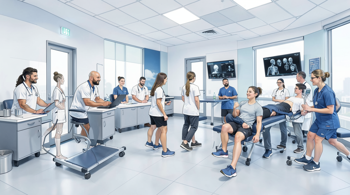
Some programs emphasize performance science in addition to injury management. Kauvery Hospital describes a service combining orthopaedics, physiotherapy, athletic conditioning, and movement science, with attention to injury prevention, mobility, sport-specific rehabilitation, and safe return to sport. Cleveland Clinic Canada’s Midtown Sports Clinic lists physiotherapy, massage therapy, chiropractic care, shockwave therapy, therapeutic injections, athletic therapy, and pre- and post-surgery rehabilitation. 15 19
Regional and international care models
Regional hospitals can offer practical access and focused services even when they are not represented in national rankings. UofL Health states that its sports-medicine and orthopaedic teams serve UofL Athletics, LouCity FC, Racing Louisville, youth academies, and 13 surrounding high schools. It also lists two sports-medicine urgent-care locations in Louisville with evening and Saturday hours at one site. 13
Other regional examples show different access models. Froedtert and the Medical College of Wisconsin lists sports-medicine hours at its Orthopaedic, Sports and Spine Center and provides Ortho Now, X-ray imaging, hand and upper-extremity treatment, and spine services. KLSMC in Kuala Lumpur describes orthopaedics, sports medicine, regenerative treatment, rehabilitation, advanced imaging, and international-patient support. International care adds travel planning, continuity, language, and follow-up considerations. 14 17
Practical screening and limitations
Clinician-level expertise can be as important as hospital branding. Emory identifies John Xerogeanes, MD, as chief of sports medicine, with clinical interests including ACL reconstruction, revision ACL surgery, meniscal surgery, rotator-cuff and labral repair, and arthroscopic knee and shoulder surgery. His listed profile also reports a 4.9 rating from 415 ratings and availability information, but ratings do not replace review of qualifications, diagnosis, outcomes, or communication needs. 18
Patients should also assess eligibility and friction points before selecting a program. Insurance authorization, referral rules, age-group eligibility, appointment location, imaging transfer, postoperative travel, and rehabilitation scheduling can affect care. Regulatory and credentialing review is especially important for surgery, injections, regenerative procedures, or international treatment. Risks include choosing a program mismatched to the injury, overlooking rehabilitation needs, relying on rankings alone, or failing to plan long-term follow-up and return-to-sport monitoring. 2 17
Questions that support an informed comparison
A structured comparison should begin with the diagnosis and intended activity, then identify whether primary care sports medicine, physical medicine and rehabilitation, orthopaedic surgery, or several disciplines are required. Programs documented in the research offer different combinations of these services. Penn Medicine, for example, describes personalized nonsurgical and surgical options, cartilage care, hip preservation, rehabilitation, and orthobiologic treatments, while other centers emphasize urgent assessment, performance, or international coordination. 11 13
Useful questions include whether the program treats the specific injury, who provides the initial evaluation, how imaging is reviewed, when surgery is considered, how rehabilitation is coordinated, and how return to sport is assessed. Additional questions concern pediatric versus adult expertise, clinician credentials, infection and safety information, expected follow-up, insurance requirements, and access for patients traveling from another region. These checks create a more balanced assessment than a single ranking or patient-review score. 1 5
Sources
- Hospital for Special Surgery, Sports Medicine
- Hospital for Special Surgery, Newsweek 2026 Orthopedics Ranking
- Mayo Clinic, Sports Medicine
- UCSF Health and Stanford Health Care, Sports Medicine
- Cleveland Clinic, Sports Medicine
- Massachusetts General Hospital, Orthopaedic Sports Medicine
- Johns Hopkins Medicine, Sports Medicine
- Duke Health, Orthopaedic Sports Medicine
- UPMC, Sports Medicine
- Oregon Health & Science University, Sports Medicine
- Penn Medicine, Sports Medicine
- UofL Health, Sports Medicine and Orthopedics
- Froedtert & Medical College of Wisconsin, Orthopaedic, Sports and Spine Center
- Kauvery Hospital, Sports Medicine
- KLSMC Hospital, Kuala Lumpur
- Cleveland Clinic Canada, Midtown Sports Clinic
- Emory Healthcare, John Xerogeanes, MD
- Mass General Brigham, Peter D. Asnis, MD
Authored by MyTrendSpot team