Police Auction Motorcycles for Sale: What Buyers Need to Know
Police auction motorcycles represent a significant opportunity for buyers seeking vehicles at substantial discounts, though the process involves specific procedures, legal considerations, and mechanical realities that differ markedly from retail purchases. Law enforcement agencies at federal, state, and local levels periodically liquidate seized property, forfeited assets, and surplus equipment through public auctions, making these sales accessible to qualified bidders nationwide. The Louisville Metro Police Department, for example, recently held a digital auction featuring approximately 100 unclaimed vehicles including a 1998 Harley-Davidson Electra-Glide and motorcycles from model years as recent as 2020 1. Understanding the mechanics of these auctions, from registration and inspection through payment and vehicle retrieval, is essential for making informed purchasing decisions.
How Police Motorcycle Auctions Operate
Police and government agencies conduct motorcycle auctions through both digital platforms and in-person events to liquidate seized vehicles, abandoned property, and surplus equipment declared beyond departmental use. Digital auctions have become the dominant method, allowing bidders to participate online from any location without attending physical sales events. The Louisville Metro Police Department holds digital auctions managed through specialized online auction infrastructure, with bidding periods typically lasting several days and checkout occurring on announced dates 1. Buyers must complete registration prior to bidding, provide valid identification, and meet age requirements, usually 18 years or older. Most auctions operate on a sealed-bid or live-bidding model where the highest qualified bidder wins the vehicle. Once an auction concludes, buyers enter a payment window lasting hours to days depending on the auctioneer's terms, followed by a pickup or retrieval period ranging from 24 hours to several weeks.
The operational framework varies by jurisdiction and auctioneer. The City of Kansas City conducts online-only vehicle auctions on the first and third Tuesdays of each month to sell unclaimed vehicles and surplus public fleet assets, with a viewing day held the second Tuesday of each month from 8 a.m. to 4 p.m. 2. The Dallas Police Department's Auto Pound auctions abandoned vehicles every other Monday according to Texas Transportation Code Section 683, with all auctions held at the Auto Pound facility at 1955 Vilbig Road. Payment requirements typically mandate full settlement within one hour after the final vehicle sells, with wire transfer or cash payment accepted. All motorcycles sold at police auctions must be retrieved by licensed tow trucks; no vehicles may be driven from auction lots under their own power.
Where to Find Police Motorcycle Auctions
Multiple online platforms and local government channels host police motorcycle auctions, enabling buyers to search by location, vehicle type, and auction date. GovDeals serves as a primary marketplace where federal, state, and local police agencies post surplus and seized motorcycles with nationwide reach 3. PropertyRoom operates as a specialized platform for law enforcement agencies to sell seized and surplus motorcycles online, while Copart auctions seized and salvage motorcycles from police departments and government agencies with live online bidding capabilities 4. The General Services Administration (GSA) manages federal surplus motorcycle auctions through its dedicated online platform, making bikes from federal agencies available to the public 5. Local police departments and county sheriff offices publish auction notices on municipal websites, community bulletin boards, and social media platforms, typically advertising sales 2 to 4 weeks in advance. Facebook Marketplace and Craigslist feature direct listings from local police and county surplus motorcycle auctions with seller contact information readily available.
Specialized auction aggregators consolidate listings across multiple jurisdictions and auctioneers. PublicAuction.com aggregates police and municipal motorcycle auctions across numerous states with searchable, sortable listings by location and vehicle type 6. Auction.com lists seized and surplus motorcycles from law enforcement agencies with real-time bidding and detailed inspection reports, while eBay Motors features police and government surplus motorcycles through certified auction sellers offering buyer protection policies 7. Liquidity Services provides search tools and educational resources for locating reliable police-seized motorcycle auctions nearby, explaining that these auctions represent public sales where law enforcement agencies dispose of motorcycles taken into custody for criminal forfeiture, abandoned property, or released evidence 8. Prospective buyers should check multiple platforms regularly, as inventory and auction schedules vary by location and administrative cycles.
Typical Condition and Pricing Expectations
Police auction motorcycles typically exhibit fair to good condition with pricing reflecting significant discounts from retail values, though mechanical and cosmetic variability requires careful assessment. Vehicles at police auctions have served diverse purposes: some are abandoned property with unknown maintenance histories, others are seized in criminal forfeitures after unknown use periods, and still others are retiring surplus police fleet motorcycles approaching the end of departmental service life. The Corpus Christi Police Department, for instance, is retiring four 2018 Harley-Davidson models that have exceeded their intended four-year service life, with one unit damaged beyond repair in an accident 9. Historical auction data indicates that police-seized motorcycles frequently sell at 50 to 80 percent discounts below comparable retail pricing, though condition and demand variations produce significant case-by-case differences. A 1979 Kawasaki Police 1000 sold for $4,400 at the 2021 Mecum Las Vegas Motorcycle Auction, while ex-police Triumph TR6P units have achieved higher valuations reflecting rarity and restoration quality.
Inspection periods before auctions allow buyers to assess mechanical condition, view cosmetic damage, and check VIN history and title status in person. The Kansas City auction model includes a dedicated viewing day the second Tuesday of each month from 8 a.m. to 4 p.m., enabling hands-on evaluation 2. Most police auction listings include damage classifications such as front-end damage, side impact, vandalism, or minor dents, helping buyers gauge repair requirements. Odometer readings are often unavailable or marked as unknown in auction listings, particularly for older units. Purchase agreements from police auctions include explicit 'as-is' conditions with limited or no warranties on mechanical or structural integrity, placing full responsibility on buyers for post-purchase repairs and maintenance. Buyers should budget for pre-purchase inspections, mechanical assessments by qualified technicians, and potential repairs before calculating true acquisition cost.
Registration, Bidding, and Payment Procedures
Participating in police motorcycle auctions requires account registration, identity verification, and understanding specific bidding mechanics unique to government sales channels. All auction attendees must register prior to participating, providing valid state-issued identification cards, driver's licenses, or in some jurisdictions, Mexican Consulate ID (Matricula Consular de Alta Seguridad, or MCAS) 10. Registration typically occurs online before auction dates or in person at physical viewing locations. Bidders must be 18 years of age or older to qualify. Most online auction platforms operate preliminary bidding windows lasting several days before live auction events, allowing bidders to place initial bids and monitor competition. Live auctions then occur at scheduled times with real-time bidding incrementing in standardized intervals, usually $25 to $100 per bid depending on vehicle estimated value.
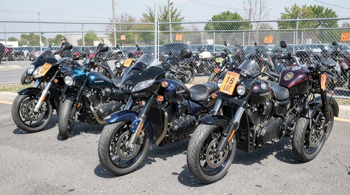
Payment protocols vary by auctioneer but generally mandate swift settlement to secure vehicle ownership. The Kansas City auction requires payment via wire transfer or cash at the tow lot by 5 p.m. the Wednesday following auction day 2. The Dallas Police Department and similar agencies require full payment within one hour after the final vehicle sells 10. Failure to meet payment deadlines results in bid forfeiture, account suspension, and potential bans from future auctions. Once payment clears, buyers receive bill-of-sale documentation and authorization to retrieve their motorcycles. The Dallas Auto Pound charges a $30 storage fee per vehicle per day for any units remaining beyond the specified removal deadline. Buyers must arrange licensed tow truck services to remove motorcycles from auction lots; no private removal or self-propulsion is permitted. Some jurisdictions offer extended removal periods for bulk purchases: the Kansas City auction allows purchasers of more than nine vehicles to retain them until 4 p.m. the Sunday following the auction, providing additional scheduling flexibility.
Legal Considerations and Title Issues
Police motorcycle auctions involve specific legal frameworks governing property transfer, title status, and buyer obligations that differ significantly from retail purchases. Agencies selling seized motorcycles operate under state forfeiture statutes, abandoned property codes, and municipal ordinances governing disposition of confiscated assets. The City of Kansas City explicitly states that it does not guarantee title to auction vehicles; instead, a bill of sale is mailed to purchasers within 30 days of auction with a $10 fee assessed for issuing duplicate bills of sale 2. Buyers must then initiate state title transfer processes independently, which typically require VIN inspection appointments at state highway patrol offices or certified inspection stations. Missouri VIN inspections, for example, require providing vehicle year, make, model, and VIN information when scheduling appointments, with all inspections performed by appointment only at designated patrol stations.
Salvage-only motorcycles impose additional legal requirements on purchasers. The Kansas City auction specifies that anyone wishing to purchase salvage-only vehicles must provide proof of current salvage or dealer's license at the time of auction registration 2. Buyers without such credentials cannot participate in salvage-only lots. Title status varies significantly: some police auction motorcycles carry clear titles, while others arrive with salvage, branded, or reconstructed titles reflecting accident history or uncertain provenance. Buyers must verify title status before committing funds, as rebuilding or insuring branded-title motorcycles involves additional costs and restrictions. Insurance carriers frequently charge higher premiums for vehicles with reconstructed or salvage titles, and some policies explicitly exclude coverage for such vehicles. Legal counsel or title search services can clarify ownership history and potential encumbrances before purchase.
Mechanical Assessment and Post-Purchase Realities
Police auction motorcycles require rigorous pre-purchase mechanical evaluation, as 'as-is' sales conditions provide no recourse for undisclosed defects or latent mechanical failures. Professional pre-purchase inspections by qualified motorcycle technicians should include compression testing, fluid analysis, electrical system diagnostics, brake system evaluation, and frame integrity assessment. Hidden mechanical issues frequently emerge only after ownership transfer: seized engines, corroded fuel systems, compromised brake lines, electrical gremlin patterns, and transmission wear not apparent during brief viewing periods. Buyers should budget an additional 10 to 30 percent of acquisition cost for post-purchase repairs, parts replacement, and mechanical restoration. Storage, transport, and tow truck fees add further costs beyond hammer price. For example, a motorcycle purchased at a $2,000 bid may incur $300 to $500 in towing costs, $200 to $400 in title transfer and documentation fees, and $500 to $3,000 in mechanical repairs before road-ready status.
Older motorcycles retiring from police service present particular challenges: they have accrued substantial operational hours, endured challenging duty cycles including high-speed pursuits and extended patrol use, and may carry wear patterns invisible during cursory inspection. Police fleet Harley-Davidson models, while mechanically robust, often show transmission wear, clutch degradation, and brake system fatigue after years of intensive use. Parts availability for vintage police motorcycles can be limited, particularly for specialized police equipment such as emergency lighting systems, radio mounts, or siren brackets that may require removal and sourcing of civilian-spec replacement components. Documentation of maintenance history, service records, and prior accident involvement is frequently unavailable or incomplete for seized or abandoned motorcycles. Buyers assuming vehicles have regular maintenance performed risk discovering deferred maintenance upon detailed inspection. Title transfers, registration fees, and insurance setup require completion before legal road use in most jurisdictions, adding complexity and additional timelines beyond immediate ownership.
Risk Factors and Market Friction Points
Police motorcycle auctions present legitimate advantages but carry substantial risks requiring honest assessment before commitment. The primary advantage is pricing: documented discounts of 50 to 80 percent below retail create genuine opportunity for budget-conscious buyers. However, this pricing reflects genuine risk transfer from seller to buyer. Motorcycles sold 'as-is' with no warranty shift all mechanical and structural liability entirely to purchasers. Unknown maintenance histories, undisclosed accident damage, hidden electrical faults, and latent mechanical failures become the buyer's financial and safety responsibility. Salvage-only titles restrict insurance options, complicate resale, and require specialized dealers for transaction. Storage and tow fees accumulate quickly, particularly if vehicles sit uncollected beyond specified removal deadlines; the Kansas City auction charges $30 per vehicle per day for extended storage, meaning a motorcycle left for three weeks incurs $630 in storage alone. Some buyers discover post-purchase that required repairs exceed motorcycle value, creating financial loss even after significant acquisition discounts.
Market friction points limit buyer pool and create inefficiencies. Auction timing unpredictability means desired models may not appear for months or years, preventing procurement planning. Inventory variability across jurisdictions creates geographic disparities, with urban police departments holding more frequent auctions than rural areas. Competition intensity fluctuates seasonally, with spring and summer auctions typically attracting higher bidding volumes and prices than winter sales. Online platform fragmentation requires monitoring multiple sites simultaneously to identify opportunities. Title uncertainty, inspection time limitations, and strict removal deadlines create operational pressure on buyers unfamiliar with auction logistics. Buyers who fail to retrieve motorcycles within deadline windows forfeit ownership and may face banned-bidder status on future sales. These friction points mean that calculated acquisition cost including all fees, repairs, transport, and opportunity cost often approaches or exceeds retail pricing for equivalent motorcycles, eroding the apparent discount advantage.
Sources
- FOX 56 News: Louisville Metro Police Department Digital Auction Listing
- City of Kansas City Official Website: Vehicle Auctions and Titling
- GovDeals Federal and State Auction Platform
- Copart and IAAI Seized Vehicle Auction Services
- GSA Auctions Federal Surplus Property Platform
- PublicAuction.com Municipal and Police Auction Aggregator
- eBay Motors and Auction.com Police Surplus Listings
- Liquidity Services: Police-Seized Motorcycle Auction Resource Guide
- Corpus Christi Police Department Fleet Modernization Report
- Dallas Police Department Auto Pound Auction Requirements
Authored by MyTrendSpot team