How to lift heavy objects safely: A practical evidence-based guide
Lifting heavy objects safely depends on more than physical strength. The load, route, posture, grip, distance from the body, repetition, and individual capability all affect injury risk, so each lift should be planned before it begins.
Assess the load and surroundings first
Before touching an object, check its approximate weight, size, shape, stability, and available grip points. A box with shifting contents, an object without handles, or a bulky item that blocks the view can be more difficult to control than its weight alone suggests. The distance the load must travel and how far it will be held from the body also increase physical demand. 1
Inspect the complete route and destination. Remove clutter, identify slippery or uneven surfaces, and confirm that doors, corners, and storage areas can be reached without sudden changes of direction. If the object is too heavy, unstable, long, bulky, or awkward to handle alone, the safer decision is to obtain help or use a material-handling aid rather than testing personal limits during the lift. 3
Use equipment or assistance when appropriate
Manual lifting should not automatically be the first option. Carts, dollies, hand trucks, pallet jacks, hoists, conveyors, and other mechanical aids can reduce the need to raise and carry a load by hand. Workplace guidance recommends using such equipment whenever practical, while ensuring that workers are trained and authorized to operate it and that the equipment is inspected before use. 3
There is no single lifting weight that is safe for every person or task. Recommended limits depend on factors such as load position, frequency, distance, posture, and the worker's capability. The Revised NIOSH Lifting Equation is designed to evaluate these task characteristics rather than assign one universal weight limit. Workplaces should therefore assess the task and reduce exposure through redesign, smaller units, improved storage heights, or mechanical assistance. 6
Position the body before raising the object
Stand as close to the load as possible, with the feet approximately shoulder-width apart to create a stable base. One foot may be placed slightly forward when that improves balance. Bend through the hips and knees rather than folding at the waist, and keep the spine in a neutral, natural position. A stable starting position reduces reaching and helps transfer effort to the larger muscles of the hips and legs. 2
Take a secure grip before attempting to raise the object. Keep the load within the body's power zone, generally between mid-thigh and chest height, whenever the task allows. Holding an object farther from the torso increases strain on the lower back, while keeping it close improves control. Do not begin a lift if the grip is uncertain, the contents may shift, or the object cannot be held securely throughout the movement. 1
Lift, carry, and turn without sudden motion
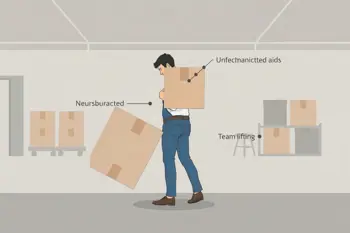
Raise the object smoothly by straightening the hips and knees, rather than jerking upward or relying on the lower back. Keep the load close to the body and avoid leaning forward as standing begins. Sudden movements, excessive bending, and twisting are recognized risk factors for lifting injuries, including strains, joint injuries, lower back pain, herniated discs, and sciatica. 1
When changing direction, move the feet and pivot instead of rotating the torso while carrying the load. Maintain a clear view of the route, walk at a controlled pace, and avoid carrying more than can be safely controlled. Fatigue and repetition can increase risk, so work organization should allow appropriate pauses, task changes, or assistance when repeated handling begins to reduce control. 5
Coordinate team lifts and safe placement
Team lifting is appropriate when an object is too large, long, unstable, or heavy for one person, but adding another person does not remove the need for planning. The people involved should agree on the route, destination, grip points, and movement sequence before lifting. One person should coordinate the commands so everyone raises, walks, turns, and lowers the load together. 3
Lower the object by reversing the lifting movement: keep it close, bend at the hips and knees, and lower it under control rather than releasing it suddenly. Keep fingers, toes, and other body parts away from pinch points and crush zones, particularly when placing a load on a floor, shelf, pallet, or uneven surface. Confirm that the destination can support the object and that it will remain stable after placement. 3
Recognize injury risks and when to stop
Manual handling can cause lower back pain, muscle strains or tears, knee, elbow, or wrist injuries, dislocations, fatigue, and acute injuries if a load falls. Falls, dropped objects, cluttered work areas, obstructed views, and slippery walking surfaces can produce crushing injuries, fractures, or broken bones. Existing injuries, reduced grip strength, repetition, and fatigue can further reduce a person's ability to control a lift. 1
Stop the task when the load or conditions cannot be safely controlled, and report hazards, injuries, incidents, or near misses in a workplace setting. Persistent or severe back pain, numbness, weakness, or pain radiating into a leg after lifting should be evaluated by a healthcare professional. Technique alone is not a complete control measure: employers also have responsibility to assess hazards, provide suitable equipment and training, and organize work to reduce unnecessary manual handling. 7
Sources
- Canadian Centre for Occupational Health and Safety, Lifting - General: https://www.ccohs.ca/oshanswers/ergonomics/lifting-general.html
- MedlinePlus, Lifting and bending the right way: https://medlineplus.gov/ency/patientinstructions/000414.htm
- OSHA Safety Manuals, Material Handling and Manual Lifting Job Safety Analysis: https://www.safetymanualosha.com/material-handling-manual-lifting-jsa/
- Praxis42, Manual handling lifting techniques: https://praxis42.com/resources/health-and-safety/manual-handling-lifting-techniques/
- Occupational Safety and Health Administration, Ergonomics: https://www.osha.gov/ergonomics
- CDC and NIOSH, Ergonomics and the Revised NIOSH Lifting Equation: https://www.cdc.gov/niosh/ergonomics/about/index.html
- UK Health and Safety Executive, Manual handling: https://www.hse.gov.uk/msd/manual-handling/index.htm
Authored by MyTrendSpot team